Looking for outdoor staircase lighting ideas that actually work at night? You are in the right place. Good stair lighting keeps people safe, lifts your home’s curb appeal, and holds up for years outdoors.
We have helped homeowners and project managers plan stair lighting for entryways, decks, and public steps, and the same questions come up every time. Which fixture fits my stairs? How bright is bright enough? What lasts outdoors without failing in a year?
This guide answers all of that. We will walk through fixture types, design approaches, key specs, cost choices, installation rules, and real project results so you can plan with confidence. Ready to light your steps the right way? Let’s start.
Why Light Your Outdoor Stairs
Dark stairs are risky stairs. When people cannot see each step clearly, they misjudge the edge and stumble. Good lighting fixes that. It marks every tread, so feet land where they should.
Safety is the first reason, but it is not the only one. Well lit stairs also look great. Soft light along the risers gives your entrance a warm, finished feel. Guests notice it the moment they arrive. Curb appeal like this adds real value, and it makes your whole exterior feel intentional rather than an afterthought.
Durability is not a nice extra. Outdoor stair lights face rain, heat, cold, and constant use. Cheap fixtures fail fast, and replacing them on a finished staircase costs far more than getting the choice right the first time. It shapes the total cost of the project over five or ten years.
That is why smart planning looks at three things together: safety, appearance, and lifecycle cost. When you balance all three from the start, you avoid the two most common regrets, which are stairs that feel unsafe and fixtures that need early replacement.
Types of Outdoor Stair Lights
Not every fixture suits every staircase. The right pick depends on your step design, your wiring, and the look you want. Here are the four types you will run into most often.
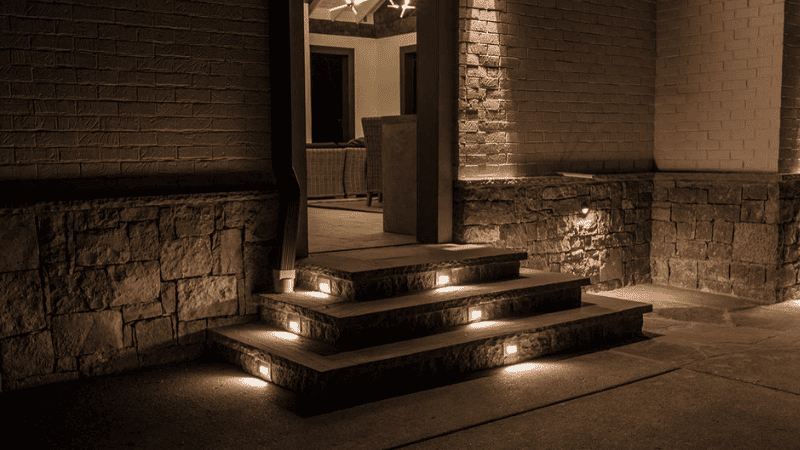
Recessed step lights sit inside the riser or side wall. They throw light down onto each tread without any glare in your eyes. This style looks clean and modern, and it works best when you plan wiring before the stairs are built. Retrofitting them into finished concrete is harder, so timing matters.
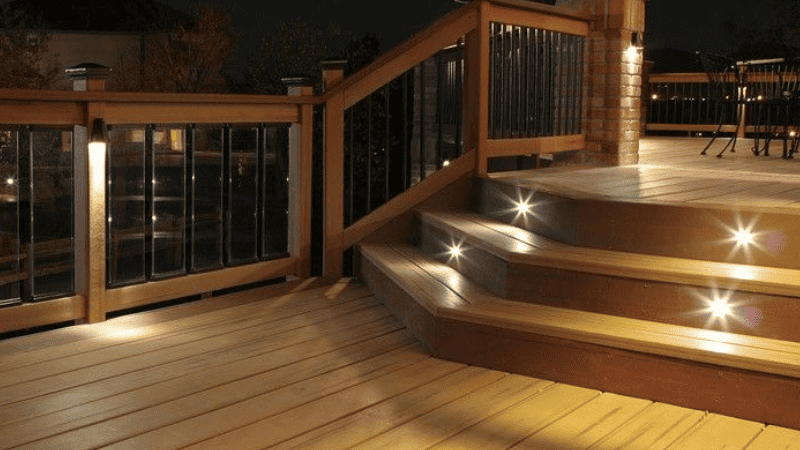
Deck and post cap lights mount on railing posts or deck edges. They light a wider area and add a decorative touch to the top of each post. Homeowners like them because installation stays simple. They suit wood decks and railed staircases especially well.
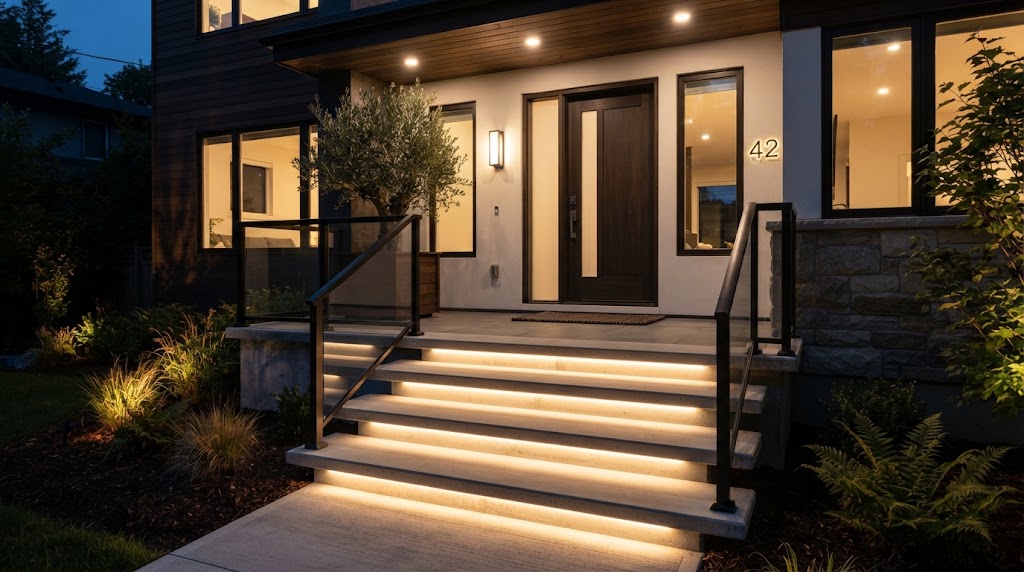
Strip and rope lighting runs a continuous LED line under the nose of each step. LED means light emitting diode, a small, efficient light source that lasts a long time. Strip lighting gives you that smooth, floating-step glow you see in modern homes. It hides well and spreads light evenly.
Solar stake and surface lights need no wiring at all. A small panel charges a battery by day, and the light runs at night. They install in minutes, which makes them popular for quick upgrades. The trade-off is brightness and runtime, since both depend on sunlight and battery size.
Fixture Type | Mounting | Best Use | Pros | Cons |
Recessed step light | Inside riser or side wall | New builds, modern look | Low glare, clean finish | Best wired before build |
Deck/post cap light | Railing post or deck edge | Railed stairs, wood decks | Easy install, decorative | Wider, less focused light |
Strip/rope LED | Under step nose | Smooth even glow | Hidden, uniform light | Needs careful sealing |
Solar stake/surface | Ground or step surface | Fast upgrades, no wiring | No wiring, quick setup | Brightness varies with sun |
Each type solves a different problem. So match the fixture to your build stage and your maintenance plans, not just to the photo you liked online.
One more thing decides long-term cost, and buyers often miss it. Many people focus only on price per unit and skip the details that matter most. Before you commit, check the housing material, the sealing rating, and the driver quality. A slightly higher price with a solid aluminum body and a proper gasket usually beats a cheap plastic fixture that fails in one winter.
Outdoor Stair Lighting Ideas & Design Approaches
Good stair lighting does more than switch on. It shapes how your steps feel and how safe they are after dark. Below are the design approaches homeowners and designers reach for most, with practical notes on when each one works best.
Warm Welcome: Entryway and Porch Scenes
The stairs near your front door set the first impression. Here, warm light does the heavy lifting. Warm white, around 2700K to 3000K, feels inviting and flatters brick, stone, and wood. Pair step lights with a soft glow on the door surround or a nearby planter. This layering gives visitors a clear, friendly path from the driveway to the door. Keep the brightness gentle, since an entryway should feel welcoming, not floodlit.
Sleek and Modern Minimalist Looks
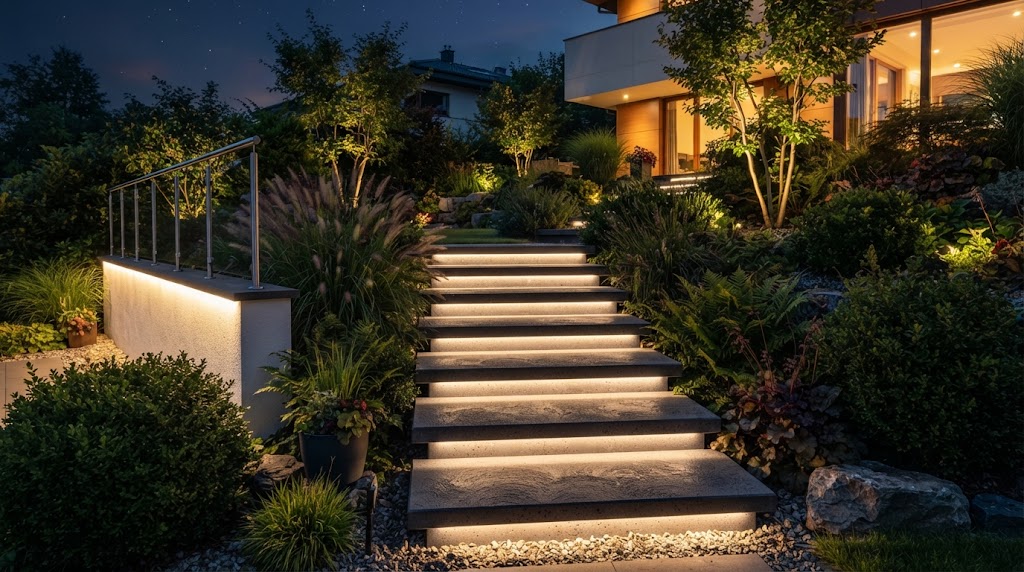
Modern homes favor hidden light and clean lines. The goal is to see the glow, not the fixture. Recessed step lights and under-nose LED strips fit this style perfectly, because they wash each tread evenly while staying invisible. Stick to one color temperature and one fixture type across the whole run. Consistency is what makes a minimalist staircase look designed rather than pieced together.
Illuminating the Full Path
A staircase is part of a longer route, so light the full path, not just the steps. Two layouts dominate here.
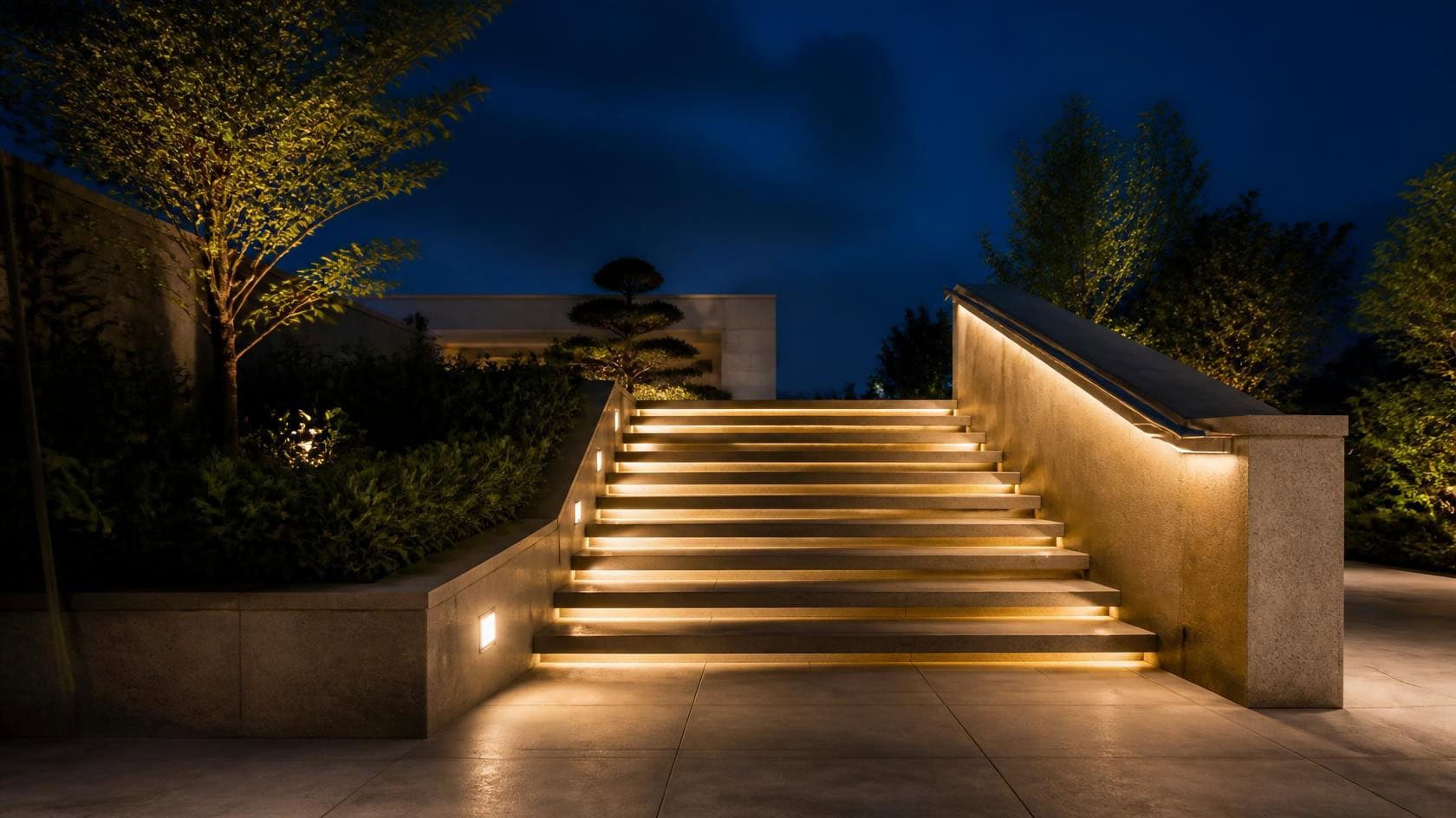
Riser-centric layouts place light in each riser, the vertical face between steps. Light spills forward onto the tread below, marking every edge clearly. This looks refined and reads well at a glance.
Alternating spacing staggers fixtures side to side as you climb. It uses fewer lights while still covering the path. This works well on wider stairs, though you must check that no tread falls into shadow. Even coverage always beats a lower fixture count.
Deck Perimeter and Post Caps
On decks and railed staircases, the railing itself becomes a lighting opportunity. Post cap lights top each railing post and add a decorative rhythm along the perimeter. Combine them with under-rail strips or recessed step lights so the treads stay lit too. Post caps alone light the top of the structure, not the steps, so treat them as one layer rather than the whole solution.
Spot and Accent Lighting
Accent lighting adds depth and highlights features near the stairs, such as a wall, a plant, or a stone column. The key choice is direction.
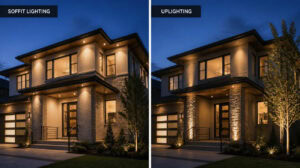
Downlight aims light toward the ground. It is safer for stairs because it lights the walking surface and keeps glare low. Uplight points light upward to graze a wall or tree. It looks dramatic but can shine into approaching eyes if aimed poorly. So use uplight for features, downlight for footing, and shield any source that a person might look straight into.
Placement and Spacing Rules for Consistent Illumination
The best design fails if the spacing is wrong. Aim for even light on every step, top to bottom. A skipped step creates a dark gap, and dark gaps are where people trip.
From our project work, one detail separates a staircase that looks great from one that just functions: mounting height and beam angle matter more than raw brightness. We have seen bright fixtures create harsh hotspots and deep shadows on the same step, which makes footing harder to read, not easier. Lower, wider, well aimed light almost always wins. So light one step first, check it after dark, then repeat the exact setup across the full run for a clean, consistent result.
Technical Specs That Matter: Lumens, Color Temp, IP & Voltage
Design gets you the look. Specs get you performance that lasts. Focus on these four.
Lumen Ranges per Tread and Pathway
Brightness is measured in lumens, the amount of visible light a fixture produces. Stairs need less than most people expect. Around 30 to 100 lumens per tread gives safe, comfortable footing. For a general pathway leading to the stairs, 100 to 200 lumens per fixture works well. Too much light is as bad as too little, because it creates glare and harsh shadows on the very steps you are trying to light.
Color Temperature for Mood and Safety
Color temperature is measured in Kelvin, or K. Warm white, 2700K to 3000K, feels welcoming and suits most homes. Cooler white, above 4000K, reads sharper and more commercial, and can improve edge definition in some settings. Whatever you choose, keep it consistent across the staircase. Mixing warm and cool light looks messy and undermines both the mood and the safety cue.
Low Voltage for Residential Installs
Many outdoor stair systems run on low voltage, often 12V. Low voltage is safer to handle and easier to route, and in most regions it does not require a licensed electrician for basic work. Line voltage systems, at 120V or 230V, deliver more power but demand professional installation.
Match the system to your skill level and local rules. For grounding and wiring safety, follow the electrical code guidance from the National Fire Protection Association.
IP65+ for Exposed Outdoor Use
The weather rating is the spec buyers skip most, and it hurts them later. Look for the IP rating, short for Ingress Protection, which shows how well a fixture blocks dust and water.
For outdoor stairs exposed to rain, choose IP65 or higher. Anything lower risks moisture failure through the first wet season. The standard behind these ratings is explained clearly by the International Electrotechnical Commission, and it is worth checking before you buy.
Get these four specs right and you avoid the two failures we see most: fixtures that die early outdoors, and lighting that is either blinding or too dim to help.
Solar vs Wired & Energy-Efficient Cost Choices
The power source you pick shapes both install effort and long-term cost. Here is how to choose.
Solar needs no wiring. A panel charges a battery by day, and the light runs at night. It installs in minutes and suits quick upgrades or spots far from power. The trade-off is output, since brightness and runtime depend on sunlight and battery health.
Low-voltage wired, usually 12V, gives steady, reliable light in any weather. It costs more to install but performs consistently for years. Choose wired for main entrance stairs you use every night. Choose solar for accent paths, mild climates, or fast fixes.
On efficiency, LED beats halogen easily. LED uses up to 80% less energy for the same light and lasts far longer, often 25,000 hours or more against 2,000 for halogen. Over a year, switching a small stair run from halogen to LED can save meaningful power, and it removes the constant bulb swaps.
Look past the sticker price too. A cheap fixture that fails in one winter costs more than a solid one that lasts a decade, once you add replacement fixtures and labor. Weigh lifecycle cost, not just upfront price.
Installation, Safety, Code & Common Mistakes to Avoid
Low-voltage systems are DIY-friendly for confident homeowners. Line voltage, at 120V or 230V, should go to a licensed electrician. When in doubt, hire the pro.
Before you start, check local code and permit rules. Outdoor circuits usually need GFCI protection, which cuts power fast if it detects a fault, and any transformer should sit in a weatherproof enclosure. Confirm every fixture carries a UL or ETL listing, the marks that show it passed independent safety testing.
Materials decide how long fixtures survive outdoors. Look for corrosion-resistant, gasketed housings, and stainless steel or marine-grade hardware near coasts or pools.
The mistakes we see most: skipping the IP check, mixing color temperatures, over-lighting steps into glare, and burying wire too shallow. Each one is cheap to avoid up front and costly to fix later.
For maintenance, wipe lenses a few times a year, keep connections dry, and check gaskets. In our service work, most “dead” outdoor lights are not dead at all. The failure usually traces back to a corroded connection or water intrusion at an unsealed joint, not the LED itself.
So before you replace a fixture, open the connection and inspect it. That one check saves buyers from tossing lights that still work.
Real-World Case Studies
You do not have to guess what works. Across residential and light commercial projects, a few patterns show up again and again. Here are two typical scenarios worth learning from.
Residential entryway upgrade. A common problem is a dim, uneven porch stairway lit by a single overhead bulb. The typical fix that succeeds: recessed step lights or under-nose LED strips, IP65 rated, set to 3000K on a 12V system. The payoff is even light on every tread, no glare at the door, and years of reliable use. The lesson most homeowners report is simple. Consistent spacing across every step mattered far more than adding brighter or extra fixtures.
Small commercial deck rollout. Cafés, small hotels, and event venues with railed outdoor stairs face a different challenge: constant foot traffic and heavy weather exposure. The proven approach combines stainless steel post caps with under-rail or under-nose LED strips, all UL or ETL listed, powered through a weatherproof transformer. The result is dependable nightly operation and easy cleaning. The recurring lesson is that marine-grade, corrosion-resistant hardware pays for itself in wet, high-use settings, where cheaper parts tend to fail within a season or two.
Both scenarios point to the same takeaway. Matching specs to the environment beats chasing the lowest price. Choose the right IP rating, voltage, and materials for where the light will actually live, and the system lasts.
FAQs
Do outdoor stair lights need to be on a timer or sensor?
They do not have to be, but it helps. A photocell turns lights on at dusk and off at dawn automatically, while a timer sets fixed hours. Both save energy and mean you never walk up to dark stairs or forget to switch them off in the morning.
Can I add lights to an existing concrete or stone staircase?
Yes, but your options narrow. Surface-mounted, deck cap, and solar fixtures fit finished stairs easily. Recessed step lights are harder to add after the fact, since cutting into set concrete is labor-intensive, so many retrofits use under-nose strips or surface lights instead.
Will outdoor stair lights work in snow or freezing temperatures?
Quality LED fixtures handle cold well, and many are rated for sub-zero use. Check the operating temperature range on the spec sheet before buying for a cold climate. Clear snow off lenses so light is not blocked, and make sure any sealed joint stays intact to keep meltwater out.
How long do outdoor LED stair lights last?
Good LED fixtures are often rated for 25,000 to 50,000 hours, which can mean well over a decade of nightly use. Real lifespan depends more on build quality and sealing than on the LED itself, so housing material and IP rating matter as much as the rated hours.
Conclusion
Great outdoor stair lighting comes down to three things working together: safety, appearance, and lifecycle cost. Get those right and your steps stay clear, your entrance looks finished, and your fixtures last for years instead of a single season.
The plan is simple. Match the fixture type to your build stage and maintenance plans. Aim for even, gentle light on every tread rather than the brightest option. Then lock in the specs that decide performance outdoors: the right lumens, a consistent color temperature, low voltage where it fits, and an IP65 or higher rating.
Do that, and you avoid the two regrets we see most, which are stairs that feel unsafe and lights that fail early.
Ready to plan your own project? Contact with us and our technical team can help you match lumens, IP rating, voltage, and materials to your exact staircase, so you buy once and buy right.