Choosing commercial cafe lights for outdoor spaces means balancing ambiance, durability, and your cafe’s actual operating hours—not just picking fixtures that look good in photos.
Before comparing string lights or wall-mounted fixtures, it helps to clarify your project scope: are you lighting a small patio for evening service, or a full terrace that stays open well past sunset?
Cafe owners, facility managers, and procurement teams often make this decision under time pressure, without a clear framework for comparing residential-grade options against commercial-grade ones.
This guide walks through why outdoor lighting matters for cafe operations, the main types of commercial string lights and fixtures available, and how to plan layouts for patios, terraces, and seating zones.
Let’s start with why lighting choices affect more than just aesthetics.
Why Commercial Outdoor Lighting Matters for Cafes
Outdoor lighting affects more than visual appeal. It directly influences guest safety, staff efficiency, and how long customers stay at your tables. Before comparing specific fixtures, it helps to understand what commercial grade lighting is actually solving for.
Safety and Security Benefits
Poorly lit patios create real risks. Guests can trip over uneven pavers, staff struggle to see spills, and dark corners become easy targets for theft or vandalism after closing.
Commercial-grade fixtures provide consistent, even illumination along walkways, steps, and seating areas. This reduces the chance of accidents and makes staff more confident moving through the space at night.
Local fire and safety codes often require minimum lighting levels for exit paths and outdoor dining zones. Because of this, procurement teams should confirm compliance requirements before finalizing any layout.
Creating an Inviting Atmosphere for Guests
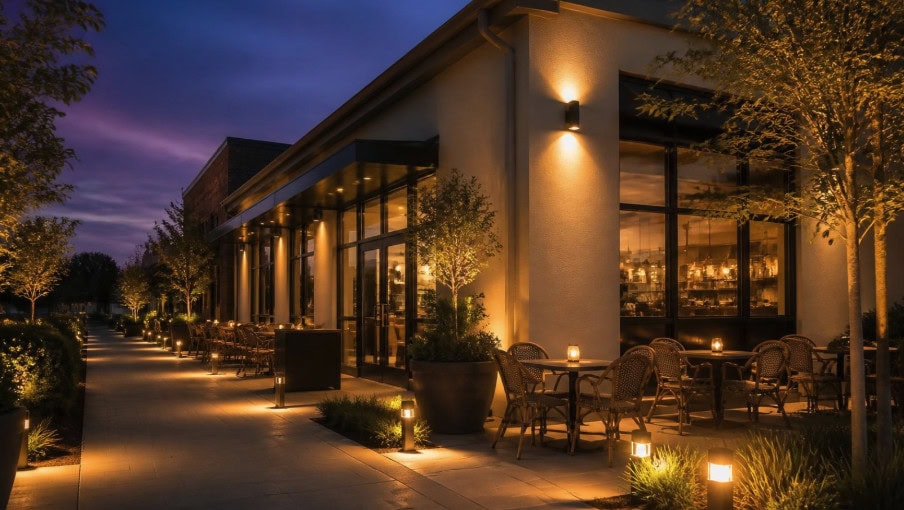
Warm, layered lighting signals that a space is welcoming and well cared for. Guests often notice this within seconds of arriving, before they even sit down.
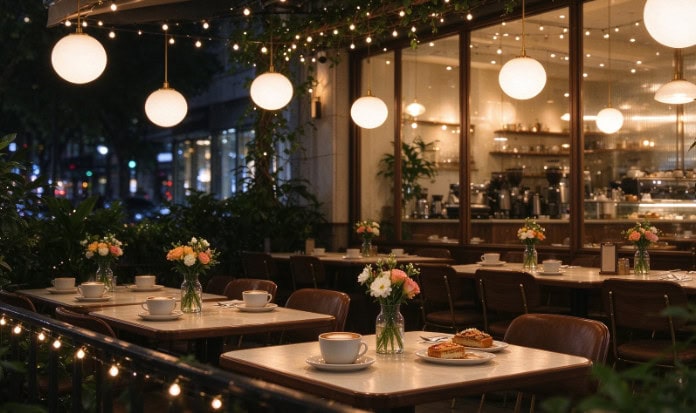
Cafes that invest in ambiance lighting, such as warm white string lights or globe fixtures, tend to see guests linger longer over coffee or a meal. The lighting becomes part of the overall brand experience rather than just a functional necessity.
Energy Efficiency Gains with LED Lighting
Switching from incandescent to LED string lights can cut lighting energy use by up to 75 percent, according to the U.S. Department of Energy (energy.gov). For cafes that run lights every evening, this savings adds up quickly across a full season.
LED fixtures also generate less heat than traditional bulbs. This makes them a safer and more comfortable choice for outdoor seating during warmer months.
Impact on Operating Hours and Customer Dwell Time
Good lighting can directly extend usable operating hours. A patio that goes dark at dusk loses revenue potential once the sun sets.
Cafes that light their outdoor space properly can comfortably serve guests well into the evening, capturing an additional revenue window. Well-lit seating also encourages longer dwell times, which often translates into a higher average ticket size per table.
Types of Commercial String Lights and Fixtures for Outdoor Cafes
Once you understand why outdoor lighting matters, the next step is choosing the right fixture type for your space.
Quick Comparison: String Lights vs Pendant vs Wall-Mounted
| Fixture Type | Best For | Install Difficulty | Maintenance Frequency | Key Limitation |
| Commercial String Lights | Large open patios, even coverage | Low to moderate (DIY possible) | Bulb replacement every 1–2 seasons | Sag over long spans without support cable |
| Pendant / Globe | Structured look under pergolas | Moderate | Lower (fewer bulbs, less exposure) | Wider spacing creates uneven light without supplements |
| Wall/Post-Mounted | Perimeter and entry zones | Moderate to high (often needs electrician) | Lowest (fixed, sealed units) | Cannot serve as sole light source for full seating area |
Cost ranges vary significantly by wattage, bulb type (LED vs incandescent), and brand. We recommend requesting a quote based on your specific layout rather than relying on generic price estimates.
Commercial Grade String Lights
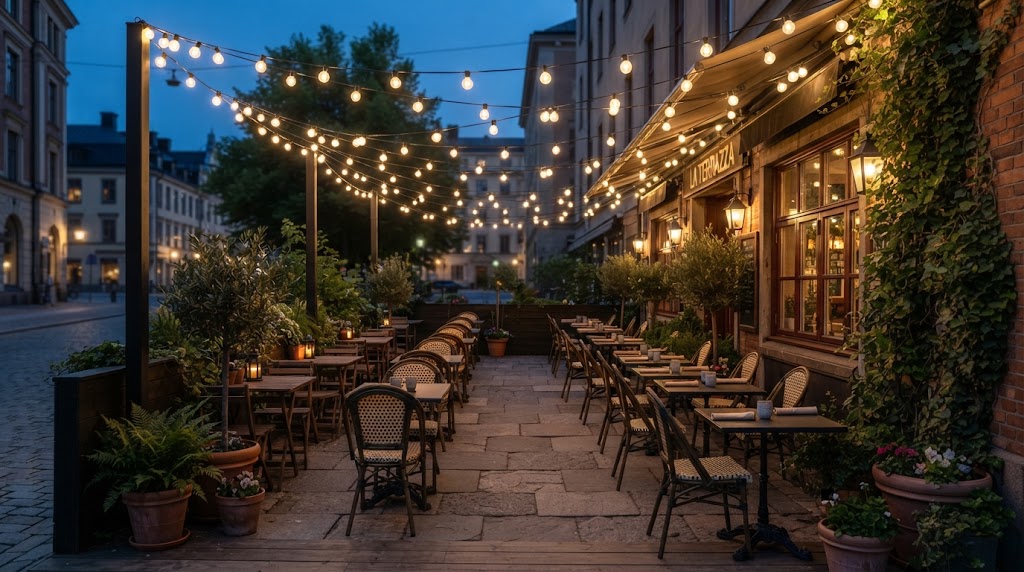
String lights are one of the most popular picks for outdoor cafes. They bring a warm, soft bulb glow to the space. The vibe feels relaxed and welcoming. It’s exactly the kind of atmosphere that makes guests want to stay longer and order another round of drinks or food.
Not all outdoor string lights are created equal, though. Most people think the bulbs make the biggest difference, but that’s not the case. The real key lies in the wire.
Commercial-grade string lights come with SPT-1 or SPT-2 rated wire. This wire is thicker and offers better UV protection than the regular indoor cords on standard household string lights. If you use consumer-grade lights outdoors, sunlight will quickly damage the cord. It will crack easily, and the bulb sockets will stop working properly after just one season.
Bulb spacing is another key detail that shapes the overall feel of your outdoor space. Commercial string lights usually have three standard spacing options: 6 inches, 12 inches and 15 inches.
Tighter spacing between 6 and 12 inches produces a fuller, more uniform glow. It’s perfect for areas with closely arranged seating. This setup creates that popular “canopy of light” look on patios. It’s super photo-worthy and guests love taking pictures to share online.
15-inch wider spacing lets each light strand cover more ground at a lower cost. However, it creates obvious dark gaps between bulbs. These gaps stand out a lot more in crowded seating areas, while they’re far less noticeable on open lawn spaces.
If you need to hang lights across a span longer than 30 feet, you’ll need an extra support cable, also known as a catenary or messenger cable.
Without this support, the string light wire will gradually sag under the weight of the bulbs over time. This tilts the lighting angle downward. The center of the patio ends up dimmer than the edges. Most people don’t notice this issue at first. It only becomes obvious when guests start complaining about uneven lighting or glare at certain tables.
Pendant and Globe Lighting
Globe and pendant fixtures are typically chosen when a cafe wants a more upscale, structured look rather than the casual canopy effect of string lights. You can compare a rustic patio to a carefully designed rooftop bar. For cafes positioning themselves as a premium or date-night destination, globes signal that intent more clearly than string lights alone.
That upscale look comes with a lighting trade-off, though. Globe fixtures are typically spaced 8 to 12 feet apart, compared to the 12-to-15-inch bulb spacing of string lights. This wider spacing is intentional. Globes work as accent or ambient lighting, not as the primary uniform light source.
A common mistake is relying on globes alone across a full patio. Because of the wide spacing, this often leaves noticeably darker zones between fixtures, especially at table height where guests read menus. This can undercut the premium feel the cafe was going for in the first place. Guests end up squinting at a menu under an otherwise beautiful fixture.
Pairing globes with lower-wattage string lights along the perimeter is a practical way to fill these gaps without changing the intended aesthetic.
Wall-Mounted and Post-Mounted Fixtures
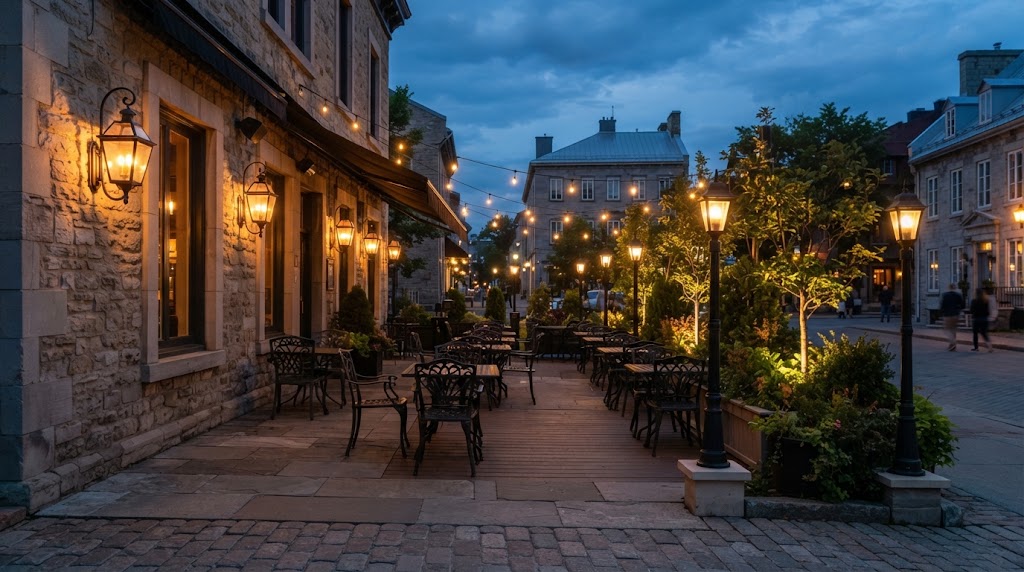
Wall and post-mounted fixtures serve a different purpose than overhead lighting. They define where the patio ends. This matters more than it sounds. Many cities require outdoor dining areas to have a visually clear boundary for permit compliance, and consistent perimeter lighting is one of the simplest ways to set that boundary without a physical fence.
Beyond compliance, boundary lighting also shapes how guests perceive the space itself. Guests use steady perimeter lighting to visually tell where the patio seating zone starts and ends. This changes how they judge the space’s size and privacy. A well-lit edge can make a small patio feel intentionally cozy rather than cramped.
For placement, wall sconces work best when mounted between 7 and 9 feet above ground level. This height sits high enough to avoid glare at eye level, yet low enough to light up the seating area instead of only the wall surface.
Weatherproof and IP Rating Considerations
Getting the IP rating wrong is one of the costliest mistakes cafes can make with outdoor lighting. The fixture may look fine at first, but an under-rated unit exposed to rain will usually fail within one season. That means the cafe ends up paying for the same lighting twice.
IP ratings follow the IEC 60529 standard. Its two digits carry separate meanings. The first digit shows dust resistance, and the second shows water resistance. For outdoor cafe lighting, the second digit usually becomes the deciding factor.
IP44: protected against water splashing from any direction. It works well for fixtures under a roof, awning, or pergola.
IP65: protected against low-pressure water jets. You need this rating for fixtures with direct rain exposure and no overhead cover.
Power Source Options: Plug-In vs Hardwired
The choice between plug-in and hardwired lighting impacts more than just installation ease. It controls how consistent your lighting stays along the full strand, and whether your cafe runs into power-related performance limits.
Plug-in string lights face limits from voltage drop across long cords. If you run a strand over 50 feet from the power source with standard gauge wire, the far end will visibly dim. Incandescent bulbs react more strongly to voltage shifts than LED options. In real use, tables at the far end of a long patio look noticeably dimmer than tables close to the outlet. Guests pick up this uneven lighting even if they cannot pinpoint the cause.
Hardwired systems bypass voltage drop entirely. They feed steady power to every bulb across long patio runs. You can cover much larger areas without brightness fading toward the far end. Hardwiring also lets you group lights on dedicated circuits. This makes it simple to split lighting zones. You can turn on perimeter lights separately from overhead string lights to adjust ambiance throughout the day.
Hardwired setups also support add-on controls like dimmers and timers seamlessly. These features are harder to implement reliably with plug-in strings. For permanent patio builds, hardwired layouts deliver cleaner cable routing too. You avoid messy extension cords strung across walkways and seating zones.
Outdoor Cafe Lighting Ideas for Patios, Terraces, and Seating Areas
Knowing which fixtures to use is only half the battle. The other half is learning how to layer and combine them properly across your patio space. The layouts below solve the most common real-world lighting issues cafes face when moving from picking fixtures to building a complete lighting plan.
Lighting Layouts for Patios and Terraces
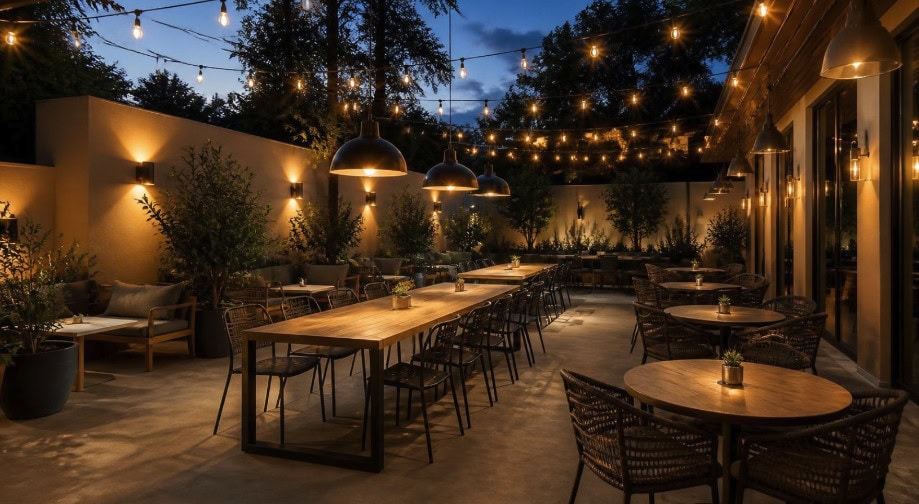
Great patio lighting always uses mixed fixture layers, instead of relying on one single light type. The most effective setup follows a simple three-part rule: overhead string lights for overall ambient coverage, globe/pendant fixtures over focal spots like bars and communal tables, and wall-mounted perimeter lights to frame the patio boundary.
This layered approach fixes the natural weaknesses of each individual fixture. String lights alone create flat, featureless lighting. Globe pendants alone leave dark shadows at table level. Perimeter wall lights cannot fully illuminate seating areas. Combining all three lets each fixture perform its intended job perfectly, with no single light forced to overcompensate.
For multi-level terraces or raised decks, split lighting into separate zones for each elevation. A single overhead light strand across height differences always leaves lower areas dim and uneven.
Layered Lighting for Different Seating Zones
Different seating areas need different brightness and tone settings.
Bar and lounge zones thrive with warm, dim light at 2200K–2700K. This cozy and intimate atmosphere encourages guests to relax.
Active dining zones work better with slightly brighter, neutral light at 2700K–3000K, making menus and food details easy to see.
Color temperature consistency is critical. Mixing ultra-warm 2200K bulbs and cool 4000K+ bulbs in the same line of sight creates patchy, unpolished lighting. You can vary brightness per zone, but keep the kelvin range unified for a cohesive, intentional design.
For standalone bar counters, create an independent lighting zone. Slightly brighter functional lighting suits staff work areas, while surrounding patio seating stays warm and dim to balance practicality and ambiance.
Illuminating Pathways and Landscape Features
Pathway lighting prioritizes safety first, aesthetics second, which calls for different specs than seating lighting.
12V low-voltage landscape fixtures are the industry standard for walkways. They minimize electric shock risks near planters, water features, and uneven ground.
Path lights use tighter spacing of 6–8 feet apart. Unlike overhead string lights designed for ambient glow, path lights need continuous, even coverage to keep walking surfaces clearly visible. Always light steps and height changes individually. Nearby fixture shadows often hide step edges and create trip hazards.
Use narrow-beam spotlights for landscape features like trees, trellises, and signage. Focused uplighting highlights specific decor elements, while wide flood lighting is reserved only for pathway illumination.
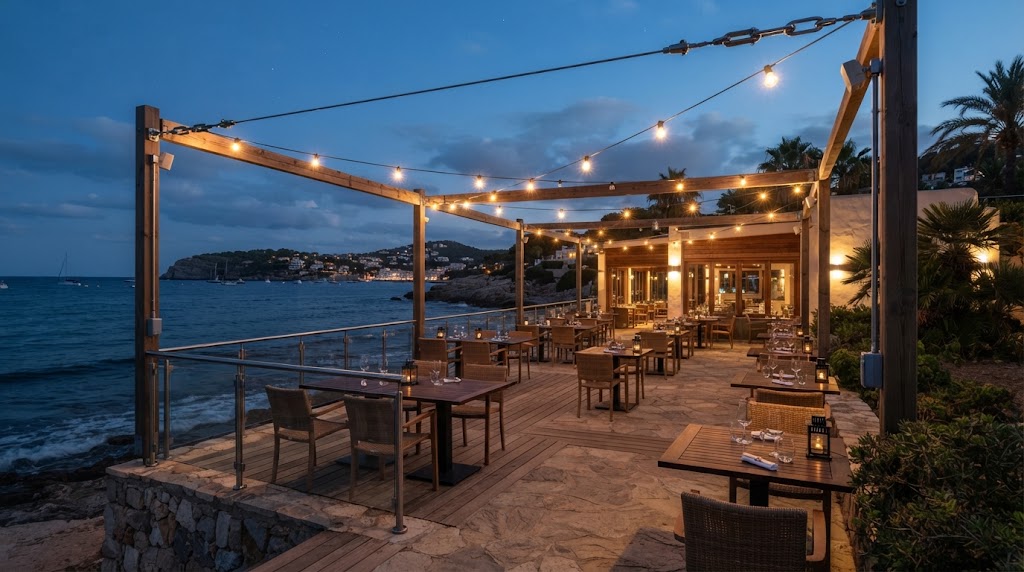
Lighting Considerations for Coastal or High-Exposure Locations
Coastal venues face unique hardware corrosion issues that inland patios never deal with. Salt air aggressively wears down standard metal parts including sockets, brackets, and connectors — even when fixtures have valid IP65 waterproof ratings. Water resistance does not equal salt corrosion resistance.
Coastal outdoor lighting requires marine-grade, corrosion-resistant hardware such as stainless steel or powder-coated aluminum components, on top of standard IP65 protection for uncovered areas. This dual specification prevents premature fixture failure from salty, humid wind exposure.
Persistent coastal wind creates another key constraint. Long string light spans swing constantly in open wind, causing wire fatigue and sagging over time. For coastal installations, a catenary support cable is a mandatory baseline upgrade, even for shorter spans that would not need support in sheltered inland locations.
FAQs
Do outdoor cafe lights need to come down for winter or bad weather?
It depends on the fixture’s IP rating and your local climate, not on the season itself. Properly rated IP44 or IP65 fixtures built for outdoor settings are designed to stay outdoors year-round, including through rain and snow.
The bigger concern in cold climates is ice accumulation on wiring and connectors, which can stress the wire insulation over repeated freeze-thaw cycles.
Cafes in regions with heavy snow or ice storms often choose to power down (not necessarily remove) string lights during the harshest weeks, then resume normal operation once conditions ease. Fixtures under a roof or pergola typically don’t need this precaution at all.
Can solar-powered string lights work for a commercial cafe patio?
Generally, no — not as a primary lighting source. Solar string lights rely on battery storage sized for residential-scale, intermittent use.
Most commercial cafe patios run lights for several consecutive hours every evening. This drains a small solar battery faster than it can recharge during the day.
Solar options can work as a supplemental accent, such as lighting a garden bed or low-traffic corner. But they are not a reliable substitute for hardwired or plug-in commercial fixtures where consistent brightness matters for guest experience. Reliable LED lighting solutions deliver the steady performance required for nightly commercial operation.
How many lights or how much wattage do I need for my patio?
There’s no fixed formula. The required amount depends on ceiling height, fixture type, and existing ambient light from your building or street.
As a general starting point, most cafes plan overhead string lighting to cover the full seating footprint with 6–12 inch bulb spacing for uniform coverage. They add globe or pendant fixtures at focal points instead of calculating total lumens per square foot.
Because layouts vary widely by site, sketch your patio dimensions and get a fixture recommendation based on the actual space rather than estimating wattage in the abstract. This simple planning step forms the foundation of well designed outdoor lighting.
How long do commercial-grade string lights typically last compared to residential ones?
Commercial-grade LED string lights generally hold up for multiple seasons of nightly outdoor use. Their longevity comes from SPT-1/SPT-2 rated wire and UV-resistant housing, the same features that stop premature cord cracking.
Residential-grade string lights are built only for occasional or seasonal use such as holiday lighting. With continuous commercial outdoor use, wires turn brittle and sockets fail within just one season.
LED bulbs also need replacement far less often than incandescent options, which further extends the practical lifespan of a commercial LED setup.
Conclusion
Choosing the right outdoor lighting for your cafe comes down to matching fixture specs to your actual space, not picking what looks best in a product photo.
String lights suit large, open patios where even coverage matters most. Globe and pendant fixtures work better as accents over bars and communal tables, not as your only light source. Wall-mounted fixtures define your patio boundary and support code compliance, but they can’t carry the full seating area on their own.
Beyond fixture type, the details determine whether your lighting holds up. SPT-rated wire, correct IP ratings, and — for coastal locations — corrosion-resistant hardware all decide whether your installation lasts multiple seasons or fails within one. Getting these specs right the first time is almost always cheaper than replacing an under-rated fixture mid-season.
With that framework in mind, the next step is finding fixtures that actually match your patio’s layout, exposure, and operating hours.
Get Commercial-Grade Fixtures Built for Your Cafe
Every patio has a different span length, seating layout, and weather exposure, which is exactly why generic off-the-shelf lighting often falls short on commercial projects.
We manufacture commercial-grade outdoor string lights and fixtures to your project’s specifications — including wire gauge, bulb spacing, cable length, IP rating, and corrosion-resistant hardware for coastal or high-exposure sites. Whether you’re outfitting a single patio or sourcing for multiple locations, our team can build lighting to the exact specs your space requires.
If you have your fixture requirements ready — spacing, span length, IP rating, or hardware finish — reach out to our team for a quote. If you’re still finalizing specs, we’re glad to walk through the technical details with you before you order.