Thinking about switching to integrated LED light fixtures but not sure they’re worth the price tag? You’re not alone—it’s the question we hear most from homeowners, designers, and property managers every week.
The right integrated LED fixture pays you back through lower energy bills, fewer replacements, and better light quality. We’ve tracked this across 300+ commercial lighting projects in the US, and the pattern is clear—buyers who choose well rarely touch those fixtures again for years.
In this guide, we’ll walk you through 6 concrete reasons these fixtures earn their keep. We’ll also flag the specs most people miss until it’s too late. Let’s dig in.
What Exactly Is an Integrated LED Fixture?
Before we get to the reasons, let’s clear up what “integrated” actually means.
A traditional fixture is just a housing. You screw in a replaceable bulb, and when it burns out, you swap it. Simple, but you’re stuck buying bulbs forever.
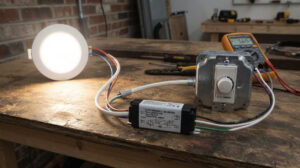
An integrated LED fixture is different. The LED light source is built directly into the unit—no separate bulb, no socket. The chips, the driver, and the heat sink all live inside one sealed body engineered to work as a system.
That design is why these fixtures run cooler, last longer, and deliver more consistent light. But it also means one thing you should know upfront: you’re buying the whole unit as a package, so the quality of what’s inside matters just as much as the look on the outside.
We’ll come back to that point a lot in this guide.
Reason 1 — Huge Long-Term Savings via Top-Tier Energy Efficiency
Let’s start with the number that gets everyone’s attention: your electric bill.
According to the U.S. Department of Energy, LED lighting uses roughly 75% less energy than incandescent lighting and lasts far longer. Switch a heavy-use space over, and you’ll feel the difference on your monthly statement fast.
Here’s a simple way to picture it. Say you run a small retail floor 12 hours a day. Cutting your lighting load by three-quarters isn’t a rounding error—it’s real money back in your pocket every month, with zero drop in brightness.
But here’s where a lot of buyers get the math wrong. They fixate on the fixture’s sticker price and miss the bigger picture entirely.
In our project work, we find that the real money goes to labor, lift equipment, and downtime. Run the numbers per fixture and it’s eye-opening: a low-end unit averages over $420 across a decade—roughly $30 for a replacement driver, $110 for the electrician, and $320 a day for lift rental, with about one repair every three years.
A quality fixture stays under $45, because usually all it needs is an annual dusting, and a solid 5-year driver warranty covers the rest.
There’s an energy angle hiding in there too. Cheap fixtures lose around 40% of their brightness within two years, so owners just add more lights to compensate—quietly piling 25–35% onto their energy costs. A quality fixture holds its output far better, staying within 30% depreciation even at 50,000 hours. For a 100,000 sq ft store, that difference alone can save 8,000to8,000 to 8,000to15,000 a year.
So when someone asks whether the higher upfront cost is worth it, this is the honest answer. You’re not really paying more—you’re paying sooner to avoid paying a lot more later.
Reason 2 — Ultra-Long Lifespan Cuts Down Replacement Hassle
If Reason 1 is about the money you save each month, Reason 2 is about how rarely you’ll ever climb a ladder again.
A quality integrated LED fixture is rated for 50,000 hours or more. Run it 12 hours a day, and that’s over 11 years before it even reaches its rated depreciation point. Compare that to an incandescent bulb at roughly 1,000 hours, and you can see why “replacing bulbs” basically disappears from your maintenance schedule.
That long life comes from the integrated design itself. Because the LED chips, driver, and heat sink are engineered as one system, heat gets managed properly—and heat is the number one killer of LED lifespan. A bulb screwed into a random socket doesn’t get that advantage.
But here’s the catch, and it’s a big one for buyers: not every “50,000-hour” claim is real.
In our sampling, roughly 1 in 3 budget fixtures fail to hold their rated output anywhere close to the stated hours—usually because the driver, not the LED, gives out first. The chips might be fine, but a cheap driver running hot will quit years early and take the whole fixture with it.
That’s why, when a fixture dies “too soon,” the driver is the culprit about 70% of the time in our repair experience, not the LED itself. It’s the part buyers scrutinize least and the part that fails most. So when you’re comparing two fixtures with the same lifespan claim, the smarter question isn’t “how many hours?”—it’s “what driver is inside, and who backs it?”
A 5-year driver warranty tells you far more about real-world lifespan than a big number printed on the box.
Reason 3 — Safer, Eco-Friendly Lighting With Zero Mercury Hazards
Here’s a benefit that’s easy to overlook until it becomes a disposal headache: integrated LED fixtures contain no mercury.
Older fluorescent tubes and CFLs rely on mercury vapor to produce light. That makes them hazardous waste at end of life—which means special handling, restricted disposal, and extra cost for your facility team.
According to the U.S. EPA, a broken CFL requires specific cleanup steps because of its mercury content. Integrated LEDs sidestep that problem entirely. When one reaches end of life, there’s no toxic material to manage.
The environmental win goes beyond disposal. Because these fixtures draw about 75% less energy (per Reason 1), they cut the power-plant emissions tied to your lighting load. Less energy in means less carbon out.
Reason 4 — Outperforms Every Traditional Lighting Option
Put an integrated LED fixture next to a traditional bulb-and-socket setup, and the performance gap shows up in ways your team will feel every day.
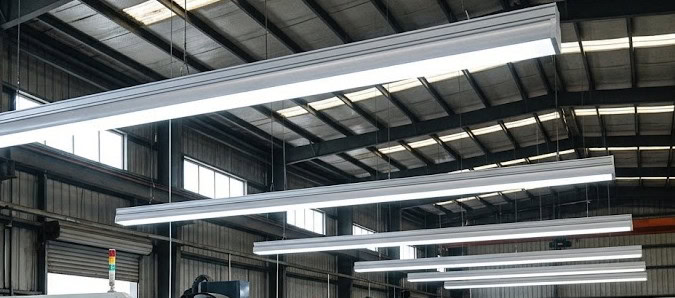
Instant full brightness. No warm-up flicker, no waiting for the room to reach full output—critical for retail, warehouses, and safety-sensitive spaces.
Better durability. With no fragile filament or glass tube, these fixtures shrug off vibration and rough handling far better. That matters in loading docks, workshops, and high-traffic areas.
No buzz, no flicker. A quality integrated driver delivers stable, flicker-free light, which reduces eye strain during long shifts.
Here’s a simple way to test the difference. Walk a space at the end of a shift: are the lights still hitting full brightness, or have they dimmed and yellowed? Traditional sources fade noticeably; a well-made integrated fixture holds steady.
Three quick performance checks when comparing options:
- Dimming behavior — does it dim smoothly, or step and flicker?
- Cold-start — does it hit full output instantly in a cold room?
- Uniformity — even wash of light, or visible hot spots and dark patches?
For most commercial spaces, the everyday reliability is the real payoff—fewer complaints, fewer service calls.
Reason 5 — Fully Customizable Light Quality for Any Space Vibe
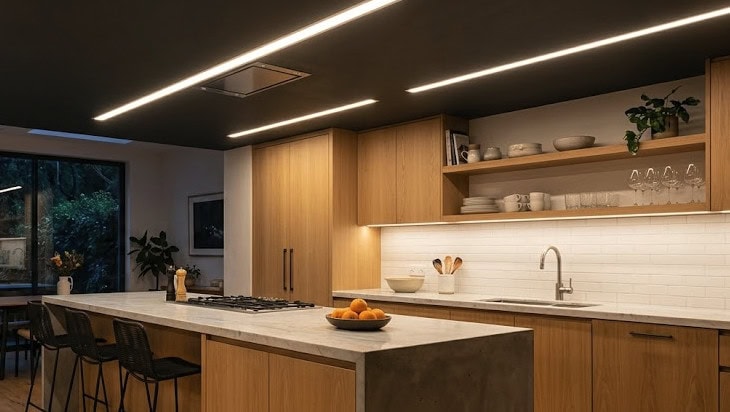
Not every room needs the same light. A cozy restaurant and a bright warehouse have completely different needs—and integrated LED fixtures let you match the light to the job.
Because the light source is engineered into the unit, manufacturers can tune three things precisely:
- Color temperature (CCT) — warm 2700K for hospitality and residential, neutral 4000K for offices, crisp 5000K for retail and workspaces
- Color accuracy (CRI) — how true colors look under the light
- Tunable and selectable options — many fixtures now let you switch CCT on-site with a small selector, so one SKU covers multiple applications
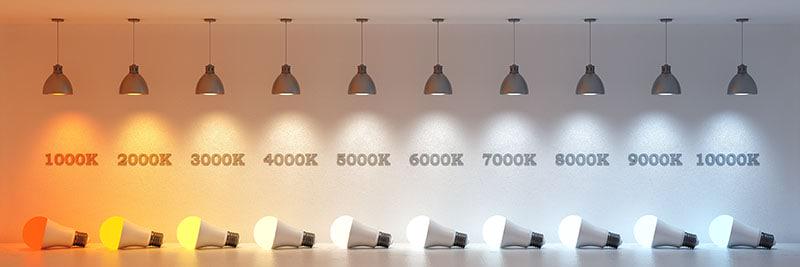
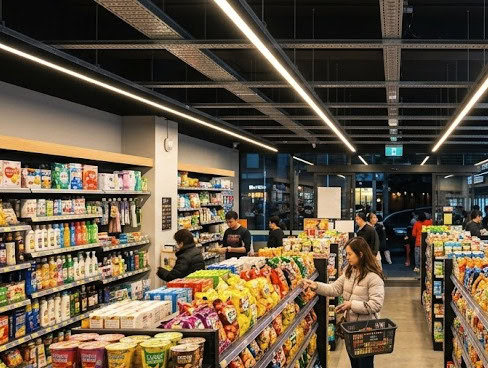
The spec we’d urge you not to skip is CRI. Aim for CRI 90 or higher anywhere colors matter—retail displays, showrooms, kitchens, or grocery. A fixture at CRI 70 makes merchandise look dull and skin tones look off, and shoppers feel it even if they can’t name why.
There’s also a quieter spec that trips up even experienced buyers: color consistency between fixtures. Two lights can share the same “4000K” label and still look visibly different side by side—something we’ve seen turn into a full batch rejection when fixtures over one section of a store drifted slightly off from the rest. The fix is to check the SDCM rating (color consistency); a value of 3 or lower keeps fixtures matched in the same sightline.
So when you compare options, look past the CCT label. Ask for CRI and SDCM together—that’s what tells you whether the space will actually look uniform once installed.
Reason 6 — Versatile Install & Smart Compatibility For All Indoor + Outdoor Scenes
The last reason is about flexibility. Integrated LED fixtures fit a wide range of mounting styles and work seamlessly with modern control systems—so one product line can cover many different jobs.
On the installation side, you’ll find integrated fixtures in nearly every format a project needs:
- Recessed downlights and troffers for clean, flush ceilings
- Surface-mount and suspended options for exposed or open ceilings
- Track and linear runs for retail, display, and workspace lighting
Because the light source and housing are one unit, wiring is straightforward and installation is faster—which keeps labor time and cost down. There’s no separate lamp to source or fit, so what you order is what goes on the ceiling.
Just as important, integrated fixtures are built for the way lighting is controlled today. Quality options support:
- 0-10V and TRIAC dimming for smooth, flicker-free adjustment
- Occupancy and daylight sensors to cut energy waste automatically
- Wireless and app-based platforms for scheduling, zoning, and remote control
This is a big reason buyers choose integrated fixtures: they drop cleanly into a smart building or energy-management setup without extra adapters or workarounds. You get a single product that fits the ceiling and the control system you plan to run—simplifying both specification and long-term operation.
Frequently Asked Questions
Are integrated LED fixtures a good fit for energy code and rebate requirements?
In most cases, yes. Because they’re highly efficient and often list their exact wattage and efficacy, integrated fixtures make it easier to meet energy codes and qualify for utility rebate programs. When compliance matters, check that the fixture reports its lumens per watt clearly and look for listings on recognized qualified-product lists, as many rebate programs require specific certifications.
Can I use integrated LED fixtures outdoors or in wet areas?
Only if the fixture is rated for it. Look at the IP rating on the spec sheet—IP65 or higher is suitable for outdoor and wet locations, while lower ratings are meant for dry indoor use only. Installing an indoor-rated fixture outside will lead to early failure, so always match the rating to the environment.
Do integrated LED fixtures work with existing ceiling openings during a retrofit?
Often yes, but not always. Recessed integrated fixtures come in standard aperture sizes, and many are designed to fit common existing cutouts. For retrofits, confirm the fixture’s aperture and housing depth against your ceiling before ordering—some slim models are made specifically to fit tight plenum spaces.
Can integrated LED fixtures be customized for a specific project?
Yes. Many manufacturers offer custom options such as specific CCT and CRI values, housing finishes, beam angles, dimming protocols, and sizes to match a project’s design and performance needs. For larger orders, customization is often worth it—you get fixtures tuned to the exact space and control system instead of compromising with off-the-shelf specs. If you have particular requirements, ask the supplier about minimum order quantities and lead times for custom builds.
Smarter Lighting, Fewer Headaches
Integrated LED fixtures win on the details that matter to a buyer: lower total cost, longer life, no mercury, stronger performance, tunable light quality, and flexible installation. Each reason on its own is useful. Together, they explain why integrated LEDs have become the default choice for so many commercial and residential projects.
The key is buying smart. Check the driver quality, CRI and SDCM ratings, and the right regional certifications—and you’ll get a fixture that performs for years.
If you’re specifying integrated LED fixtures for an upcoming project, RC Lighting can help you match the right product to your space and compliance requirements. Our team supports custom CCT and CRI options, UL/ETL-listed fixtures, and sample requests so you can verify quality before you commit.
Request a quote, and we’ll help you spec it right the first time.