On paper, the job looks simple. Then the fixtures show up on site and won’t bolt onto the poles. That’s why you need to lock down three things before you order: photometric performance, certifications, and the mounting interface. Fix a mistake after the concrete is poured, and it becomes the most expensive kind.
The pressure keeps rising as LED takes over. The U.S. Energy Information Administration found that only 9% of commercial buildings used LED lighting in 2012. By 2018, that number jumped to 44%.
Quick Answer: To specify commercial LED post lights, define delivered lumens and efficacy (not wattage), color temperature (3000K–5000K), a distribution pattern matched to pole height and spacing, IP65/IP66 ingress protection, UL/cUL and DLC listings, and controls such as a photocell. Then verify the fixture base matches the pole’s bolt pattern, tenon size, and cavity depth before placing the order.
What Are LED Post Lights
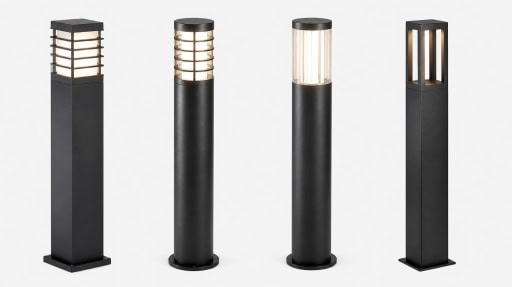
Commercial LED post lights are pole-mounted fixtures that light up parking lots, walkways, and building entrances. They differ from the decorative lanterns that trace back to early street lighting in the United States.
Instead of an open frame, a commercial unit seals its LED boards and drivers inside a sealed body. The optics then spread light evenly across the ground.
Manufacturers usually list these fixtures in outdoor lighting catalogs, right next to wall, ceiling, rechargeable post, and gas lantern options. This grouping helps you view full product families and compare mounting types in one place.
Finish affects both looks and durability, so treat it as a real decision, not an afterthought. Black commercial LED post lights are a popular choice for architectural settings, as long as the coating resists corrosion.
Cost follows a clear pattern too. A single decorative fixture in a comparable outdoor family can run close to $239, and the price of commercial LED post lights climbs from there.
Size, driver quality, and optical controls all push it higher.
Where Are LED Post Lights Used?
LED post light fixtures are built for pedestrian-scale and lower-pole lighting. You will usually find them on poles under 20 feet.
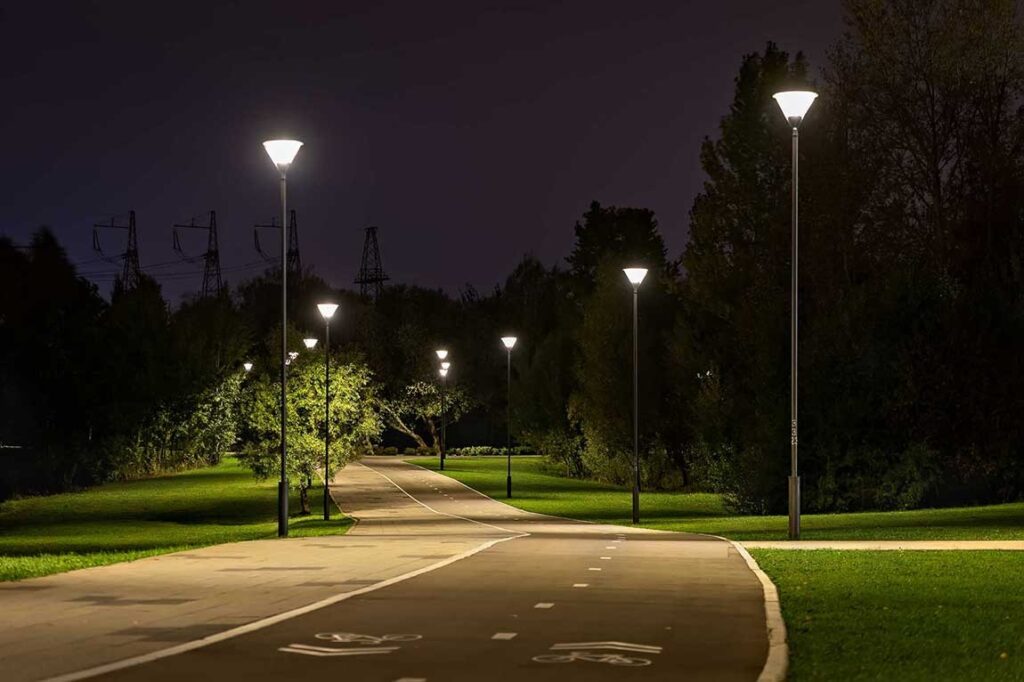
They fit a wide range of spaces. Common applications include pathways, parks, campuses, HOA common areas, and commercial courtyards.
You will also see them in small parking areas, decorative streetscapes, playgrounds, and outdoor building corridors. In all these settings, appearance, comfort, visibility, and low maintenance matter just as much as brightness.
Matching the fixture to mounting height and optical distribution is the first decision rule:
Application | Typical Pole Height | What to Specify |
Parking lot | 15–20 ft | Wide distribution optics for even coverage across the driving surface |
Pedestrian pathways | 8–12 ft | Uniform output without harsh dark spots |
Parks and greenspaces | 10–15 ft | Warm 3000K color temperature for an inviting feel |
Playgrounds | 10–15 ft | High CRI (82+) so faces and terrain render accurately |
Building corridors | Under 20 ft | Post top lighting that prevents shadowing along walkway edges |
Commercial grade LED post top fixtures commonly support photocell compatibility for dusk-to-dawn operation, and advanced models offer adjustable CCT and wattage-selectable output for tuning across seasons. In HOA common areas, dimmable options let property managers balance comfort with energy use.
These fixtures are not always the right fit, though. For poles over 20 feet, large parking lots needing broad area coverage, high-security sites, or focused task lighting, shoebox area lights, bollards, or flood lights are often the better specification.
Key Specifications to Define for a Commercial Project
A spec sheet for commercial outdoor LED post lights should lock down performance parameters before any product compare begins. Use this matrix as a starting checklist:
Spec Item | What to Define | Why It Matters |
Delivered lumens & efficacy | Actual lumen output, lm/W | Drives coverage and energy cost |
CCT & CRI | 3000K/4000K/5000K; CRI target | Sets atmosphere and visibility |
Distribution & BUG | Optic type per application | Uniformity, glare, light trespass |
IP / IK rating | IP65/IP66 minimum outdoors | Weather and impact survival |
Mounting interface | Tenon size, bolt pattern, cavity depth | Prevents installation failures |
Driver & controls | VAC input range, photocell, dimming | Compatibility and operating flexibility |
Light Output & Efficacy
Never pick a post top light by wattage alone. Wattage tells you power draw, not how much light lands on the ground.
Instead, judge the fixture by pole height, pole spacing, lumen output, and distribution together. As a rough starting point, a 12 to 15 foot pedestrian pole often needs 3,000 to 6,000 lumens, while a busier walkway or small lot may call for 8,000 lumens or more.
Poles spaced far apart create dark gaps between fixtures. When spacing runs wide, step up to a higher lumen package. High output LED post lights in commercial grade help you hold even coverage across the whole area.
Retrofit projects bring a different problem. You often do not know the existing light levels, so guessing the output is risky. Wattage-adjustable models solve this. You install first, then dial the output up or down until the levels look right.
Color Temperature & CRI
Color temperature sets the mood and the feel of a space. The three common options are 3000K, 4000K, and 5000K.
Here is a simple rule. Choose 3000K for warm, welcoming areas like courtyards and HOA walkways. Pick 4000K for balanced, neutral light in parking areas and campuses. Go with 5000K when you want crisp, high-visibility light for security zones.
If the right look is hard to call before install, use color-adjustable post top lights. You can switch the color in the field once the fixtures are up.
CRI matters too. It measures how accurately a light shows true colors. When accurate color rendering counts, such as retail entrances or signage, choose a fixture rated at 90 CRI.
Photometric Distribution & BUG Rating
Distribution decides where the light actually goes, so match it to the space. A pathway wants a narrow, forward throw. A plaza needs wide, even spread. A parking area often calls for a symmetric pattern that covers all sides of the pole.
Do not guess on larger jobs. For commercial properties, campuses, parks, and security-sensitive areas, ask for a photometric plan before you order.
That plan lets you review light levels, uniformity, glare, light trespass, and dark-sky rules on paper first. Fixing a layout after install costs far more than checking it early.
BUG ratings help here as well. When a manufacturer lists them, they give you a standard read on backlight, uplight, and glare. Lower numbers mean less wasted and stray light.
Ingress & Impact Protection (IP / IK), Housing, Driver, and Controls
Outdoor fixtures fight water, dust, and physical abuse every day. Two ratings tell you how well they hold up. IP covers dust and water resistance, and IK covers impact strength.
Still, an IP rating alone does not guarantee a long life. Many waterproof products fail outdoors within a season despite strong ratings, and post top fixtures face the same seal-quality risk.
So look past the number and inspect the build. Check the housing seal and fastener quality closely. In coastal or humid sites, condensation can attack the driver and LED board even when standard tests pass.
The electrical side needs the same care. Confirm the driver’s rated VAC input matches your site supply, since a mismatch can cut fixture life or void the warranty.
Finally, decide on controls up front. If you want automatic dusk-to-dawn switching, choose commercial LED post lights with a photocell. Also settle early on dimming needs and whether you want wattage-selectable output for future flexibility.
Common Specification Mistakes to Avoid
Choosing fixtures based on wattage instead of delivered lumens
The most common error is matching the wattage of the old metal halide or high-pressure sodium fixture. This looks safe, but it wastes the whole point of LED.
LEDs deliver far more useful light per watt. So a lower-wattage post top unit can easily outperform the lamp it replaces. Chasing the same wattage often means you overpay and over-light the space.
Do this instead. Compare delivered lumens and efficacy straight from the spec sheet. Never rely on HID wattage equivalence alone, since it tells you nothing about how much light actually reaches the ground.
Ignoring distribution and pole layout for parking lot coverage
Before you choose fixtures for a parking lot, confirm your pole spacing first. Wide spacing changes the required lumen output, the distribution, and the total fixture count.
Optics matter just as much. A pathway optic throws a narrow beam, so it will never spread evenly across a parking area or plaza. Match the distribution to the space, not the other way around.
Sometimes a post top is the wrong tool. If the layout needs taller poles or broad-area coverage, an area light is often the better fixture type. See the use-case table above for height guidance.
Overlooking IP/IK ratings and the mounting interface
Outdoor fixtures endure daily temperature swings, not just rain. A housing can pass IP water-ingress testing and still pull humid air inside as the internal air expands and contracts.
So look deeper than the IP number. Confirm the breather valve works as a true moisture barrier and that internal fasteners resist corrosion. Impact resistance counts too, because a cracked housing seam breaks the seal and speeds up failure.
The mounting interface is the costliest blind spot of all. In one of our projects, 286 post-top fixtures arrived with a factory flange using 120mm bolt spacing, while the pre-installed poles used 105mm spacing. The pole cavity measured 32mm deep, but the driver protruded 41mm.
That mismatch forced custom adapter flanges, a 14-day delay, and over $27,000 in extra cost. The lesson is simple. Before installation, verify the bolt hole pattern, flange dimensions, and minimum pole cavity depth against the spec sheet. Do not check the outer housing alone.
Certifications and Compliance to Verify

DLC listing and UL/cUL certification
Start with the safety marks. UL or cUL certification shows a fixture passed third-party testing for fire and shock hazards. These marks cover luminaire safety standards like UL 1598 for wet-location fixtures and UL 8750 for LED equipment.
Inspectors usually require these marks for code approval, so treat them as a must-have. If you also want utility rebates, verify the DLC listing, since most rebate programs only pay out on DLC-qualified products.
Still, certification is a baseline, not a guarantee. In the rollout described above, every fixture was fully UL-listed, yet the base did not align with the poles. The marks confirmed product safety. They did not confirm compatibility with the finished civil work.
Wet location ratings and IP65/IP66 ingress protection
Outdoor fixtures face rain, sprinklers, and condensation every day. A parking lot, courtyard, or building perimeter puts the housing under constant weather stress.
For weather-exposed areas, look for IP65 or IP66. For harsher settings that may see submersion, step up to an IP68-rated unit. The product data sheet lists the rating, so check it before you order.
Know the limit of that number, though. IP tests measure liquid water intrusion, not the condensation that forms inside a sealed driver cavity during day-night temperature swings. That hidden moisture is a common cause of early driver failure.
Title 24, dark-sky, and warranty coverage
Local rules can decide which fixtures you are even allowed to install. For California properties, confirm Title 24 status before ordering, since it shapes your options.
Where dark-sky rules apply, check the uplight limits through the BUG rating. A low uplight number keeps you compliant and cuts stray light into the night sky.
Give the warranty equal attention. Outdoor post lights face thermal cycling, moisture, and UV exposure, so coverage terms matter over the long run. Read closely whether the warranty excludes finish, labor, or shipping. Once you confirm the terms, record them in the project spec sheet so nothing gets lost before install.
How to Evaluate LED Post Light Suppliers

Start with the mounting interface rather than the photometric sheet alone, since compatibility with the existing tenon — a 2 3/8 inch pole, 3 inch pole, or slip fitter — determines whether a rollout goes smoothly. Three checks separate a reliable supplier from a box-mover:
- Verify the pole-side civil interface. Spec sheets usually state only the fixture’s outer dimensions and rarely list internal bolt hole spacing, flange layout, or minimum cavity depth. The driver body may protrude below the flange, and a shallow cavity can crush it during installation. Request these measurements, and confirm whether a suitable tenon adapter exists when sizes differ.
- Compare actual performance data. When you view product spec sheets side by side, review lumen output, distribution, pole height, and spacing together rather than matching old wattage.
- Inspect environmental details for harsh sites. For coastal or high-humidity locations, confirm the breather valve is a genuine e-PTFE type and that internal fasteners are corrosion-resistant. Also check that photocells, adjustable CCT, or wattage-selectable options fit the operating plan.
Understanding Total Cost of Ownership (TCO)
Energy and maintenance over the fixture’s lifespan
Purchase price is one line item among several. Estimate annual energy cost as fixture wattage × operating hours × your utility rate, multiplied across the fixture count. Because LEDs outlast the HID sources they replace, maintenance savings — fewer lamp changes, fewer lift rentals — often outweigh the price difference over the service life.
Comparing purchase price against efficacy and replacement frequency
When you buy commercial LED post lights, compare cost per delivered lumen, not cost per fixture. A cheaper unit with lower lumens per watt or a weaker housing can cost more over a decade through energy waste and early replacement. The best commercial LED post lights balance first cost, efficacy, and proven weather resistance.
Controls, rebates, and warranty terms
Photocells and dimming controls cut runtime and energy use, while DLC listing can unlock utility rebates that offset first cost. Factor commercial LED post lights installation labor into the budget as well — and remember that a longer, more inclusive warranty reduces the risk carried on every remaining line of the TCO calculation.
FAQ
What pole height do commercial LED post lights suit?
Post top fixtures are typically mounted on poles under 20 feet: 15–20 ft for parking lots with wide optics, and 8–12 ft for pedestrian pathways. Taller poles usually call for shoebox area lights instead.
Can I use one fixture for multiple areas by adjusting output and color?
Often, yes. Many commercial units now offer field-adjustable CCT and wattage-selectable output. This lets you stock one SKU and tune it per zone during install.
This flexibility helps on mixed properties, like an HOA with warm courtyards and brighter security corners. It also simplifies procurement, since you order fewer part numbers and cut the risk of specifying the wrong fixed model.
Do commercial LED post lights need a photocell?
Not always, but photocell-equipped models are common for dusk-to-dawn operation and eliminate manual switching. Many fixtures also offer dimming or wattage-selectable output for finer control.
Are commercial LED post lights compatible with smart controls?
Many are. Beyond a basic photocell for dusk-to-dawn switching, higher-end fixtures support 0-10V dimming or networked lighting control systems.
Decide on your control strategy before ordering, because retrofitting controls later can mean rewiring or swapping drivers. If you plan to add motion sensors or scheduling down the road, confirm the driver supports dimming now to keep future upgrades simple.
Conclusion: Specify Right the First Time
Sourcing commercial LED post lights comes down to getting three things right before the order ships: photometric performance, valid certifications, and the mounting interface. Miss any one of them, and the fix waits until the concrete is poured, when it costs the most.
So make the spec sheet your checklist. Confirm delivered lumens over wattage, match distribution to pole height and spacing, verify UL, DLC, and IP ratings, and measure the bolt pattern, tenon size, and cavity depth against your existing poles.
If you are early in the process, a photometric plan is the smartest next step. It lets you review light levels, uniformity, and dark-sky compliance on paper, long before a single fixture reaches the site.
Work With a Supplier Who Checks the Poles, Not Just the Photometrics
We manufacture commercial LED post lights with the details that decide a rollout: verified photometric data, UL and DLC listings, genuine e-PTFE breather valves, and mounting interfaces confirmed against your actual pole specs.
Before you commit to a fixture count, our technical team can review your pole heights, spacing, and tenon sizes to flag compatibility risks early. That single check has saved projects from the kind of 14-day, five-figure delay described earlier in this guide.
Ready to specify with confidence? Request a project quote to compare delivered lumens, distribution options, and mounting details side by side.