If you have ever picked LED fixtures for a commercial project and gotten flickering lights or a dimmer that will not go below 10 percent, you are not alone. Many lighting buyers find 0-10V dimming problems only after installation, and fixes at this point cost a lot.
This guide explains how 0-10V dimming works. It also tells you what makes a good driver different from a faulty one, and how to avoid compatibility errors before you place an order. We have worked with drivers and fixtures for warehouses, retail spaces and offices. Most site issues come from the same few technical details.
By the end of this article, you will know how to read driver specs correctly, match dimming curves to your project needs, and ask the right questions before you buy.
What Is 0-10V Dimming for LED Lighting?
0-10V dimming is a low-voltage control method that adjusts LED brightness using a separate signal wire.
The dimmer does not cut the main power supply. Instead, it sends a control voltage between 0 and 10 volts DC to the driver. The driver reads this voltage and adjusts output current to the LEDs accordingly.
At 10V, the fixture runs at full brightness. Brightness falls as voltage moves toward 0V. Most drivers stop supplying current somewhere between 0.1V and 1V, and this range depends on the driver design.
0-10V vs. 1-10V: What’s the Difference?
These two terms often get mixed up, but the difference matters for procurement.
1-10V dimming was the original analog standard, commonly used with fluorescent ballasts. It requires the dimmer to actively source and sink current on the control line.
While 0-10V is the more common standard for LED drivers today. It typically uses a simpler, sinking-only control circuit, which is less expensive to manufacture and easier to integrate into LED systems.
Most modern LED drivers support 0-10V, but some older building control systems still use 1-10V logic. Mixing the two without checking compatibility is a common source of installation problems.
Why 0-10V Remains a Standard Choice for Commercial Projects
0-10V dimming has stayed popular in commercial and industrial lighting for a few practical reasons:
- It’s simple to wire, typically just two low-voltage control wires.
- It’s compatible with a wide range of building automation and lighting control systems.
- It doesn’t require communication protocols or programming, unlike DALI or other digital dimming systems.
- It’s cost-effective for large-scale installations where every additional control complexity adds labor cost.
Core LED Driver Parameters for Reliable 0-10V Dimming
Not all 0-10V drivers behave the same way, even when the spec sheet looks similar. A few numbers determine whether a fixture dims smoothly or causes problems on site.
Minimum Dimming Threshold
Some drivers claim dim-to-off, meaning the fixture can go all the way to zero output. Others stop at a 1-5% low-end floor and hold there instead of switching off.
This difference matters for the application. A conference room may need true dim-to-off for scene control. A warehouse aisle may be fine stopping at a low floor, since going fully dark is not the goal.
The number on the spec sheet does not always match the number you see on site. Ambient temperature, dimmer brand, and wiring length can all shift the actual floor by a few percentage points.
Dimming Curve & Linearity
A linear curve changes brightness at a constant rate as voltage changes. A logarithmic curve adjusts more gradually at the low end, which matches how the human eye perceives brightness changes.
Logarithmic curves usually feel smoother in the 10-50% range, where most day-to-day dimming happens. Linear curves can feel like they jump too fast at low levels and barely change near full brightness.
Current & Anti-Flicker
A quality driver maintains constant-current output even as the control voltage changes. This keeps color consistent across the dimming range.
High-frequency switching, typically above 500Hz, helps prevent visible or camera-detectable flicker. This matters more in spaces with cameras, such as retail floors or classrooms, than in open warehouse aisles.
Driver Grade Impact
Driver grade is not just a price difference. It directly affects three things buyers care about: how smooth the dimming feels, how stable the fixture is at low output, and how closely actual brightness matches the dial setting.
0-10V Compatibility & Retrofit Solutions for LED Fixtures
Compatibility issues are one of the most common reasons 0-10V projects go over budget. Knowing where your fixture stands before ordering saves a site visit later.
Natively Compatible Fixture Series
LED high bays, LED flood lights, and LED retrofit kits are commonly built with 0-10V dimming drivers already installed. These fixtures only need the control wire connected to a compatible dimmer or building system.
Checking the spec sheet for “0-10V dimmable” and confirming the dimming range, not just the presence of the feature, is the first step before ordering.
Retrofit Procedure for Non-Compatible Standard LED Fixtures
If a fixture was not built with 0-10V dimming, the standard driver typically needs to be replaced with a 0-10V dimmable driver that matches the fixture’s voltage, wattage, and form factor.
This usually involves:
- Confirming the existing fixture’s electrical specifications
- Selecting a replacement driver rated for the same wattage and output current
- Running new low-voltage control wiring to the dimmer or control system
- Testing the dimming range after installation
Factory Wiring & Signal Rules
At the factory level, the purple and gray control wires are the standard convention for 0-10V signal input, though polarity and labeling can vary by manufacturer.
For example, one driver vendor labels purple as 0-10V (+) and gray as 0-10V (-), while another supplier uses the same wire colors but marks gray as signal reference.
During a fixture factory pre-production build, the assembly team followed the general purple/gray color convention without cross-checking the driver datasheet. When test units powered up, the fixtures stayed at full brightness and ignored dimming commands. No hardware damage occurred, but the wiring harness had to be reworked before full production launch.
Confirming terminal labeling against the driver’s datasheet, rather than assuming a universal wiring standard, avoids reversed polarity issues during installation.
Entry vs Premium Fixture Performance
Entry-level fixtures often support the 0-10V signal but may only dim reliably down to 10-20%. Premium fixtures typically extend that range lower and hold tighter tolerances between the dial setting and actual output.
LED Fixture Performance Under 0-10V Dimming Operation
0-10V dimming controls an LED fixture using a low-voltage DC signal, usually ranging from 10V (full brightness) down to 0V or 1V (minimum output). As this control voltage drops, the fixture’s driver reduces the current sent to the LEDs.
Lumen Output Behavior Under 0-10V Dimming
As the control voltage decreases, lumen output decreases with it. This relationship is mostly linear across the middle of the range, roughly between 100% and 20% output. A 50% control signal typically produces close to 50% of full brightness.
Near the bottom of the range, this relationship changes. Below about 10% output, lumen output tends to flatten out rather than continuing to drop in a straight line. Many fixtures reach a minimum dimming point, often between 1% and 10%, where the light stops getting dimmer even if the control voltage continues to fall.
This flattening happens because the driver needs a minimum current to keep the LEDs lit and operating in a stable range. Below that current threshold, the driver either holds output steady or shuts the fixture off entirely.
Color Temperature Behavior Under 0-10V Dimming
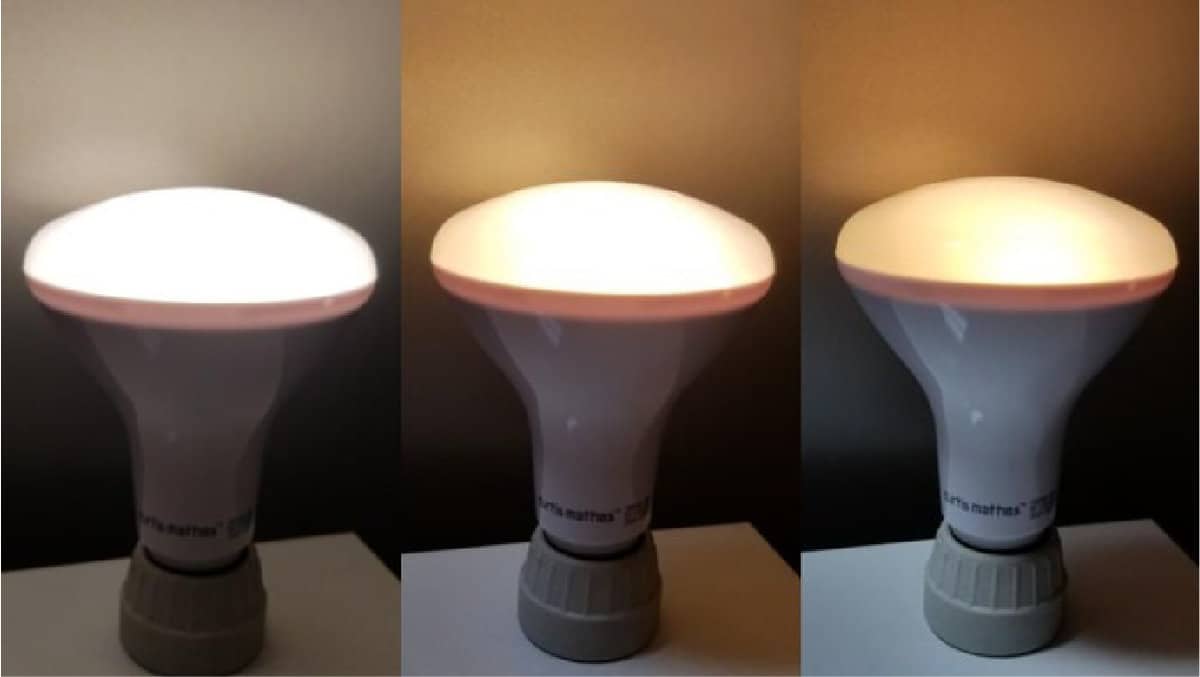
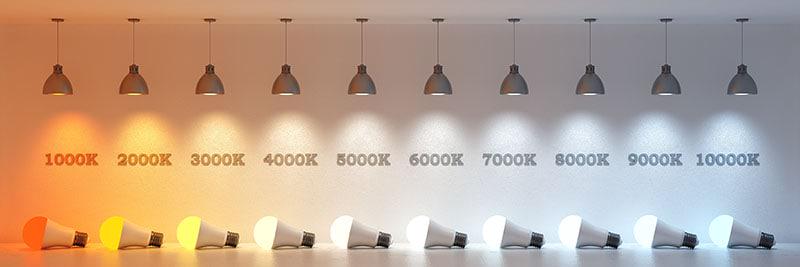
Color temperature in a 0-10V dimming system generally stays close to constant across the dimming range. This is because 0-10V dimming works by reducing current to the same set of LEDs, rather than mixing different color channels or changing the LED’s color output directly.
In practice, there is often a small shift in color temperature as output drops toward the low end of the range, typically within 100-200K. This shift happens because LED chips respond slightly differently to lower current levels, which affects how the phosphor coating emits light.
This shift is usually too small to notice in a single fixture viewed on its own. It becomes more visible when dimmed fixtures are compared side by side, since the human eye is more sensitive to color differences between two light sources than to a shift in one source over time.
System Efficiency Behavior Under 0-10V Dimming
System efficiency, measured in lumens per watt, is not constant across the dimming range. It is highest near full output and decreases as the fixture dims.
This happens for two reasons. First, the driver itself draws a small, mostly fixed amount of power to operate its internal circuitry, regardless of how much light the fixture produces. As total output drops, this fixed power draw makes up a larger share of total energy use, which lowers overall efficiency.
Second, LED chips themselves become slightly more efficient at lower current levels, up to a point. This partly offsets the driver’s fixed power loss in the middle of the dimming range. But at very low dimming levels, the driver’s fixed power draw becomes the dominant factor, and system efficiency drops more noticeably.
Commercial & Industrial Application Matching for 0-10V LED Fixtures
Matching the right fixture and dimming logic to your space prevents poor performance. It also stops you from spending budget on features your project does not need.
Warehouse & High-Bay Fixture Selection
Warehouses and factories commonly use LED high bay lights from 100W to 240W. Teams set dimming to cut light output when few people are present. These spaces rarely need dim-to-off capability. A 10% minimum dimming level meets most requirements.
Retail, Office & Classroom Dimming Logic
Retail and office sites need smoother, lower dimming floors. This supports scene control and daylight harvesting. Fixture power usually falls between 30W and 100W based on model. More classrooms adopt 0-10V dimming with daylight sensors. The setup reduces eye fatigue and adapts light for different teaching activities.
Outdoor Flood Lighting Dimming Requirements
Commercial outdoor flood lights rely on 0-10V dimming for scheduled brightness cuts in off-peak hours. Users do not manually adjust brightness most of the time. Your layout must consider beam angle and mounting height. Dimming cannot fix bad fixture placement.
Energy Savings and Human-Centric Lighting Benefits
0-10V dimming delivers energy savings by lowering output during low-occupancy periods. It also enables human-centric lighting systems. Brightness shifts through the day to match natural light and user preferences.
0-10V Dimming vs. Conventional LED Dimming Technologies
Compared to other dimming methods, 0-10V solves specific problems that show up repeatedly in commercial projects.
Performance vs. Phase-Cut Dimming
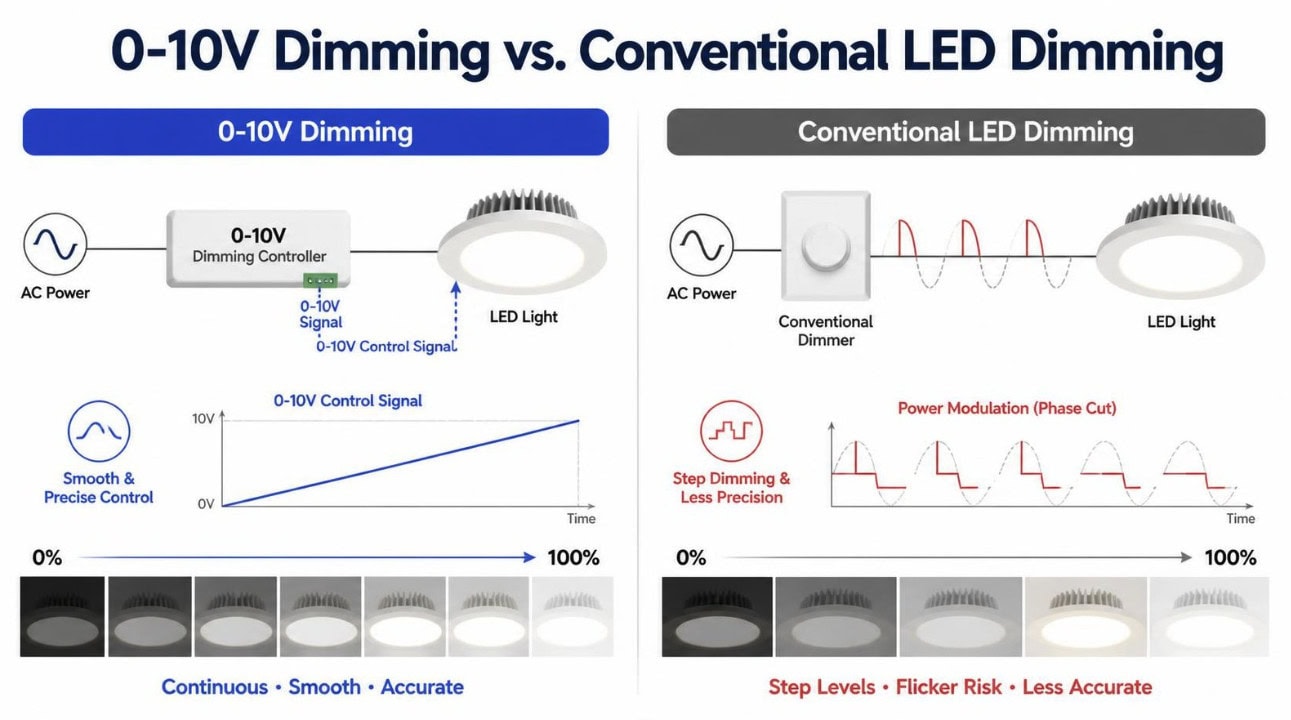
Phase-cut dimming works by cutting part of the AC waveform, which can cause flicker or buzzing with LED loads, especially at low dimming levels. 0-10V avoids this by using a separate low-voltage signal instead of modifying the main power waveform.
Industry Pain Points Solved by 0-10V
0-10V addresses three recurring complaints with phase-cut systems: flicker at low dimming levels, unstable performance across different LED loads, and limited compatibility with high-wattage fixtures.
Long-Term Reliability in Large-Scale Projects
Because 0-10V separates the control signal from the main power circuit, it typically causes less electrical stress on the driver over time compared to phase-cut methods, which can support longer fixture reliability in large installations.
Wiring Cost and System Stability
For large commercial projects, the simpler two-wire control of 0-10V usually means lower installation labor cost compared to digital protocols like DALI, while still providing stable dimming performance across many fixtures on the same circuit.
Industry Certifications & Specification Standards for 0-10V LED Systems
For procurement and bidding, certification details matter as much as the technical specs themselves.
UL and DLC Requirements for 0-10V Fixtures
UL certification confirms the fixture meets electrical safety requirements, while DLC (DesignLights Consortium) qualification is often required for utility rebate eligibility. Both certifications should specifically list 0-10V dimming compatibility, not just general fixture safety.
Buyers should check the DLC Qualified Products List directly for the specific model and wattage, since certification does not always cover every variant in a product line.
Factory QA Standards for Dimming Performance
Reliable manufacturers test dimming linearity, low-end floor performance, and flicker levels as part of routine factory QA, rather than relying only on the driver manufacturer’s published specs.
Key Specifications for Project Bidding
Bid specifications typically require documentation of dimming range, minimum dimming percentage, flicker performance, and confirmation of UL/DLC listing status for the exact model being quoted.
Qualification Evidence for Mass-Produced Orders
For large orders, requesting third-party test reports for dimming performance and flicker compliance, rather than relying solely on datasheet claims, reduces the risk of non-conforming shipments.
Frequently Asked Questions
How many fixtures can one 0-10V dimmer control?
This depends on the dimmer’s current-sourcing capacity, not the fixture wattage. Most 0-10V dimmers can drive the control input of 15-30 fixtures on a single control line, but manufacturers specify this as a maximum load in milliamps, not a fixture count. Checking the dimmer’s rated sink current against the total control current draw of all connected drivers prevents dimming range from degrading as more fixtures are added to one zone.
What happens if the 0-10V control wires are left disconnected?
Most 0-10V dimmable drivers default to full brightness when the control wires are not connected, since an open circuit reads as 10V to the driver. This is a deliberate fail-safe design, so a fixture won’t go dark if a control wire comes loose. Some driver models behave differently, so confirming default behavior on the datasheet avoids surprises during commissioning.
Does 0-10V control wiring need its own power supply?
No. The 0-10V control signal is low-voltage and typically sourced by the driver itself, not by an external power supply. The dimmer only needs to vary the voltage on the control line between 0 and 10V; it does not need to deliver significant current. This is part of why 0-10V wiring is simpler and cheaper to install than systems requiring separate low-voltage power.
How far can 0-10V control wiring run before signal quality becomes an issue?
For most commercial installations, 0-10V control wiring performs reliably up to roughly 150 feet (about 46 meters) without voltage drop affecting dimming accuracy, though this varies by wire gauge and the number of fixtures sharing the line. Longer runs or heavily loaded control lines may need thicker gauge wire to maintain accurate voltage at the far end of the circuit. If a project involves long control runs, requesting the driver manufacturer’s recommended wire gauge and maximum distance prevents dimming inconsistencies across a large space.
Conclusion
Choosing 0-10V dimming isn’t only about picking a driver labeled “0-10V compatible.” The details that actually determine performance on site—minimum dimming floor, wiring polarity, flicker behavior near the low end, and driver grade—rarely show up clearly on a standard spec sheet. That’s why confirming these details before you place an order saves time, avoids rework, and prevents the kind of site issues that cost far more to fix after installation.
Whether you’re specifying fixtures for a warehouse retrofit, a retail buildout, or an outdoor lighting upgrade, understanding how driver quality and wiring practices affect real-world dimming performance puts you in a stronger position to choose the right product the first time.
Confused with Choosing Commercial Fixture with 0-10V Dimming?
Fed up with LED fixtures that flicker, fail to dim smoothly at low levels, or cause compatibility troubles on your commercial projects?
We are a professional LED lighting fixture manufacturer, and if you need verified dimming specs, flicker test reports, or customized lighting solutions for your project, feel free to contact our team. We help you eliminate on-site dimming risks and procure stable, long-lasting commercial LED lighting directly from the factory.