Choosing between an LED floodlight and a spotlight sounds simple, until you realize the wrong beam angle can leave your space either poorly lit or blindingly harsh. If you are planning outdoor lighting, a security setup, or a commercial project, picking the wrong fixture wastes both energy and budget.
The difference comes down to how each light spreads its beam. A floodlight covers a wide area with soft, even light, while a spotlight concentrates a narrow beam onto a specific target. Getting this match right is what separates a well lit space from an expensive mistake.
In this guide, you will learn the main differences between LED floodlights and spotlights, how beam angle affects coverage, and which option fits common applications. By the end, you will know exactly which one to choose for your project and budget.
LED Floodlight Vs. Spotlight- A Brief Overview
Honestly, the difference between floodlighting and spotlighting can be explained in two words, Beam Angle. LED floodlights have a beam angle between 45 – 120°. Meanwhile, LED spotlights range between 25 – 45°.
What is a Beam angle?
The beam angle is a metric that determines the light spread from a source. A light bulb on the ceiling will cast a wide beam on the ground if it has a large beam angle.

Wider bream angles result in a more light spread, resulting in less intense lighting because the same amount of light is spread over a greater area.
By calculating the beamwidth (beam diameter), we can determine the minimum number of lights required for proper illumination.
How to Calculate Beam Width?
Using simple trigonometry, we can generate a simple formula for calculating beamwidth,
Beam Width = [0.0175] x [Beam Angle] x [Light Distance]
The number 0.0175 converts the beam angle from degrees into a usable ratio, so you do not need any advanced math to apply it.
Example: Say you have a floodlight with a 60 degree beam angle mounted 10 meters from a wall. The beam width would be:
0.0175 × 60 × 10 = 10.5 meters wide
That means the light will spread across roughly 10.5 meters at that distance. If your target area is only 5 meters wide, a 60 degree beam wastes light and energy, and a narrower angle would be a better fit.
What are Floodlights?
Floodlights are high-intensity lights designed to flood a space with maximum illumination. Floodlights will commonly have a 45 – 120° beam angle, and since wider beam angles result in lower light intensity, manufacturers compensate by increasing the wattage of floodlights.
So, the critical characteristics of flood beam patterns are high diffusion, non-directional, and result in softer shadows. Floodlightsare also less power-hungry and have both indoor and outdoor applications.

Applications of LED Floodlights
LED floodlights are built to cover large areas with wide, even light, which makes them the go to choice for spaces where broad visibility matters more than pinpoint focus. While they are most common in outdoor and nighttime settings, their use has expanded well beyond that.
Outdoor and Security Applications
Most floodlights are installed outdoors, where wide coverage improves both visibility and safety.
- Driveways and parking lots: A single well placed floodlight can illuminate an entire driveway or lot, reducing dark spots where accidents or intrusions happen.
- Building facades and perimeters: Floodlights wash walls and fences with even light, supporting both security and architectural highlighting.
- Sports stadiums and fields: High output floodlights light large playing surfaces uniformly, which is essential for players, spectators, and broadcast cameras.
Commercial and Industrial Applications
Floodlights are not limited to the outdoors. Their wide beam also works well in large indoor spaces.
- Warehouses and distribution centers: High ceilings and open floor plans need broad, consistent light, which floodlights deliver more efficiently than clustered spotlights.
- Factories and workshops: Even illumination reduces shadows and improves worker safety around machinery.
- Loading docks and yards: Floodlights keep transition zones bright for round the clock operations.
When a Floodlight Is the Right Choice
As a rule, choose a floodlight when you need to light a wide area rather than a single object.uses.

Benefits of using LED Floodlights
Floodlights are typically used for commercial applications, where convenience is the primary focus. But LED floodlights do have a few other benefits outside of convenience.
1. Wide Area Coverage from a Single Fixture
The defining benefit of a floodlight is its wide beam angle. One fixture can light an entire driveway, yard, or playing field, so you need fewer units to cover the same space compared to narrow beam lighting.
2. Even, Shadow Free Illumination
Because the light spreads broadly, floodlights reduce harsh shadows and dark spots. This creates safer, more usable spaces for workers, drivers, and security cameras.
3. Strong Security Value
A brightly and evenly lit area discourages intruders and removes hiding spots. This makes floodlights the standard choice for perimeters, entrances, and parking areas.
4. Flexible Mounting and Aiming
Most floodlights come with adjustable brackets, letting you aim the beam exactly where coverage is needed. Raising the mounting height widens the coverage area, giving you control over how much ground each fixture lights.
5. Cost Effective for Large Spaces
Since one floodlight covers so much ground, fewer fixtures, less wiring, and simpler installation are needed. For big open areas, this makes floodlighting far more economical than using many focused lights.
What are Spotlights?
Spotlights get their name from the shape of their light spread, a sharp circular spot. For precise and sharp beam spread, the narrow beam angle needs to be less than 45°, though spotlights typically don’t go lower than 25°.
Contrary to floodlights, spotlights are directional, have concentrated beam spread, and result in sharper shadows. With such specific characteristics, the applications for spotlights are limited.

Applications of LED Spotlights
Spotlights are generally more compact than floodlights, and their tight, directional beam makes them useful across a wide range of applications. Because the light is concentrated rather than spread out, a spotlight can draw attention to a single object highlighting specific features or reach a target that sits far from the fixture.
Accent Lighting
One of the most common uses for spotlights is accent lighting, which draws the eye to a specific feature while leaving the surrounding area darker. This contrast is exactly what a narrow, fixed beam does best. Typical examples include:
- Statues and monuments. A focused beam highlights shape and texture without washing out the background.
- Landscape features. Trees, water features, and architectural details stand out when lit individually.
- Concert and event stages. A fixed spotlight isolates a performer or a key set piece and keeps the beam concentrated on that spot.
- Retail and gallery displays. Products and artwork get direct emphasis without lighting the whole room evenly.
Illumination in Space-Constrained Applications
Spotlights are also used where there is limited room to mount a fixture, or where light needs to travel a long distance to hit a specific target. The compact housing and long-throw beam make them a practical choice in these settings:
- Billboards and signage. A few well-aimed spotlights can light a large sign evenly from a distance, without bulky fixtures.
- Rescue and emergency vehicles. Small, high-intensity spotlights direct light exactly where crews need it.
- Security and perimeter points. A single spotlight can cover a driveway entrance, gate, or doorway from a tight mounting position.
- Industrial inspection. Focused light helps workers see fine detail in machinery, tanks, or hard-to-reach areas.

Finally, the everyday use of spotlighting is, highlighting specific areas or persons, like in a stage play, where you can highlight a lead actor from the background.
Benefits of LED Spotlights
Spotlights have fewer specific benefits than floodlights, mostly because they are built for a narrower job. A floodlight is designed to light a large area, so its advantages tend to show up across wide spaces. A spotlight does one thing well: it puts a concentrated beam exactly where you want it. Still, when that focused output is what you need, LED spotlights offer several clear advantages.
Precise, Controlled Lighting
The main benefit of a spotlight is control. The narrow beam lets you light a single object or point without spilling light onto everything around it. This keeps the surrounding area darker, creates strong contrast, and makes the target stand out.
Long Throw Distance
Because the light is concentrated rather than spread out, a spotlight can reach targets that sit far from the fixture. This makes it useful for signage, tall structures, and any point that a wider fixture would struggle to reach clearly.
Compact Size
Spotlights are generally smaller than floodlights, so they fit into tight mounting positions where a larger fixture would not work. This makes them practical for vehicles, display cases, and confined installation points.
Instant, Stable Output
LED spotlights reach full brightness the moment they switch on, with no warm-up delay. The beam stays stable and consistent, which is important for inspection work, security points, and stage use.
Floodlight vs. Spotlight: Beam Angle Comparison
We talked about floodlights and spotlights individually, but now let’s make some side-by-side comparisons. First is the beam angle; let’s consider two identical led bulbs on a ceiling with the exact power requirement (wattage). The only difference between the two is their beam angle.
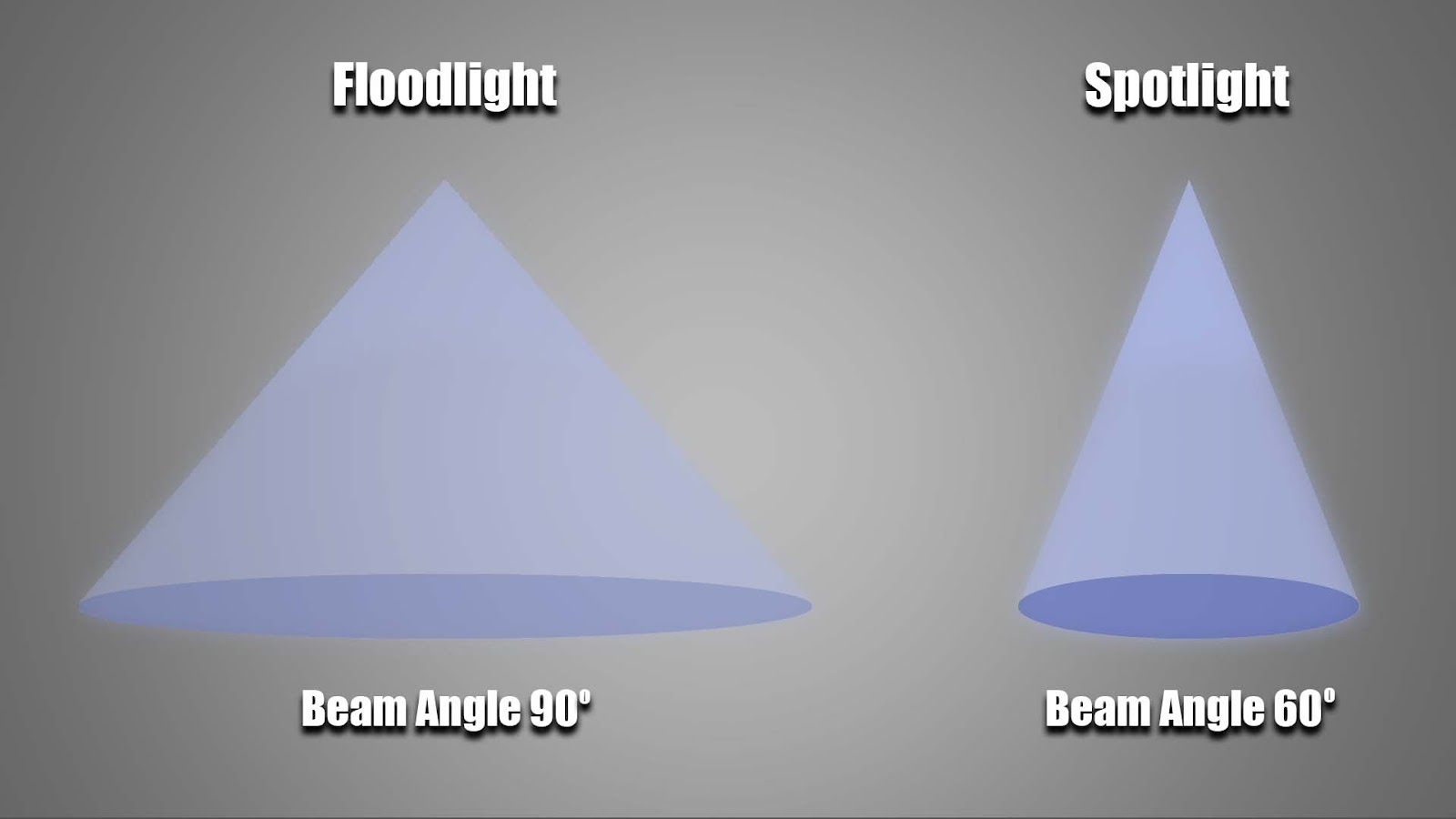
Since the two bulbs are identical, they produce the same amount of light. But the way each beam of light spreads across the space will be different.
Now let’s move on to a secondary attribute of beam angle, “Throw Distance.” In short, the throw is the distance a beam of light can travel before fading away.
Consider the example of a car driving down a narrow road at night. The picture below shows the results of a spotlight vs. a floodlight.
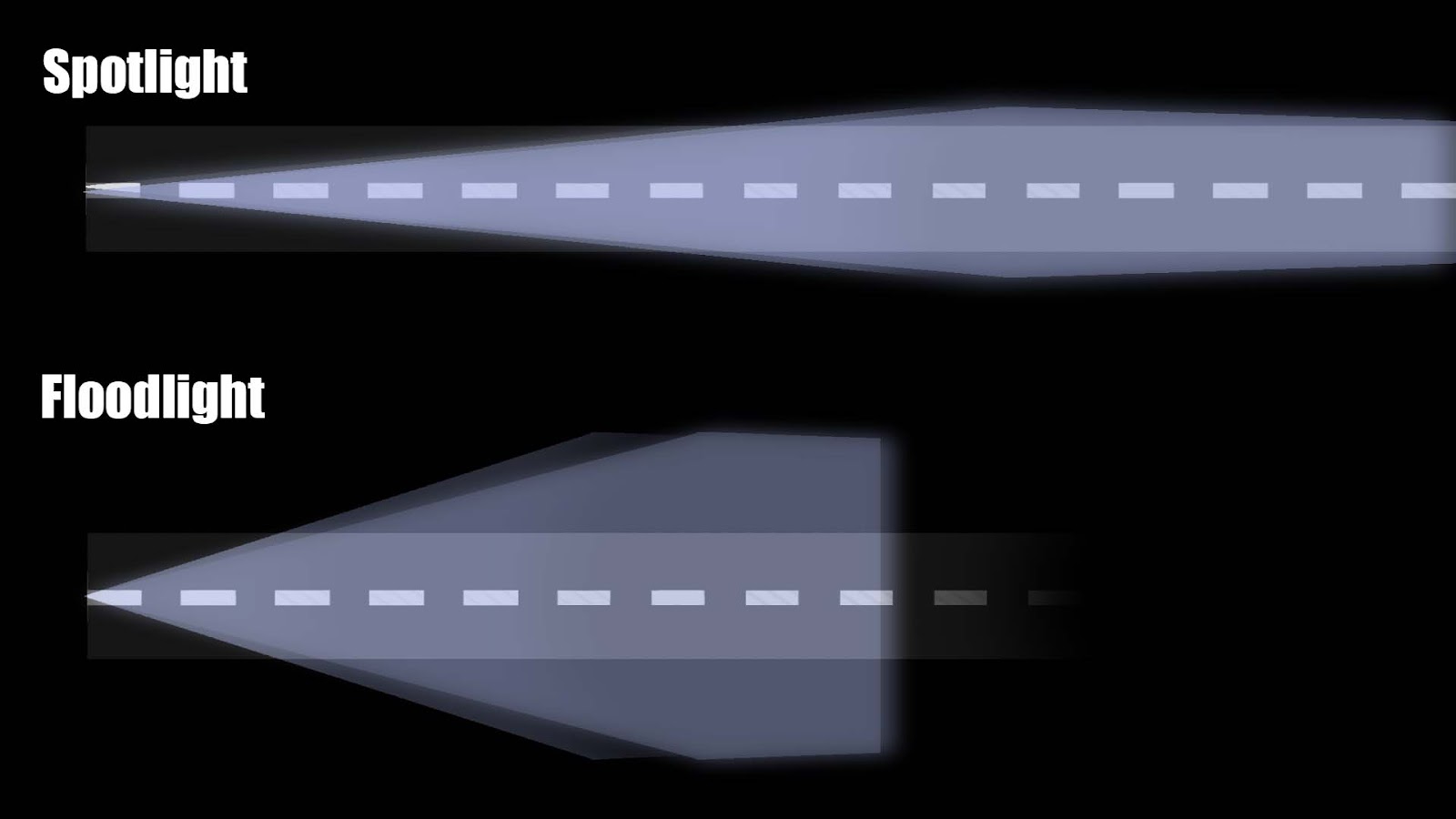
The beam pattern for spotlights shows a greater throw distance because of the focused light. Meanwhile, flood lights’ beam pattern shows a shorter throw distance because the car projects light to the surrounding areas.
Which One Is Better for Your Application?
There is no single winner between spotlights and floodlights. The right choice depends on what you need to light, how much area you need to cover, and where the fixture will go. The easiest way to decide is to work through a few practical factors before you buy.
Location
Start with where the fixture will be mounted. Tight or elevated spots often favor a compact spotlight, since it fits into small positions and can reach a target from a distance. Open areas with room to mount a larger fixture usually suit a floodlight. Also consider access for maintenance, because a fixture placed high or in a hard-to-reach spot should be one you rarely need to touch.
Coverage Area
Think about how much space you actually need to light. A floodlight is the better choice for wide, even coverage across a yard, parking lot, or building face. A spotlight is the better choice when you only need to light a single object or a specific point. Using a spotlight for a large area leaves dark gaps, while using a floodlight for a single target wastes light on the surroundings.
Power Budget
Consider how much energy you are willing to run and how long the fixtures will stay on. Floodlights generally draw more power because they light a larger area, so running several of them adds up over time. Spotlights use less power for their focused output, which can lower running costs when you only need light in one place. LED versions of both cut energy use significantly compared with older technology.
Niche Applications
Some jobs point clearly to one type. Signage, monuments, stage highlights, and long-distance targets call for the directional beam of a spotlight. Perimeter security, sports areas, work sites, and general area lighting call for the wide spread of a floodlight. When your application has a clear, specific purpose like these, the fixture type often chooses itself.
Frequently Asked Questions
Can I use a floodlight instead of a spotlight?
You can, but the result depends on your goal. A floodlight spreads light over a wide area, so if you use it in place of a spotlight, the light will scatter instead of focusing on a single object. If you need to highlight a sign, tree, or feature, a spotlight is the better fit. For general area lighting, a floodlight works fine.
Which is brighter, a spotlight or a floodlight?
It depends on how you measure brightness. A floodlight usually produces more total light (lumens) because it covers a larger area, but a spotlight often appears brighter on its target because it concentrates that light into a narrow beam (higher candela). So a spotlight can look more intense at a distance even with fewer lumens. Choose based on whether you need wide coverage or focused intensity.
Can I mix floodlights and spotlights in the same area?
Yes, and combining them often gives the best result. Floodlights handle broad, even coverage for safety and general visibility, while spotlights add accent and highlight key features like trees, signage, or architecture. This layered approach is common in landscape and building facade lighting. Just plan the placement so the beams complement each other instead of creating harsh shadows or hotspots.
Do floodlights or spotlights cause more light pollution?
Floodlights cause more light pollution because their wide beam spills light upward and outward, creating skyglow and glare. Spotlights stay focused on the target with less spill. To cut light pollution with either type, aim the beam downward, use shielding, and choose warmer color temperatures (3000K or lower) for outdoor use.
Can I get floodlights and spotlights customized for my project?
Yes. Many commercial and outdoor projects need specific beam angles, wattages, color temperatures, or IP ratings that standard fixtures don’t offer. Working with a manufacturer lets you match the lighting to the exact application, whether that’s a stadium, storefront, or landscape design. If you have a project in mind, our team can help you spec the right floodlights and spotlights and provide a quote.
Conclusion
Spotlights and Floodlights may seem similar at first glance, but the two couldn’t be more different when you look closely. Floodlights are broad and bulky, but they output a lot of light. While spotlights are small and sleek, they output less light, but all of the light is concentrated in a single beam.
We hope that this article has given you a better understanding of LED lights and the critical difference between spotlights and floodlights. If you want our recommendation for LED lighting solutions, we suggest RC Lighting.
We provide a broad range of lighting services, including LED spotlighting and floodlighting. Some of our most popular lighting solutions include indoor track spotlighting, architectural floodlighting, led light bar, and underwater led lights.