Choosing a waterproof LED strip sounds simple, right up until the lights fail six months into an outdoor project. If you spec strips for landscapes, facades, or pool edges, the wrong choice means callbacks, warranty fights, and whole runs you have to replace.
In this guide, we’ll walk you through the six factors that decide whether a waterproof LED strip lasts outdoors. We’ll break down how to pick by application, and we’ll give you a B2B procurement checklist you can send straight to your suppliers. Let’s have a look.
5 Factors to Choose Waterproof LED Strip Lights
A waterproof LED strip only performs as well as its weakest point. Before you compare prices, work through these six factors in order.
If you’re still new to strip basics like voltage, chip types, and cutting points, our LED strip lights guide covers the fundamentals before you go outdoor grade.
1. IP Ratings
The IP (Ingress Protection) rating is the first spec you’ll check on any waterproof LED strip. It tells you exactly how much water and dust the strip can handle. Get this wrong and nothing else you do matters.
What the Two IP Digits Mean
An IP rating uses two digits, like IP65. The first digit rates protection against solids and dust on a 0 to 6 scale. The second digit rates protection against water on a 0 to 9 scale.
For outdoor strips, you’ll care most about the second digit. A “6” for dust is standard, so the water digit is where products really split apart. You can check the exact classifications in the IEC 60529 standard, the reference behind every IP number.
Here’s something suppliers rarely spell out. Labs test IP ratings on complete, uncut strips. That detail matters more than most buyers realize, and we’ll come back to it.
IP65 vs. IP67 vs. IP68 (When to Use Each)
These three ratings cover almost every outdoor job, but you can’t swap one for another.
IP65 resists water jets from any direction. It fits covered outdoor areas like eaves, soffits, signage, and facade lines that see rain but never sit in water.
IP67 survives temporary immersion up to 1 meter for 30 minutes. Choose it for ground level landscape lighting, walkways, and spots where water tends to pool.
IP68 handles continuous submersion. It’s the only rating you should trust for pools, fountains, and anything underwater.
A quick rule of thumb. If water can sit on or around the strip, move up a level. Over specifying costs you a little more, but under specifying costs you the whole run.

2. Waterproofing Method
An IP rating tells you the test result. It does not tell you how the strip was sealed. Two strips can both claim IP67 and still age very differently outdoors. The sealing method decides how the strip handles heat, UV, bending, and years of weather. So before you compare ratings, learn the three ways a strip gets waterproofed.
Silicone Coating vs. Silicone Tube vs. Silicone-Filled
Silicone coating is the entry level method. A thin layer of silicone glue is coated over the front of the strip. It is cheap. It stays flexible. It bends easily around corners. But it does not last. The coating can yellow under UV and peel at the edges. It also leaves the back and sides exposed. Use it for short, low-cost runs under cover. Do not use it in direct sun for years.
Silicone tube slides the strip into a hollow silicone sleeve. The ends are capped and sealed. The tube adds real physical protection. It holds up better against UV and impact. But it has one weakness. A sealed tube traps heat around the LEDs, and that heat shortens their life at high power. Keep tube strips at moderate wattage and they will serve you well.
Silicone-filled is the top tier. The strip is fully encapsulated in solid silicone. It is usually co-extruded, so there are no air gaps. It resists UV, abrasion, and water. You will see it on quality IP68 pool and fountain strips. It costs more. It bends less. But for hard outdoor and underwater jobs, it is the method that lasts.
Which Method Fits Your Environment
Match the method to the exposure. Do not match it to the price. Under an eave or a covered soffit, a coated strip is often enough. On a sun-facing facade, or a run that takes knocks, choose a tube or filled strip. That way UV and impact do not cut its life short. For anything underwater or splashed all day, only a fully silicone-filled IP68 strip belongs there. Think pools, fountains, and water features.
The biggest mistake is buying by IP number alone. People ignore the method. Then they wonder why an IP67 strip yellowed and cracked in one summer. The rating passed a lab test. The wrong encapsulation still failed in the field.
When we open a failed outdoor strip, we first look at where the damage sits.
It tells us the real cause faster than any test report. Say the corrosion sits only at the ends, cut points, and connectors. You see greenish-white oxidation on the copper and solder pads. But the middle silicone body is clean. That is almost always an installation sealing failure. It is not a defect in the strip’s waterproofing method. Moisture creeps through the gap. It forms a water film on the PCB. Then it slowly eats the copper.
Now say the whole strip shows even yellowing, hazing, and fine cracks. There is no internal corrosion yet. That means the wrong material was chosen. Someone used epoxy or standard PU instead of UV-grade silicone.
And if the silicone shell tears or splits along the body, that points to an extrusion or hardness problem. Here is the key point buyers miss. IP lab tests use uncut strips. Once you cut a strip on site, the original seal is broken. The rating no longer describes what you installed.
3. Voltage & Outdoor Power Supply
Your ideal voltage hinges on cable run length, power supply selection, and the physical placement of your LED strip.
5V, 12V, or 24V?
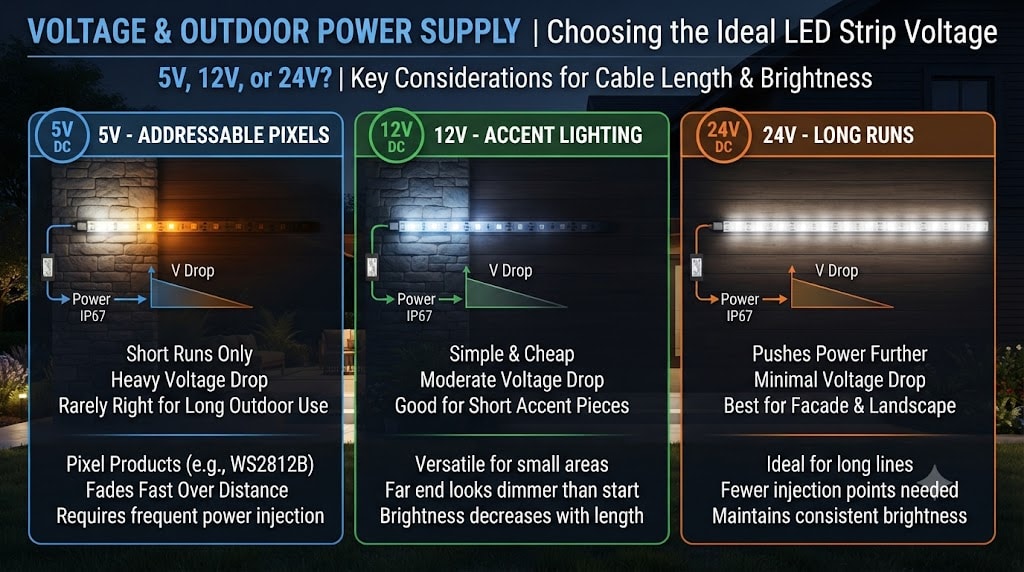
5V strips show up mostly on addressable pixel products. They suffer heavy voltage drop over distance. They are rarely right for long outdoor runs.
12V is simple and cheap. It works well for short accent pieces. But a 12V strip loses brightness the longer the run gets. This is called voltage drop. The far end looks dimmer than the start.
24V pushes power further before that happens. It suits longer facade lines and landscape runs. You also need fewer injection points. As a rough guide, move to 24V once your run passes a few meters. Do the same if you feed from one end only.
Weatherproof Drivers & Voltage Drop Over Distance
The strip is only half the system. The driver has to survive outdoors too. Use a driver rated IP65 or higher. Mount it in a spot that matches its rating. Size it with headroom above the strip’s total wattage. Do not run it at 100%.
Voltage drop still applies at 24V on long runs. So plan power injection at intervals. Feed from both ends where you can. Pick the right wire gauge for the current. Undersized wiring is a hidden cause of dim ends and overheating. No IP rating will warn you about it. For wiring near pools and wet spots, follow your local electrical code. In the US, that is the National Electrical Code (NEC).
4. Connectors & Sealing
Connectors are the weak point of almost every outdoor strip. The strip body can be sealed well. But the joints, cuts, and end caps are where water gets in. Get these wrong and the strip fails early, no matter how good the IP rating is.
IP-Rated Connectors
Not every connector is built for the outdoors. Many quick connectors are made for dry indoor runs. Their metal contacts sit close to the open air. Those contacts corrode fast once moisture reaches them. For outdoor work, use connectors that carry their own IP rating. Match the connector rating to the strip rating. An IP68 strip joined with an IP20 clip is only as strong as that clip.
Sealing Cut Ends & Solder Joints
One rule matters more than any other. Cut equals seal. The factory seals both ends of a strip at the plant, but the moment you cut it to length, that seal is gone. The fresh cut exposes bare copper and the PCB. An open cut end is an open door for water.
That open cut is where you add a connector or solder a wire, so the joint and the seal become the same problem. Get the joint wrong and water walks straight into the strip. Three mistakes cause most of these failures in the field.
- Wrong sealant on the cut end. Installers seal a fresh cut with ordinary glass sealant, or leave it open, instead of using the matching silicone end cap. Glass sealant bonds poorly to silicone and peels off after a few thermal cycles.
- Solderless connectors with no outer seal. A quick connector left on its own lets the gasket shift, trap dust, and form a slow path for water.
- Mechanical stress on the joint. Cable pulling and tight bends work the joint loose over time.
Our own standard closes all three gaps. Every cut face gets a matching silicone end cap plus dedicated silicone sealant, never plain glue. Every outdoor joint gets soldered, then covered with double-wall heat shrink. Waterproof connectors get an outer bead of silicone once they lock in place.
Two habits finish the job. Rest the run for 24 hours before power-on so the sealant fully cures. Re-inspect every joint after the first heavy rain. One flooded connector can short out and burn the entire run.
5. Testing & Certifications to Verify
A rating on a datasheet is a claim. Testing and certification are the proof. For outdoor and commercial jobs, this is where you separate real products from paper promises.
IP Test Reports & Salt-Spray Data
Always ask for the real IP test report, not just the number on the box. And know its limit. IP testing is not corrosion testing. Salt air near the coast speeds up solder and copper corrosion far beyond what an IP rating predicts. For any coastal project, always request a neutral salt-spray test report on top of the IP report. The IP number alone will not warn you about corrosion risk.
UV Resistance, Temperature Range & Rated Lifespan
UV, heat, and cold decide how long a strip really lasts.
Low-cost strips often skip the specs that prove it. They leave out L70 lifespan data and the silicone grade, whether fumed or precipitated.
These problems stay invisible during sampling. They only surface 6 to 18 months after install. That is when you see yellowing, cracking, brightness drop, and color shift. Also confirm a thermal-cycling test. Large day-night temperature swings outdoors can cause color shift and seal delamination.
Certifications to Ask For (CE, UL, RoHS)
Certifications protect you and your client. Ask for these before you buy.
CE covers sale in Europe. It shows the product meets EU safety and EMC rules. UL matters in North America, where many commercial jobs and insurers require it. You can check listings at UL Solutions. RoHS limits hazardous materials like lead and is often required for import and resale.
A missing certificate can stop a shipment at customs or fail an inspection on site. Always get the real certificate with a number you can verify. A logo on a datasheet is not proof.
Waterproof LED Strips by Application
The right strip depends on where it goes. The same IP67 strip that works on a garden path can fail in a fountain. Match the product to the environment before you match it to the price.
Landscape & Garden Lighting
Garden runs sit in sprinklers, rain, and damp soil, but they are not submerged. An IP65 or IP67 strip usually covers it, as long as every cut end and connector is sealed to the same level.
Keep the driver above grade in a weatherproof enclosure. Buried connectors are the first thing to fail here.
Building Facade & Outline Lighting
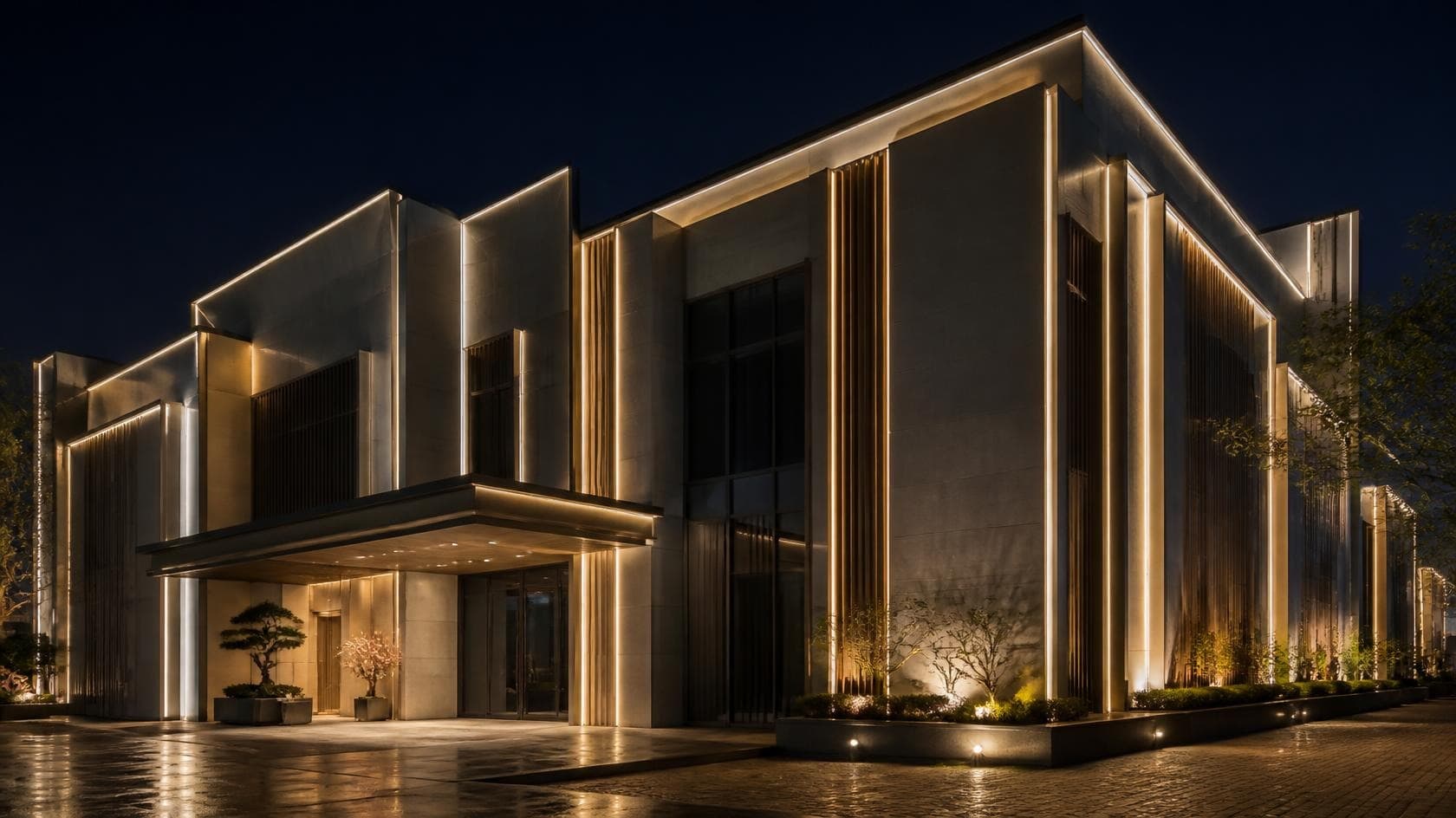
Facade and outline lighting runs long, sits high, and takes direct sun for years. UV resistance and rated lifespan matter more than raw brightness.
Use UV-grade silicone strips and confirm the L70 rating before you commit. A strip that yellows or dims after one summer forces a full re-install on a hard-to-reach wall.
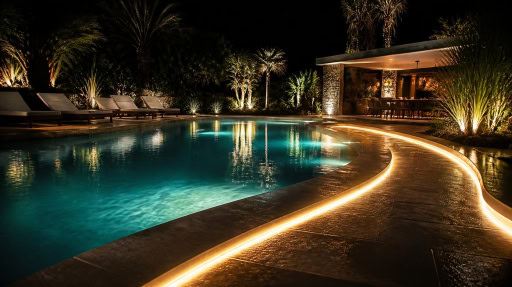
Pool, Fountain & Submerged Use
Anything sitting in water needs IP68 — the only rating built for continuous submersion. IP65 and IP67 will flood.
Confirm the rated submersion depth and duration in the IP68 report, not just the “IP68” label. Depth ratings vary widely between products.
Installation tip: For submerged RGB projects, check chip selection against underwater spectral attenuation to avoid color distortion once installed.
Signage & Commercial Outdoor Projects
Signage needs even light, stable color, and long service life, often behind a diffuser. Prioritize consistent color temperature across the batch and a solid L70 rating.
For commercial jobs, tie the specification to the certifications your client requires — CE, UL, or RoHS — before quoting.
B2B Procurement Checklist
Most outdoor LED strip disputes don’t start on site — they start in the RFQ. As a supplier, we see most RFQs list only IP rating, voltage, and LED spec, skipping the long-term reliability specs that don’t show up in a short sample check but surface as batch failures 6 to 18 months later.
Four specs get missed most often. First, define the silicone type and UV grade — fumed versus precipitated — because if you only write “IP65/IP67,” low-cost bids may substitute PU, epoxy, or precipitated silicone that yellows and cracks within months.
Second, require L70 lifespan data with test conditions, since missing this fuels warranty disputes when brightness drops in two to three years. Third, separate body IP from system IP — cut ends and connectors sit outside the factory IP test, so state the post-cut sealing standard in the contract.
Fourth, for coastal jobs, mandate a salt-spray report, not just an IP report.
Factory QC & Inspection Photos
Ask for inspection photos from the actual production run, not stock images — you want to see solder quality, silicone fill, and reel labeling from your batch. A supplier confident in their QC will share aging-test and pre-shipment inspection records without hesitation.
RoHS / CE / UL Certifications
Confirm which certifications your destination market requires before you order: CE and RoHS cover most of Europe, while UL is often mandatory for North American commercial jobs. Match the certificate number to the exact model, because a certificate for a different SKU protects no one.
OEM / ODM Capability & MOQ
If you need custom lengths, connectors, PCB width, or private labeling, confirm OEM/ODM capability and the minimum order quantity early. MOQ affects unit cost, lead time, and tooling fees, so clarify all three before you build the specification.
Pricing, Lead Times & Sample Policy
Always order samples from the same production process you’ll receive at volume, and ask whether sample and bulk runs use identical materials. Confirm lead times and sample policy in writing — a low unit price means little if the delivery date slips past your install window.
Frequently Asked Questions
Can I use indoor LED strip lights outside if I add a cover?
No. Indoor strips lack UV-stable silicone and sealed ends, so they yellow, crack, and let water in within a season or two.
A cover slows the damage but doesn’t stop it — use strips rated for outdoor use from the start.
How long do outdoor LED strip lights last?
Quality outdoor strips are typically rated to L70 at 30,000–50,000 hours, meaning light output stays above 70% to that point. Cheap strips without real L70 data often fade or shift color within one to two years, which is why we treat verified lifespan data as a purchasing requirement, not a nice-to-have.
Do I really need a salt-spray report for coastal projects?
Yes. An IP report proves water resistance but says nothing about corrosion, and coastal salt air corrodes solder and copper faster than any inland environment.
For any project near the sea, a salt-spray report is the document that actually predicts real-world lifespan.
Can I order custom outdoor LED strips for a specific project?
Yes. Most reliable suppliers offer OEM/ODM options such as custom cut lengths, PCB width, connector type, color temperature, and private labeling for custom lighting projects.
Confirm three things early: the minimum order quantity, any tooling or setup fees, and the lead time — these decide whether a custom run fits your budget and install schedule. For non-standard IP or UV requirements, request a sample from the same production process before committing to a full batch.
Conclusion
Choosing a waterproof LED strip comes down to matching every layer to the environment — IP rating, sealing method, voltage, connectors, and verified test data. Get those right, and the strip you install will still be performing years later, not failing in the first summer.
The strips that fail early rarely fail because of one bad spec. They fail because a good IP number hides a cheap encapsulation, an unsealed cut end, or a missing L70 report. Now that you know what to check, the smartest next move is to build these six factors into your RFQ before you request a single quote.
Work With RC Lighting on Your Next Outdoor Project
At RC Lighting, we manufacture outdoor and waterproof LED strips built for exactly the failure points covered in this guide — UV-grade silicone encapsulation, verified IP and salt-spray reports, and L70 lifespan data you can check before you order. Our team supports OEM/ODM projects, from custom lengths and connectors to private labeling, with samples pulled from the same production run you’ll receive at volume.
If you’re specifying strips for landscape, facade, signage, or submerged installations, our technical team can help you match the right product to your environment and confirm the test documents your market requires.
Request a quote to compare specifications against the checklist above — and get outdoor lighting that lasts.