Your home’s nighttime facade appearance largely depends on the direction of exterior lighting. Both soffit lighting and uplighting brighten residential exteriors, yet they serve distinct functional purposes.
Choosing an unsuitable lighting method often leads to fixture readjustments or full replacements within the first year. From our extensive review of residential lighting layouts, this common mismatch remains one of the most avoidable mistakes homeowners encounter.
This guide outlines the core structural differences between soffit lighting and uplighting. It also covers standard mounting requirements, essential LED specifications, and a practical scenario-based decision framework.
After reading, you will clearly understand which lighting solution matches your home’s facade and which key details to verify before purchasing outdoor lighting fixtures.
Soffit Lighting vs. Uplighting: Definitions and Key Differences
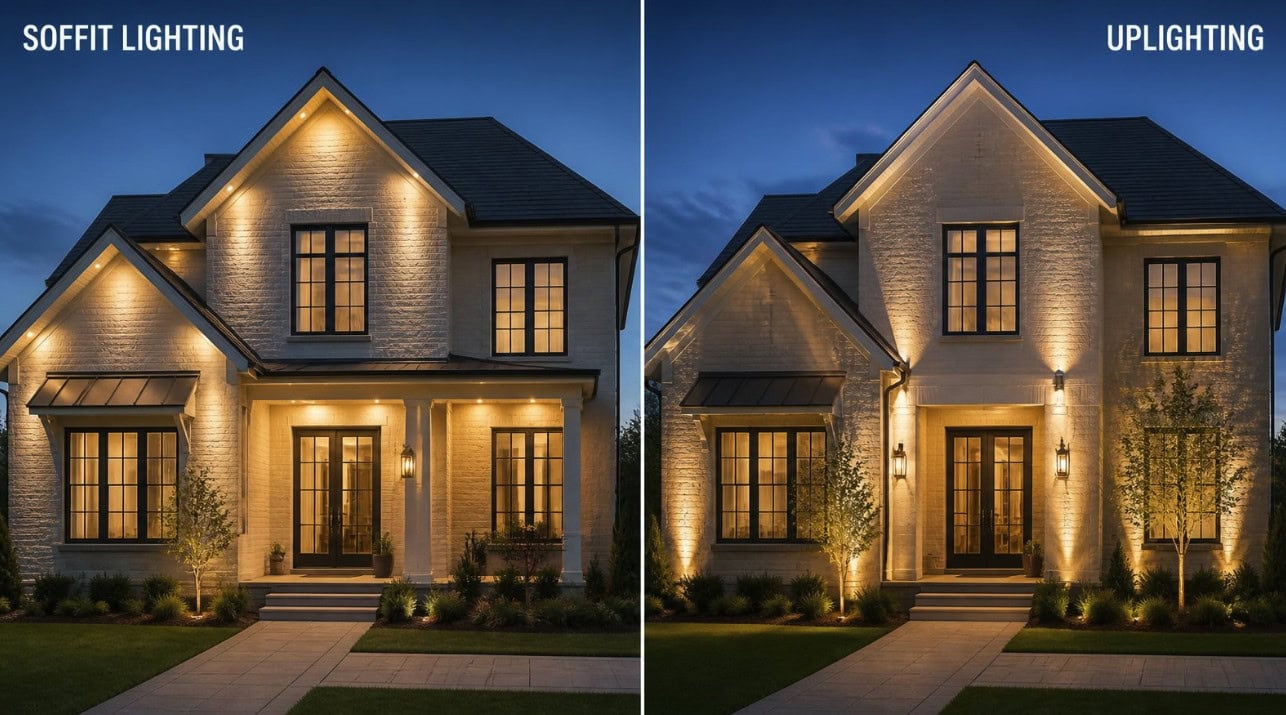
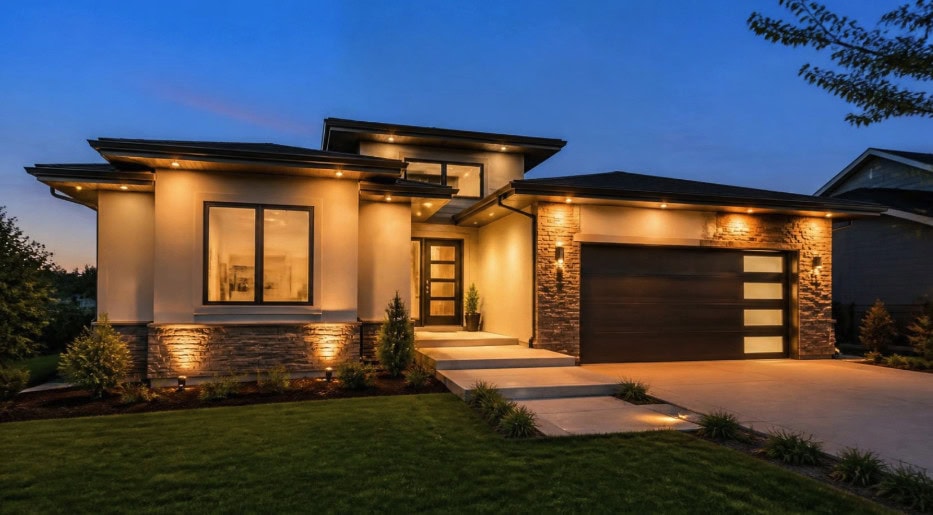
Soffit lighting and uplighting solve the same goal of illuminating your home’s exterior, but they work in opposite directions. Soffit lighting installs fixtures under the roof overhang (the soffit) and points light downward onto the wall or entryway below. Uplighting installs fixtures at ground level and points light upward onto the facade, columns, or architectural features.
Uplighting also offers more control over the finished look. Because ground fixtures can be moved closer or farther from the wall, installers can either graze textured surfaces like stone or stucco, or wash flat surfaces with even light. Soffit lighting is fixed in place once mounted, so it typically produces one consistent wash effect without this flexibility.
Key Structural Differences
The table below compares both approaches across the factors that matter most for exterior lighting decisions.
| Factor | Soffit Lighting | Uplighting |
|---|---|---|
| Light distribution | Even, downward wash | Directional, can graze or wash |
| Glare risk | Low (fixture hidden in soffit) | Moderate (fixture visible at ground level) |
| Installation flexibility | Fixed once mounted | Easy to re-aim or relocate |
| Security lighting value | Moderate (illuminates entry area) | High (can highlight movement at ground level) |
| Ability to reach gables | Limited (no soffit on gable ends) | Strong (ground fixtures reach any height) |
This last row matters more than most homeowners expect. Homes with prominent gables, the triangular wall section under a roof peak, often can’t use soffit lighting there, since gables typically lack a horizontal soffit to mount fixtures into. We’ll cover this gable limitation in more detail in the decision framework section below.
For terminology consistency, this guide follows lighting distribution and glare classification definitions used by the Illuminating Engineering Society (IES).
Fixture Placement, Mounting, and Well Light Installation
Once you’ve decided between soffit lighting and uplighting, the next question is where exactly the fixtures go. Get the placement wrong, and even the right method won’t deliver the effect you’re after.
Mounting Height and Setback Distance
Ground-mounted uplighting fixtures — including well lights set into the foundation bed — typically sit 12–24 inches from the base of the wall. A wider setback works better for textured facades like stacked stone or stucco, since the light needs distance to graze the surface at a low angle. A tighter setback tends to wash flat surfaces more evenly.
Soffit-mounted fixtures need far less clearance — usually just 2–3 inches of standoff from the underside of the overhang. This shorter throw distance is one reason soffit lighting produces a more contained, downward beam instead of the directional grazing effect ground fixtures allow.
If you’re working with a designer, confirm both numbers on the placement diagram before installation day. Setback errors are difficult to correct once fixtures are wired and the bed is backfilled.
Well Light Installation: Planting Beds vs. Hardscape Near the Facade
Where the well light sits changes the installation method. In a foundation planting bed, installation is straightforward: dig the housing in, backfill, and route the wire beneath grade toward the transformer.
Where the facade uplighting needs to come from a walkway, patio, or driveway instead of a planting bed, installers typically need core-drill installation — cutting a precise hole through the paver, stone, or concrete surface to seat the housing without cracking the surrounding material.
Avoiding Trip Hazards Near Entry Walkways
A well light installed in a walkway near the entry needs to sit flush with — or slightly below — the surrounding surface. A housing that protrudes even half an inch becomes a hazard the first time someone walks the path at night.
Wiring is the other common failure point. Any cable crossing a walkway toward the facade should run below grade or through conduit, never left exposed at the surface.
IP Rating for Grade-Level Fixtures
Any fixture mounted at grade and exposed to rain or runoff near the foundation should meet a wet-location IP rating. For most residential uplighting applications, this means checking that the housing is rated to the wet-location classifications defined under IEC 60529.
If you’d rather not core-drill your own pavers or verify IP ratings yourself, our installation team handles fixture placement and mounting as part of a full lighting install.
LED Specifications: Lumens, Color Temperature, and Efficiency
Before comparing quotes or talking to a designer, it helps to know the four specs that actually determine how a fixture performs on your facade: lumen output, color temperature, CRI, and lifespan.
Lumen Output
Lumens measure how much light a fixture produces, not how much electricity it draws. For most residential facade uplighting, fixtures in the 150–300 lumen range per head are typical for grazing textured walls, while wider washes on flat surfaces may call for slightly higher output to avoid dark gaps between fixtures.
Soffit fixtures generally need less lumen output than ground-mounted uplighting, since the shorter throw distance concentrates the light over a smaller area.
ColorTemperature
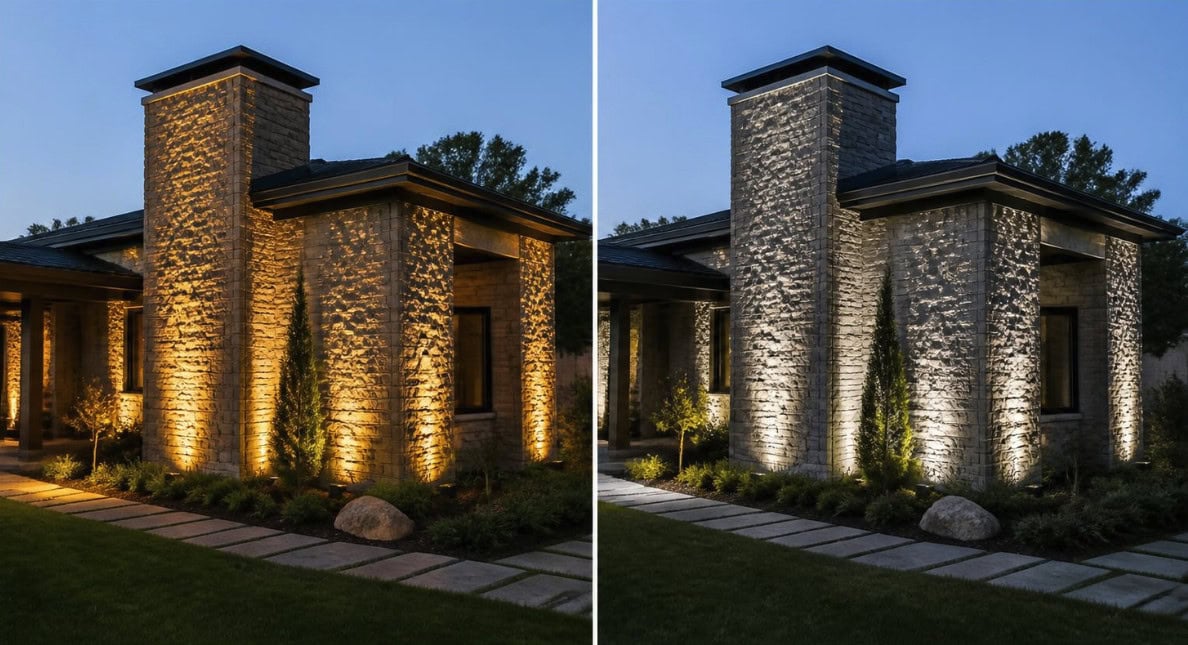
Color temperature, measured in Kelvin, determines whether the light reads as warm or cool. For most home exteriors, 2700K–3000K produces a warm white tone that complements brick, stone, and wood siding without looking clinical.
Cooler temperatures above 4000K can work for modern facades with concrete or metal accents, but they tend to clash with traditional materials. Mixing color temperatures between soffit and ground fixtures on the same wall is one of the more common mismatches homeowners run into after installation.
CRI: Why It Matters More Than Homeowners Expect
CRI (Color Rendering Index) measures how accurately a light source reveals the true colors of a surface, on a scale up to 100. A fixture with low CRI can make warm-toned brick or stone look flat or slightly off-color, even when the color temperature itself is correct.
For facade lighting, look for fixtures with a CRI of 80 or higher, since this threshold keeps natural material tones looking accurate under nighttime viewing conditions. Testing follows the IES LM-79 standard, which measures LED luminaire output, efficacy, and color characteristics under controlled conditions.
L70 Lifespan and Efficiency Controls
L70 refers to the point at which an LED fixture’s output drops to 70% of its original brightness. This is the industry benchmark for “end of useful life,” not a hard failure point, so fixtures usually keep working well past this threshold with gradually reduced brightness.
Quality residential fixtures typically carry L70 ratings of 30,000–50,000 hours. Pairing fixtures with a photocell, timer, or dimming control adds efficiency without sacrificing brightness when it’s needed, since the system only draws power during the hours you actually want light.
How to Choose: Soffit Lighting vs. Uplighting by Project Scenario
Neither soffit lighting nor uplighting is universally better. The right choice depends on your facade’s physical layout, how much flexibility you want after installation, and whether you’re already mid-renovation. Use the two scenarios below to match your situation to the right approach.
When Soffit Lighting Fits Your Facade
Soffit lighting works best when your home already has a continuous soffit overhang along the section you want to light, since the fixtures need that horizontal surface to mount into. Homes with deep eaves, covered porches, or wraparound overhangs are usually good candidates.
This approach also suits homeowners who want a clean, low-maintenance result and don’t plan to change the lighting layout later. Because soffit fixtures are recessed and fixed in place, there’s little upkeep beyond occasional bulb replacement, and the wiring stays hidden above the ceiling line rather than running through the yard.
Soffit lighting is a strong fit if you’re already renovating the roofline or replacing soffit panels, since running wiring during that work avoids the cost of opening finished surfaces later.
When Uplighting or Well Lights Fit Your Facade
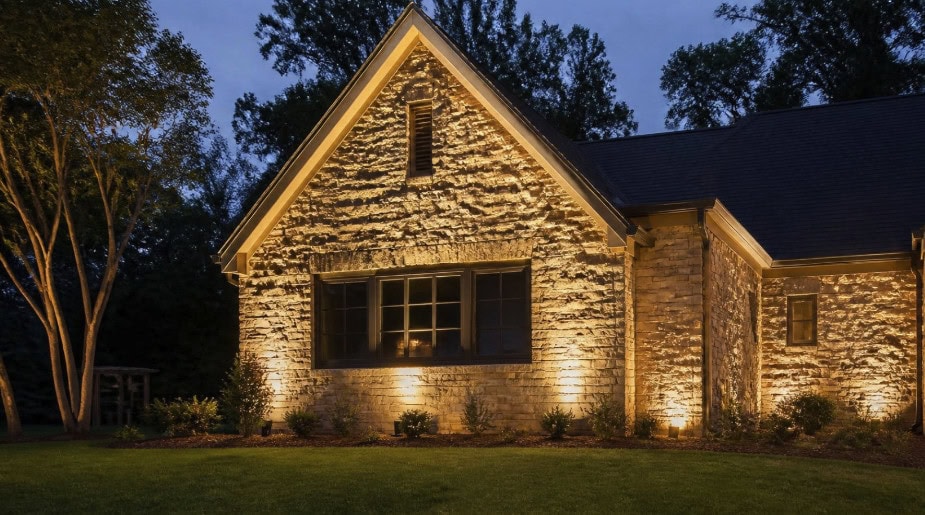
Uplighting becomes the better option as soon as gables enter the picture. A gable, the triangular wall section under a roof peak, typically has no soffit overhang, so there’s no horizontal surface for a soffit fixture to mount into. Ground-mounted well lights solve this by reaching any height on the wall, regardless of roofline.
Uplighting also fits homes with columns, stone accents, or architectural details that benefit from grazing light at a low angle rather than a flat downward wash. If you want the option to re-aim fixtures later, whether because landscaping matures, a tree gets removed, or you simply want to adjust the effect, ground fixtures offer that flexibility in a way fixed soffit fixtures don’t.
Homeowners who aren’t renovating the roofline but still want facade lighting often default to uplighting for a simpler reason: it doesn’t require any work on the soffit or roof structure at all.
Quick Decision Summary
If your facade has continuous soffit coverage and you want a low-maintenance, fixed result, soffit lighting is usually the simpler choice. If your facade includes gables, columns, or textured surfaces you want to graze, or if you want the flexibility to re-aim fixtures later, uplighting with well lights typically delivers better results.
Many homes end up using both: soffit lighting along covered walkways and entries, paired with uplighting on gables and accent features elsewhere on the same facade.
Cost, Lifecycle, and Total Cost of Ownership
Upfront fixture pricing is only the tip of the iceberg for exterior lighting comparisons. Experienced lighting designers know the real cost gap between soffit lighting and ground uplighting rarely appears on initial quotes. It stems from four long-term factors: renovation difficulty, fixture degradation, hidden maintenance labor, and repair frequency.
Differences in mounting structure, exposure and service access create cost gaps that usually emerge 3–5 years after installation — hidden expenses most homeowners overlook.
Installation Cost Differences
Soffit lighting pricing varies drastically depending on whether the project is new construction or a retrofit. Wiring roughed in during home builds or roof work keeps labor low, as electricians do not need to cut finished panels.
Retrofitting soffit lights into a completed home is disruptive and costly. Installers must remove sections of sealed soffit panels, run wiring, re-seal joints and patch exterior finishes. Labor hours often double, with extra charges for panel damage, paint touch-ups and waterproofing. Many homeowners only compare fixture prices and underestimate these hidden modification fees.
Uplighting is far more retrofit-friendly. Contractors trench low-voltage cable from the transformer to each well light. No roof or soffit demolition is required. It is a non-invasive option for finished homes and mature landscapes, with predictable pricing and few surprise add-ons.
Fixture Lifespan and Environmental Wear
Most homeowners focus only on manufacturer specs, but operating environment drives around 80% of fixture lifespan. Soffit lights sit protected under roof overhangs, away from direct rain, snow and harsh sun. Dry internal housing and mild temperature swings slow degradation of gaskets, drivers and LEDs. Properly installed soffit fixtures typically last 30–50% longer than ground units, with far fewer water intrusion or corrosion failures.
Well lights operate in one of the harshest outdoor lighting environments. They face irrigation spray, soil moisture, organic debris and thermal cycling. Freeze-thaw cycles in cold regions gradually shift fixtures and break waterproof seals. Even premium IP67/IP68 well lights suffer unavoidable wear. Driver degradation, fogged lenses, base leaks and misalignment are common; low-quality units may fail within 1–2 years.
Maintenance and Long-Term Ownership Costs
The biggest distinction between these two systems lies in ongoing time, labor and repair costs — the main criteria professional designers use for client recommendations.
Soffit lighting requires minimal, infrequent maintenance. Fixtures stay fixed to the building and retain their aiming angle. Correct installation locks in waterproof integrity. Service is limited to bulb replacement every 3–5 years, with no cleaning or re-aiming. The only downside is needing a ladder for access. It is ideal for homeowners wanting low-fuss lighting.
Uplighting has low upfront cost but recurring maintenance burdens. Well lights in planting beds and lawns get buried under mulch and overgrown vegetation, reducing light output. Mowing, foot traffic and soil movement tilt or sink fixtures. Field records show well lights need cleaning, re-leveling and re-aiming at least once or twice annually, with quarterly service needed during heavy growing seasons. These routine tasks add up to substantial hidden labor costs over time.
Final Lifecycle Cost Verdict
Neither option is universally cheaper over its full lifecycle. For new builds or concurrent roof renovations, soffit lighting delivers lower total cost and stronger reliability. Retrofitting soffit lights into finished homes carries high modification risk and extra fees, making non-invasive uplighting the more practical choice.
The deciding factor is not the installation invoice, but the homeowner’s willingness to maintain the system. Choose soffit lighting for hands-off performance. Choose uplighting for flexible aesthetics only if you accept annual cleaning and fixture adjustments.
Frequently Asked Questions
Can I use soffit lighting and uplighting together on the same house?
Yes, and many homes do. A common combination is soffit lighting along covered porches, entries, or walkways, paired with uplighting on gables, columns, or trees elsewhere on the same facade. The two systems can run on separate circuits or the same transformer, depending on your electrician’s setup.
Does uplighting damage siding or landscaping over time?
Well lights installed at the correct distance from the foundation shouldn’t damage siding. The more common issue is landscaping growing over or around the fixture, which is a maintenance issue rather than a damage issue. Keeping mulch and groundcover clear of the lens prevents most complaints in this area.
Is soffit lighting more energy-efficient than uplighting?
Both approaches use similarly low-wattage LED fixtures today, so energy use is comparable per fixture. Total energy cost depends more on how many fixtures you install and how many hours per night they run, not which mounting method you choose.
Can soffit lighting be added without removing the roof or soffit panels?
In most cases, no. Adding soffit lighting to an already-finished home typically requires opening sections of the soffit panel to route wiring, which is why many homeowners wait until a roofline renovation or soffit replacement project to add it.
Conclusion
Soffit lighting and uplighting solve different physical problems, not competing versions of the same one. Soffit lighting works when your facade already has the overhang to support it, and you want a fixed, low-maintenance result that stays untouched for years.
Uplighting works when gables, columns, or textured surfaces call for light from the ground up, or when you want the flexibility to re-aim fixtures as your landscaping changes.
Most facades end up using both, matched section by section to the architecture rather than applying one method across the entire exterior. The mistake to avoid isn’t picking the “wrong” system outright — it’s applying one approach to a wall that was never built to support it.
Before you buy fixtures or schedule installation, walk your facade section by section: soffit coverage, gable walls, textured surfaces, and any areas near walkways or hardscape. Match each section to the method it can physically support, and you’ll avoid the readjustments and replacements that come from guessing.
Not Sure Which Fixture Fits Your Facade?
If you’re unsure whether your gables, textured walls, or covered entry call for soffit lighting or well lights, our team can match the right fixture, with the correct IP rating, lumen output, and color temperature, before you place an order.
Get a Free Fixture Matching Consultation
Send us your facade type and we’ll recommend the specs that fit. No guessing, no mismatched fixtures to return later.