
IK ratings prevent cracked housings and exposed wiring, but only when supported by genuine IEC 62262 testing. Learn how to specify, verify, and avoid overpaying.
Choosing lighting or enclosures for a demanding site? Then the IK rating is one spec you cannot afford to guess on. It indicates how much physical impact a product can withstand before its housing cracks, yet it remains one of the most frequently misinterpreted values on a datasheet.
We have reviewed a large number of supplier datasheets over the years, and the same issue keeps emerging. An IK rating may be printed on the spec sheet, but no supporting test report validates this claim. Buyers specify the rating and install the product, and they only uncover this discrepancy once a fixture sustains an impact, develops cracks and allows water ingress. This outcome may trigger returns, warranty claims or safety hazards.
This guide breaks down the true definition of an IK rating, its IEC 62262 testing procedure, interpretation of the IK scale, its relationship with IP ratings, guidance for picking the right rating for your project, and most importantly, methods to verify a supplier’s claim before purchase. Let us start with the basics.
What Is an IK Rating and IK Code?

Defining IK Rating as an Impact-Protection Metric
An IK rating tells you how much physical impact a light fixture’s housing can survive before it fails. For lighting specifically, “failure” means a cracked lens, a shattered diffuser, or a broken housing that exposes the LED module and wiring inside.
The rating runs from IK00 to IK10, with each step tied to a specific impact energy in joules (J). The higher the number, the harder the hit a fixture can take without breaking.
This is a separate concern from every other spec on the datasheet. A luminaire can be fully waterproof, energy-efficient, and rated for outdoor use—and still crack the first time a ball, a forklift, or a vandal strikes it. That’s why IK is its own line item when you’re specifying lighting for exposed or public sites.
IK Code Origin and EN/IEC 62262 References
The IK code is defined by the international standard IEC 62262, harmonized in Europe as EN 62262. It sets the exact test method, the impact energy for each IK level, and the pass/fail criteria a fixture must meet.
For lighting buyers, the value of this standard is consistency. An IK08 street light tested to IEC 62262 means the same thing whether it’s built in Germany, China, or the United States—so you can compare fixtures from different suppliers on equal terms, provided each claim is backed by a compliant test.
You can review the standard’s scope on the IEC 62262 listing at the IEC Webstore.
Common IK Ratings on Lighting Datasheets
In practice, most lighting datasheets cluster around a few IK levels, matched to where the fixture is installed:
- IK07–IK08 — commercial and semi-exposed luminaires, such as recessed downlights in accessible ceilings or wall-mounted amenity lights
- IK08–IK09 — outdoor area lighting, façade lights, and pole-mounted fixtures
- IK10 — high-risk installations: parking garages, tunnels, sports facilities, and vandal-prone public lighting
Lower ratings (IK00–IK06) show up on protected indoor fittings, but they rarely drive a procurement decision because the impact risk is low.
One clarification before we move on—and it’s the mistake we see most often on lighting projects: IK is not IP. IK measures impact resistance; IP measures protection against dust and water. A fixture can carry a high IK rating and a weak IP rating, or the reverse. They’re two separate tests and two separate codes, and one never substitutes for the other. We’ll show how to pair them correctly in a later section.
Why IK Rating Matters in Lighting and Enclosures
It’s easy to treat IK as a minor line on the datasheet. But in the field, the wrong impact rating shows up as cracked fixtures, failed inspections, and repeat service calls—all of which cost far more than the fixture itself. Here’s where it actually bites.
Safety: preventing exposed live parts after impact
When a luminaire’s housing cracks, the problem is not just a broken light. A shattered lens or split housing can expose the internal LED driver, wiring or live terminals.
Public spaces such as school corridors, parking garages and transit stations carry shock and fire risks once this electrical hardware becomes exposed. An adequate IK rating maintains enclosure integrity after foreseeable impact, so electrical parts remain sealed and protected.
Impact protection acts as a safety requirement rather than an optional feature for any fixture that people can reach.
Maintenance and Lifecycle Cost: Fewer Replacements, Fewer Service Calls
Under-rated fixtures fail early, and each failure carries a hidden bill. You pay not only for a replacement luminaire but also for the truck roll, the labor, the access equipment, and the downtime.
That cost multiplies in hard-to-reach installations. Replacing a cracked high-bay light in a warehouse or a pole-top fixture over a roadway can cost several times the price of the fixture, once you factor in a lift and a two-person crew.
Specifying the right IK level upfront is one of the cheapest ways to cut a project’s total lifecycle cost. A slightly higher-rated fixture that never needs replacing almost always wins over a cheaper one that fails twice.
Compliance and Liability: Meeting Spec and Audit Requirements
For many projects, IK is contractual. Tender documents, building specs, and safety standards often name a minimum IK rating for a given area—especially in public infrastructure, transport, and industrial facilities.
If the installed product doesn’t meet the specified rating, you have a compliance gap—failed inspection, rejected handover, or liability if an incident occurs later. Auditors don’t accept “the datasheet said IK08”; they want evidence the product was tested to that level.
In reviewing supplier datasheets, the most common issue we find is not a wrong IK number but an unsupported one.
The rating is printed, yet no IEC 62262 test report backs it up. Buyers who accept the number at face value carry all the risk if the product later fails an audit or cracks on site.
So before a rating influences your decision, treat it as a claim to be verified rather than a fact, because the datasheet tells you what the supplier says and the test report tells you what the product actually did.
This is where a claim without a report becomes a real risk, and it’s the thread we’ll return to when we cover verification.
The Hidden Risk: When Impact Damage Also Breaks Ingress Protection
Here’s a connection most specs and most suppliers gloss over: an impact failure often triggers an ingress-protection failure at the same time.
Think about how it happens. A fixture is rated IP66 (fully sealed against water jets) and IK08 (protected against moderate impact). It gets struck harder than IK08 allows. The lens cracks or the gasket seat deforms—and now that IP66 seal is gone.
So a single impact can defeat two protections at once: the housing lets moisture in, and moisture reaches the electronics that were supposed to be sealed. This is exactly how outdoor and industrial fixtures fail early despite carrying strong IP ratings on paper.
The takeaway for procurement: don’t evaluate IK and IP in isolation. In exposed environments, your impact rating is effectively protecting your ingress rating too. Under-spec the IK, and you can lose the IP the moment something hits it—no matter how high that IP number looks on the datasheet.
The IK Rating Scale and Chart
Once you know what an IK rating represents, the next question is practical: what does each level actually mean in terms of force? This section breaks down the full scale, explains how the ratings are tested, and flags a common trap—claims that look official but sit outside the standard.
IK Rating Scale from IK00 to IK10
The IK scale runs from IK00 to IK10, and each step corresponds to a specific impact energy measured in joules. A higher number means the enclosure survives a harder hit without losing its protective function.
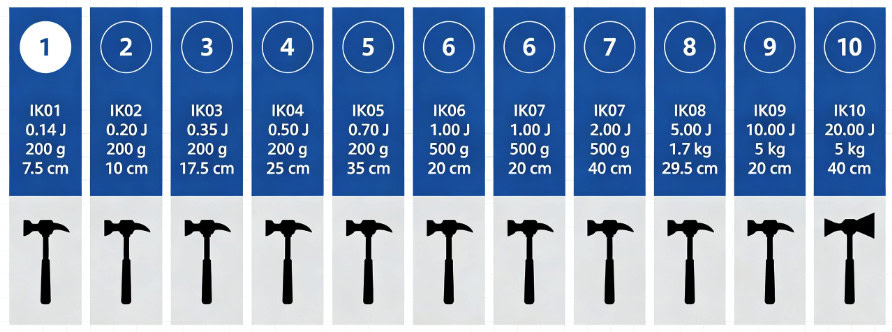
Here’s the complete scale as defined by IEC 62262:
| IK Code | Impact Energy (Joules) | Equivalent Test Impact |
|---|---|---|
| IK00 | Not protected | No protection specified |
| IK01 | 0.14 J | 200 g dropped from 7.5 cm |
| IK02 | 0.20 J | 200 g dropped from 10 cm |
| IK03 | 0.35 J | 200 g dropped from 17.5 cm |
| IK04 | 0.50 J | 200 g dropped from 25 cm |
| IK05 | 0.70 J | 200 g dropped from 35 cm |
| IK06 | 1.00 J | 500 g dropped from 20 cm |
| IK07 | 2.00 J | 500 g dropped from 40 cm |
| IK08 | 5.00 J | 1.7 kg dropped from 29.5 cm |
| IK09 | 10.00 J | 5 kg dropped from 20 cm |
| IK10 | 20.00 J | 5 kg dropped from 40 cm |
Notice that the scale is not linear. Moving from IK08 (5 J) to IK10 (20 J) means a fourfold jump in energy, not a small upgrade. This is important because when someone suggests specifying “one level higher to be safe”, the cost and weight difference can be significant.
How IK Ratings Are Tested Per IEC 62262
An IK rating isn’t an estimate. It’s assigned only after the product passes a controlled impact test defined by IEC 62262. Knowing how the test works helps you judge whether a supplier’s claim is credible.
Three elements define the test:
The impact tool. Depending on the energy level, the lab uses a pendulum hammer, a spring-loaded hammer, or a free-fall hammer. Each is calibrated to deliver a precise, repeatable amount of energy.
The impact energy. The hammer delivers the exact joule value tied to the target IK code—5 J for IK08, 20 J for IK10, and so on. The energy comes from a defined mass dropped or swung through a set distance.
The impact points. The product is struck at its most vulnerable points, not just a flat, reinforced panel. After the impacts, the enclosure must still protect against electric shock and, where relevant, maintain its ingress protection.
The key takeaway: a genuine IK rating is backed by a test report, not just a printed number. If a datasheet states IK08 but no IEC 62262 report exists behind it, the rating is a claim—not verified performance.
IK11 and “IK10+”: Flagging Nonstandard Claims
You may occasionally see products marketed as IK11 or “IK10+.” Be cautious. Under IEC 62262, the scale stops at IK10 (20 J). There is no IK11 in the standard.
That doesn’t automatically mean the product is weak. A manufacturer may have tested it beyond 20 J for genuine high-impact applications. But because the label sits outside the standard, it is not self-explanatory and it needs supporting evidence.
If you see IK11 or IK10+ on a datasheet, ask two questions:
What impact energy (in joules) was actually applied?
Which lab tested it, and can you provide the report?
A defensible above-standard claim comes with numbers and a report. A marketing label without either is not something you can put in a spec or defend in an audit. When in doubt, specify IK10 plus a stated joule value. That gives you a number an inspector can verify.
IK Rating vs IP Rating: How They Work Together
IK and IP ratings commonly appear together on product datasheets. It is easy to infer that strong performance in one rating translates to robust overall protection. However, the two metrics address separate environmental risks, and careful matching is needed to align with site requirements.
What IP Rating Means
IP (Ingress Protection) rating, defined by IEC 60529, measures how well an enclosure resists solid objects and liquids—dust, debris, and water.
An IP rating uses two digits. The first digit (0–6) rates protection against solid particles, from large objects down to fine dust. The second digit (0–9) rates protection against water, from light dripping to full submersion.
For example, IP66 means the product is dust-tight and protected against powerful water jets from any direction. That’s a sealing performance, not an impact performance.
IK vs IP Side-by-Side
IK and IP ratings answer two completely different questions. Here’s how they compare:
| Aspect | IP Rating | IK Rating |
|---|---|---|
| Standard | IEC 60529 | IEC 62262 |
| Protects against | Dust and water ingress | Mechanical impact |
| Format | Two digits (e.g., IP66) | Two digits after “IK” (e.g., IK08) |
| First element | Solid particle protection (0–6) | Not applicable |
| Second element | Water protection (0–9) | Impact energy level (00–10) |
| Typical concern | Sealing, weatherproofing | Vandalism, collision, falling debris |
The key takeaway: a high IP rating says nothing about impact resistance. An IP68 fixture delivers full water sealing, but it may crack from a moderate knock with a low IK rating. The two ratings require separate evaluation.
Common IP/IK Combinations for Outdoor and Industrial Use
In practice, most outdoor and industrial specifications call for both an IP and an IK rating, chosen based on the environment. Here are combinations commonly seen in the field:
| Application | Typical IP Rating | Typical IK Rating | Why |
|---|---|---|---|
| Outdoor area lighting | IP65–IP66 | IK07–IK08 | Weather exposure + moderate impact risk (debris, maintenance tools) |
| Parking structure lighting | IP65 | IK08–IK09 | Exposure to vehicles, carts, occasional vandalism |
| Tunnel and underpass lighting | IP66–IP67 | IK09–IK10 | Vibration, vehicle clearance risk, high public exposure |
| Industrial floodlights | IP66 | IK08–IK09 | Dust/washdown environments plus equipment movement |
| Sports and stadium lighting | IP65–IP66 | IK08–IK10 | Height mitigates some risk, but ball impact and weather remain factors |
| Indoor commercial fixtures | IP20–IP44 | IK03–IK06 | Low ingress and impact exposure indoors |
Two things to keep in mind when reading combinations like these. First, a higher IP number doesn’t require a higher IK number—they’re set independently based on what the site actually exposes the product to. Second, these are starting points, not universal rules. A tunnel with unusually high vehicle clearance risk may still justify IK10 even where IK09 is typical.
How to Select the Right IK Rating for Your Project
This is the section that turns a rating chart into a real specification. Rather than picking a number because it “sounds safe,” the goal is to match the IK rating to actual site conditions—risk, height, access, and budget. Here’s a practical framework for getting it right.
Step 1: Assess Site Risk Level and Exposure Frequency
Start by asking what’s actually likely to hit the fixture, and how often.
Risk isn’t just about location—it’s about activity. A warehouse aisle with forklift traffic carries different risk than a warehouse office. A schoolyard light pole faces different exposure than the same pole outside a corporate lobby.
Consider these risk drivers:
- Foot and vehicle traffic near the fixture
- Tools, equipment, or moving objects that pass close by
- History of vandalism or impact damage at the site or similar sites
- Weather-driven debris, such as branches or hail, in outdoor settings
The higher the frequency of potential contact, the more the IK rating matters—regardless of how remote any single impact seems.
Step 2: Factor in Mounting Height and Public Access
Height changes the equation significantly. A fixture mounted at 6 meters faces different risks than one at 2 meters, even in the same environment.
Two mounting factors to weigh:
Reach and accessibility. Fixtures within arm’s reach or reachable by common tools (broom handles, sports equipment, thrown objects) need higher IK protection than fixtures mounted well above typical reach.
Public access level. Unsupervised public spaces—parks, transit stations, parking structures—carry higher risk than access-controlled areas like fenced industrial yards or staff-only corridors, even at similar heights.
The combination matters more than either factor alone. A low fixture in a controlled area may need less protection than a moderately high fixture in an open public space.
Recommended IK Ratings by Environment
The table below reflects common industry practice—not a formal IEC requirement, since IEC 62262 defines the test method, not which rating applies to which use case. Treat this as a practical starting point to adjust based on your Step 1 and Step 2 assessment.
| Risk Level | IK Range | Typical Environments |
|---|---|---|
| Low risk (indoor) | IK02–IK05 | Offices, retail interiors, hotel corridors, residential indoor fixtures |
| Medium risk (commercial) | IK07–IK08 | Warehouses, loading docks, outdoor commercial lighting, covered parking |
| High risk (industrial/public) | IK09–IK10 | Open parking structures, tunnels, transit hubs, stadiums, unsupervised public plazas |
A few examples worth noting:
- Parking structures often specify IK08–IK09 due to vehicle proximity and low supervision.
- Tunnels frequently call for IK09–IK10 because of vibration, vehicle clearance risk, and difficult maintenance access.
- Transit hubs (stations, platforms) typically sit at IK09–IK10 given high foot traffic and unsupervised public access.
When to Specify a Higher IK Rating
Certain conditions justify moving up the scale even if the general environment category suggests a lower rating:
- Vandalism-prone areas, such as public restrooms, underpasses, or sites with documented impact history
- Fully exposed outdoor locations with no overhang, barrier, or protective housing
- Unsupervised public spaces where damage may go unnoticed or unreported for extended periods
- Sites with prior failure history—if fixtures have cracked or failed at a specific location before, that’s a strong signal to upgrade
In these cases, treat the site history and access pattern as more reliable guidance than the generic environment category.
Avoiding Over-Specification: Why Higher Isn’t Always Better
It’s tempting to default to IK10 “just to be safe,” but that instinct often wastes budget without adding real protection. The scale isn’t linear—jumping from IK08 to IK10 means a fourfold increase in impact energy, which typically means thicker materials, heavier housings, and a higher unit price.
Over-specifying is a common but avoidable cost driver. In our experience reviewing project specs, indoor commercial fixtures are sometimes bumped to IK08 or IK09 by default, even in spaces with no realistic impact exposure—a decision that can add 15–30% to fixture cost without any corresponding benefit.
Before specifying a high IK rating, check whether the site risk actually supports it, or whether the number was simply carried over from an unrelated project template.
In high-risk sites, that extra durability pays for itself by avoiding replacement and downtime costs. In low-risk, controlled indoor environments, the same spend adds no real value. The right question isn’t “what’s the highest IK rating available?” It’s “what’s the lowest IK rating that still covers this site’s realistic risk?”
FAQs
How is IK impact resistance actually tested in a lab?
Testing follows IEC 62262, which uses a spring-loaded hammer to strike the housing with a specific impact energy—measured in joules—corresponding to each IK level. The test is repeated at multiple points on the housing, and the sample passes only if it shows no cracks, deformation, or loss of protection after impact.
What should I do if a fixture gets damaged despite meeting its rated IK level?
An IK rating reduces the likelihood of damage under expected impact energy—it doesn’t guarantee immunity from every possible hit. If a fixture is damaged, check whether the impact exceeded the rated energy level for that IK class, and inspect for any internal exposure before returning it to service. Repeated damage at the same rating suggests the site may need a higher IK class than originally specified.
Can I retrofit a low-IK fixture with an external guard instead of replacing it?
Sometimes. Wire guards or polycarbonate shields can raise effective impact resistance for existing installations. However, added guards may affect light distribution and don’t carry the same certified IK rating as an integrated housing—verify with the manufacturer before relying on this as a long-term fix.
Do LED and traditional fixtures need different IK ratings?
The IK requirement itself depends on site risk, not lamp technology. However, LED fixtures often use thinner housings for heat dissipation, so it’s worth double-checking the certified IK rating rather than assuming it matches a traditional fixture of similar size.
Conclusion
Here’s the real test before any spec gets finalized: can the supplier hand over a test report, or just a datasheet? That single question separates a verified IK rating from a printed claim—and it’s the one buyers skip most often.
If you’re reviewing a spec, don’t just check the IK number. Confirm it matches the actual risk at that specific location, not the risk category it was templated from. A fixture inherited from a previous project’s spec sheet may be over-built for a low-traffic corridor or under-built for a loading dock that sees forklift traffic daily.
And if a fixture has already failed—cracked, let in moisture, exposed wiring—don’t just replace it at the same rating. That failure is data. It’s telling you the original spec didn’t match the site, and repeating the same number invites the same outcome.
Need IK Rating Lights You Can Verify, Not Just Print?
If your project needs a specific IK/IP combination, or you want to confirm the rating on a fixture you’re already sourcing, welcome to request a quote.