When it comes to bollard lights, one of the most common questions people ask is how far apart the should be placed. While there is no definitive answer, there are a few things to consider when making your decision.
In this post, we’ll take a look at some of the factors that can influence how far apart bollard lights should be spaced. Keep reading to learn more!
What are Bollard Lights?
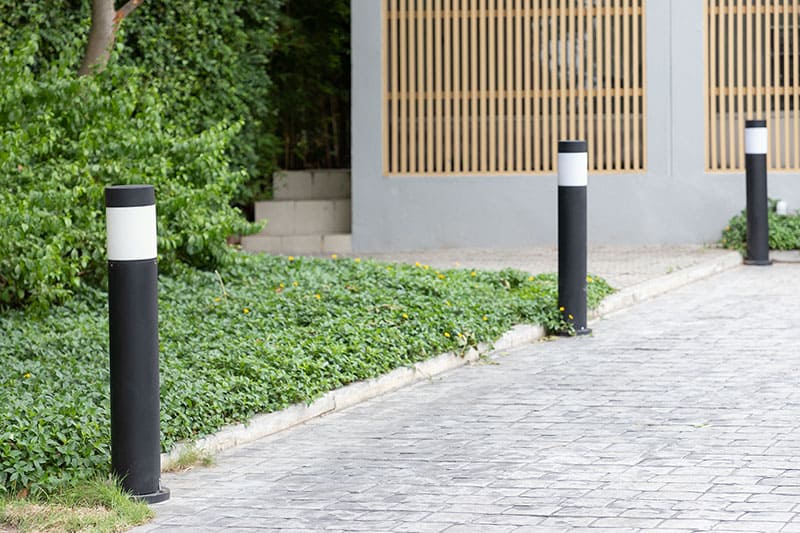
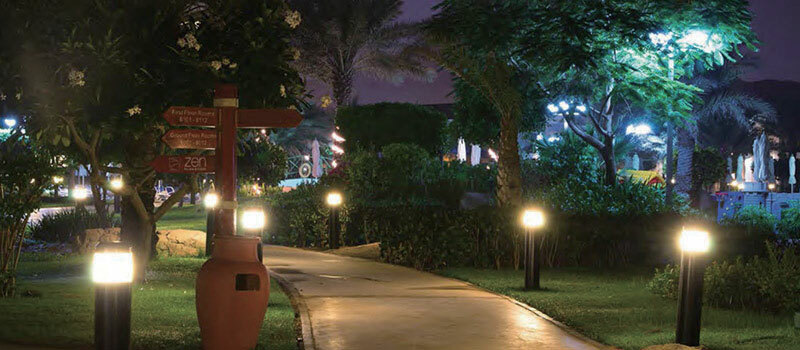
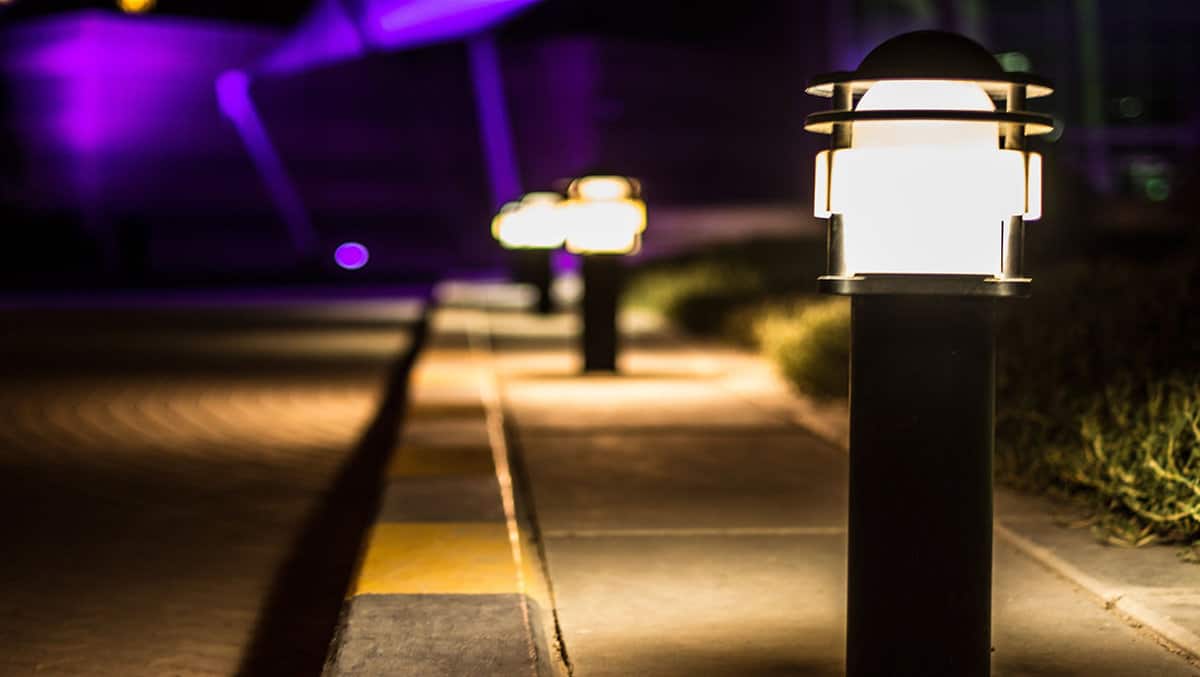
Bollard lights are outdoor fixtures mounted on short vertical posts, typically at least 1 foot tall. This low-mounted design places light close to the ground, making it ideal for illuminating sports areas, parking lots, small car parks, and residential pathways.
However, these fixtures can contribute to light pollution if you space or shield them poorly. To prevent this, aim the beam only where it’s needed by adjusting the angle and adding proper shielding.
Dark-sky-compliant bollard lights handle this for you. With built-in shielding, they direct light efficiently across your space while keeping stray light out of the night sky.
Bollard Spacing
The spacing or placement of bollard lights depends on several factors, including personal preference, bollard optics, ambient light levels, and site requirements. Lighting requirements typically vary depending on the application of the bollard lights.
How Do Bollard Optics Affect Bollard Light Spacing
When designing a bollard lighting exterior, you must select the right optics for the proper layout.
This will allow you to optimize bollard spacing and minimize spill light.
Here are three popular bollard optics and how they affect spacing:
Standard Reflector
Standard reflectors are a popular, safety-focused choice for walkways and driveways. They hide the light source and cast an even, downward beam.
Here’s how that shapes spacing: because the reflector spreads light outward as it pushes it down, each fixture throws a relatively wide pool of light on the ground. A wider pool means neighboring fixtures don’t need to sit close together for their light to overlap.
Aluminum cone reflector LED bollards, for example, aim light straight down onto the path while spreading it across a broad area. That wide coverage is why the standard reflector allows the widest spacing of the three optics. You can place two fixtures up to 14 feet apart and still maintain at least 0.5 footcandle on the ground between them.
Type V Glass
Type V glass is the next popular choice of bollard lights for walkways and driveways. Bollard light fixtures with this technology diffuse the beam while providing broad light distribution.
The LED array is usually installed beneath the top of the fixture. The colorful, clear type V glass provides low glare. If light trespass is an issue, you can use an optional light shield to prevent the light from going where you don’t want it to.
This closer spacing comes down to how Type V distributes light. It spreads the beam evenly in all directions around the fixture rather than pushing it far outward, so each fixture covers a slightly smaller ground area than a standard reflector. Because the light reaches less distance, the fixtures need to sit closer together for their pools of light to overlap and keep the 0.5 footcandle level between them.
The ideal spacing requirement between two type V bollard lights to maintain a 0.5 footcandle is 9 feet or less.
Louvered LED Bollard Light Fixtures
Louvers have a classic look and incredible aesthetic value. These stylish LED lights suit lighting applications that need minimum light pollution.
Architectural grade round LED lights with louvers are perfect for commercial and pedestrian use. They provide not only excellent light distribution but also safety and visual comfort.
The louvers hold light down and close to the fixture, so it covers the smallest area of the three optics. You can effectively maintain a 0.5 footcandle between two louvered fixtures with 7 feet or less spacing.
Comparison Using a 15-Watt LED Array
A type V bollard light will distribute 1 footcandle over a 12-foot diameter. A louvered fixture will spread 1 foot-candle over a 4.5-foot diameter. A standard reflector bollard light will distribute 1 footcandle over a 7.5-foot diameter.
According to these figures from an access fixtures lighting specialist, you can maintain 1 footcandle with type V bollards by spacing 24 feet. The light distribution will feature dark spots if you place the bollards apart.
How Mounting Height Affects Spacing
Bollard lights are available in three main sizes, large, medium, and trim. Large LED bollard lights range in height from 39 to 47 inches, medium lamps range from 25 to 38 inches, and small ones range from 8 to 24 inches.
The ideal spacing between LED or HID bollard lights depends on the minimum light level. The darkest space between bollards must not be below the lowest illuminance level.
Bollard lights with a high mounting height of approximately 39 to 47 inches can push more light toward the sides. But will have a low illuminance level at the front. This means you can have wider spacing between taller bollards.
A bollard light with a lower mounting height produces less light towards the sides and bright light at the front. This, therefore, requires you to mount small LED bollard lights closer to each other to provide the appropriate light levels.
How Light Directions Affect Spacing
The bollard light direction does also affect spacing. There would be three main types of bollard lights if you considered advice of lighting – shielded, wide beam, and unshielded.
Shielded Bollard Lights
The reflectors on shielded fixtures direct the light to the ground. The light is contained in the front of the luminaire, with no side lighting. Shielded luminaires provide maximum glare control, appropriate light output, and superior visual comfort.
The spacing of these bollard lights has to be closer to produce functional light along the pathway.
Wide Beam Bollard Lights
These types of bollard lamps have wide light distribution. These lights are not as bright in the front as shielded lamps. But they produce a much wider illuminated area towards the sides. These fixtures are typically spaced far apart while maintaining minimum illuminance levels.
Unshielded Bollard Lights
As the name suggests, these bollard lamps don’t have any shielding. They are specifically designed to provide ambient light output. They are the perfect choice for vertical lighting, especially for facial recognition and landscape elements.
Access Fixtures Bollard Light Spacing
Access Fixtures is well-known for its production of high-performance outdoor lighting solutions. Here is a breakdown of the recommended spacing for some of their popular fixtures:
ARIE
This is a round-open-top luminaire that features a polycarbonate lens. The light is approximately 42 inches high and has a 19-watt rating. It is suitable for industrial parks, retail centers, and campuses. The ARIE light has a 16-foot illumination diameter or a lighting distribution of 8 feet away.
CLYD
The CLYD bollard light has a power rating of 19 watts. It comes with a round-flat-top design that is dark sky friendly. The light is roughly 34 inches high. It distributes 1 footcandle of light in a 12-foot diameter or 6 feet away.
CONA
The CONA LED bollard has a cone reflector and a round-flat-top design. It features 17 system watts that produce up to 1,510 lumens. It distributes 1 footcandle of light in 12-foot diameter and up to 6 feet away.
LUVO
This LED bollard light has a medium socket louvered round-flat-top design. It has a power rating of 17 system watts and is approximately 42 inches tall. Its design can distribute 1 footcandle of light up to 4 feet away. It reflects light to the ground, which is ideal for car parks and pedestrian use.
How to Install Bollard Lights
Once you have determined the appropriate spacing requirements for your outdoor bollard lights, you can proceed with the installation process.
Any installation of LED bollard lights must comply with the local building codes. So, you may have to employ the services of a professional like an access fixtures lighting specialist.
But, understanding the installation process of bollard lighting luminaires can help you make an informed decision about bollard light spacing and purchase.
Here is our step-by-step breakdown:
Step 1: Dig a Deep Hole
You have to check with your local building codes for the correct depth. The hole must be deep enough to hold the cement and fixture firmly.
Step 2: Place a Tube and Run the Appropriate Wiring
Mount a tube into the hole, ensuring that the top of the tube is above the surface. Use rocks to stabilize the tube and keep it in an upright position.
It is essential to run the appropriate wiring for the installation for safe burial and longevity. It would help if you had enough length for a stress-free connection to the socket or ballast.
Run the wire through the center of the tube and set up the anchor bolts. Then fill the tube with vast quantities of cement and sink the anchor bolts into the wet cement.
Step 3: Mount the Plate and Wire the Socket
Insert the mounting plate into the bolts and bolt it down. Then wire the LED driver, ballast, or socket to the wiring. Mount the bollard lights, connect the wiring to a power source and turn on the light.
Frequently Asked Questions About Bollard Light Spacing
How deep should bollard lights be spaced from the edge of a walkway?
Bollard lights are usually set back 1 to 2 feet from the edge of a walkway or path. This keeps fixtures clear of foot traffic, snow removal, and maintenance equipment while still lighting the walking surface effectively. The exact setback depends on your path width, landscaping, and whether the bollard uses a shielded or wide-beam optic.
Should bollard lights be placed on one side or both sides of a path?
For narrow walkways under 6 feet wide, single-side placement is usually enough. Wider paths, driveways, or two-way pedestrian areas often need bollards on both sides, either aligned or staggered, to avoid dark zones. Staggered layouts can also let you increase spacing while keeping the light coverage even.
Does surrounding lighting affect how far apart bollards should be?
Yes, nearby streetlights, building fixtures, or landscape lighting can supplement your bollards and reduce how many you need. If an area already receives spill light, you can often widen the spacing without creating dark spots. It’s best to evaluate existing light sources on-site before finalizing your layout.
Can I get help planning bollard spacing for a large or complex project?
Yes, large or irregular sites often need a proper photometric layout rather than a fixed spacing rule. A lighting plan maps out fixture placement, optics, and wattage to hit your target light levels while avoiding gaps or overbuying. At RC Lighting, our team can create a custom layout and recommend the right bollards for your project. Reach out for a quote to get started.
Conclusion
Bollard lighting is one of the best outdoor lighting technologies. But to make the most out of it, you must correct the spacing or placement of bollard lights.
This guide has covered all the critical factors that affect bollard light spacing and site planning. In addition to this guide, we recommend consulting a bollard lighting specialist for further assistance.
RC Lighting is one of the leading outdoor lighting manufacturers in China. Contact us if you have questions about bollard lights or other outdoor lighting fixtures.