
Safety is paramount when it comes to lighting solutions for your home or business. But with so many lighting fixtures from various unknown manufacturers on the market, choosing the right one has become a real challenge. To resolve the uncertainty in your buying decisions, you can look for ETL-listed lighting products. But What does ETL even mean?
In this article, we delve into ETL listing, its benefit to modern lighting design, and its importance in meeting safety regulations and compliances.
What is ETL Listed Lighting?
ETL is a lighting safety testing and certification mark monitored by Intertek, an international quality assurance provider. The ETL safety certification process involves various tests assessing a light fixture’s electrical safety and reliability.
The exact testing procedures are fine-tuned to the luminaire design—LED lights, for example, are held to additional energy-efficiency and driver requirements that traditional incandescent or halogen lamps aren’t. Consumers can check the comprehensive ETL listing at the Intertek website, which shows all certified products bearing the ETL mark.
ETL-listed lighting products comply with various national and international safety standards, such as those from the National Fire Protection Association (NFPA). However, the ETL marking is primarily relegated to the North American market.
It’s worth understanding that ETL itself isn’t a standard—it’s a mark confirming a product has been tested against recognized industry standards. For lighting products, the specific standards behind an ETL Listed mark typically include:
- UL 1598 – the general safety standard for luminaires and fixtures.
- UL 8750 – the safety standard covering LED components and drivers used in lighting.
- NFPA 70 (National Electrical Code / NEC) – governing how fixtures are safely wired and installed.
- FCC Part 15 – limiting electromagnetic interference from a fixture’s electronic components.
In other words, the exact standards applied depend on the type of luminaire. An LED panel and a traditional incandescent fixture may share some baseline safety requirements, but the LED product will also be evaluated against LED-specific criteria. This is why the ETL mark on one product isn’t tested against an identical checklist as another—the standards are matched to the technology inside the fixture.
You can learn more about the ETL certification process and Intertek Testing Laboratories here.
Origins of ETL
The origins of ETL date back to 1896, when a young Thomas Edison established the Lamp Testing Bureau. By 1904, the lab was renamed Electrical Testing Laboratories and served as an independent lighting testing facility. Eventually, the lab became part of Intertek, and its name was shortened to just “ETL.”
What is UL Certification?
UL Enterprises (formerly Underwriters Laboratories) is another well-known name in equipment safety testing based out of the US. The massive company is made up of three organizations.
- UL Research Industries – Responsible for researching new testing techniques and technologies
- UL Standards & Engagement – Responsible for designing safety standards for various electronic components and devices.
- UL Solutions – Responsible for testing products and issuing certifications.
UL certification division is a result of years of research and development investment by its partner company. While ETL listed and UL certification share some similarities, key differences set the two apart.
ETL Certification vs UL Certification
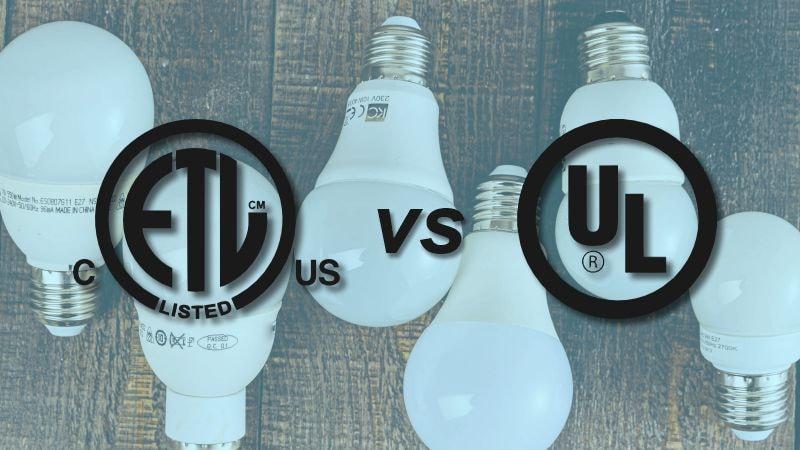
Electrical safety has always been a major concern for governments, private businesses, and the general public. So, it should come as no surprise that several companies across the globe provide safety testing and certification of electrical components and devices.
ETL-listed and UL-listed are two of the most popular lighting certifications in the North American market. Here are some key differences between the two organizations and their certification standards.
1. OSHA Recognition
The Occupational Safety and Health Administration (OSHA) is a regulatory body of the United States Department of Labor. It sets standards and guidelines for businesses to ensure worker safety.
OSHA lists Nationally Recognized Testing Laboratories (NRTLs) that recognize Intertek and UL Enterprises as reputable testing and certification bodies.
This is an important point, because on the question of OSHA recognition there is no difference between ETL and UL. A product carrying an ETL Listed mark and one carrying a UL Listed mark are equally accepted for U.S. workplace safety compliance, so any real differences between the two lie elsewhere and not in their regulatory standing.
2. Testing Standards
The main difference between these two certification companies is their approach to safety standards. UL is a much larger company than ETL and develops its own testing standards. In contrast, Intertek uses established standards, including UL ones.
3. Applications & Industries
ETL tests products related to lighting fixtures. Meanwhile, UL covers a much broader category of electrical devices. UL Solutions provides certifications in over 200 product categories, including 19 light design certifications.
It should be noted that ETL’s parent company, Intertek, also provides a diverse range of certification services. However, the ETL-listed mark is only limited to lighting fixtures.
4. Certification Period
Due to the more streamlined process, getting an ETL certification usually takes less time. By comparison, UL certification is a more time-consuming process. Part of the delay can be attributed to the more complicated operations at UL Solutions.
5. Brand Recognition
ETL-listed and UL-certified markings hold equal value in the United States. However, the global market is a different story. UL-recognized products are well-known by international consumers and help build brand trust.
ETL-listed products are tested to high standards like UL and are becoming popular worldwide. They may even catch up to UL certifications in the next few years.
Comparing ETL and UL Listed Lighting Products
| Attributes | ETL Lighting | UL Lighting |
|---|---|---|
| OSHA Recognition | Yes | Yes |
| Testing Standards | Using Existing Standards | Creates its Own Standards |
| Applications & Industries | Only Applicable to Lighting Products | Applicable to All types of Electrical Devices |
| Certification Period | Short | Long |
| Brand Recognition | Limited Outside of NA | Well Recognized Worldwide |
6 Benefits of ETL-Listed Lighting Products

ETL-certified products assure consumers of quality, reliability, performance, and safety. The certification helps businesses establish trust with customers and enables expansion in the global market.
Here is a list of the top benefits of ETL-listed lighting products.
1. Ensuring Public Safety
By far, the biggest benefit of ETL-listed (and UL-listed) products is their guaranteed safety. When consumers buy a light fixture with an ETL marking on the side, they know that it has been thoroughly tested and will not shock, malfunction, or start a fire.
Businesses upgrading their lighting design will also benefit from using ETL-certified products. Their workspace will be safer for employees and guests, and safety inspections will process smoothly.
2. Lighting Quality Assurance
Lighting products sold in the United States cover a wide field. From modern controlled LED lights to old-school warm halogens, every light fixture has to pass a safety check.
An ETL or UL certified fixture gives customers more than a promise of reliable operation. The certification confirms that the product has been tested for electrical safety, fire and shock hazards, and construction quality, and that its materials and components meet recognized standards.
It also verifies that the manufacturing process is monitored through regular factory inspections, so buyers can trust that the fixture they receive matches the sample that was originally tested.
In short, the mark assures customers that the product will perform as advertised, stay safe under normal use, and run for a long time without a hitch.
3. Energy Efficiency Certification
An often overlooked benefit of ETL-listed products is their compliance with energy efficiency standards. A single energy-efficient light bulb will not make much of a difference in your electricity bill. Businesses and commercial buildings save money over time by using fewer light fixtures and reducing energy consumption.
4. Meeting Legal Compliance
Countries across the globe require businesses to meet certain safety regulations and energy efficiency criteria. You have covered most of the lighting requirements by using ETL or similar certified lighting products.
Learn more about lighting requirements and legal compliances here.
5. Establishing Brand Credibility
Brand recognition and credibility are the keys to long-term success in any industry. Using top-notch light fixtures approved by a well-known testing lab can make your business stand out from competitors.
The hospitality industry, in particular, runs on brand credibility and consumer trust. ETL-listed and UL-certified products show guests they are in a safe and welcoming place.
6. International Recognition
Businesses looking to expand internationally will first need to establish credibility and trust. An ETL or UL certification can go a long way toward establishing a brand.
Buyers will always be hesitant when buying from an unknown new brand. However, suppose they know these products comply with the same safety standards they recognize. In that case, brand adoption will be a lot easier.

Other Certification Standards
Beyond ETL and UL, several other agencies and regulatory bodies provide lighting safety certifications worth knowing about.
Canadian Standards Association (CSA)
The US’s neighbor from the cold north has its own lighting certification standard, CSA International. Canada’s regulations overlap greatly with those of the US, and the CSA certification primarily follows standards set by the ANSI, UL, and NSF.
ETL and UL certificates are valid throughout North America, including Canada. The CSA certification is mostly for businesses based in Canada.
Conformité Européenne (CE)
The European Union has its own safety standards, carefully designed to align with all 27 member nations. CE sets more detailed and stricter standards for all electronic standards. Despite leaving the EU, the UK still follows many of the same standards.
North American companies looking to expand to the EU should consider CE certification.
What Types of Lighting Products Can Be ETL Certified?
One common question buyers ask is whether their specific fixture qualifies for ETL certification. The short answer is that almost any lighting product intended for the North American market can be ETL Listed, as long as it is tested against the standards that apply to its design and technology.
Because the testing criteria are matched to each luminaire, the certification covers a broad range of categories. Here is how the main product types typically fit in.
Residential and Indoor Fixtures
These include ceiling lights, recessed downlights, track lighting, and wall sconces. The evaluation focuses on wiring safety, insulation, heat management, and how the fixture is installed in a home environment.
Outdoor and Landscape Lighting
Floodlights, wall packs, garden fixtures, and streetlights fall into this group. Because these products face rain, dust, and temperature swings, they are also tested for enclosure protection and their IP rating, so buyers should confirm the fixture is certified specifically for wet or damp locations rather than dry indoor use only.
LED and Smart Lighting
LED downlights, smart bulbs, sensor-based lights, and connected systems require extra attention, because they contain drivers and electronic controls. In addition to basic safety, these products are checked against LED-specific standards such as UL 8750, and connected devices may also need FCC Part 15 compliance to limit electromagnetic interference.
Commercial and Industrial Lighting
High bay lights, vapor-tight fixtures, and emergency lighting serve demanding environments, so they often carry additional requirements for durability, thermal performance, and reliable operation during power loss. Emergency and exit lighting in particular may need to meet backup-power and runtime criteria.
What Usually Cannot Be Covered by an ETL Lighting Mark
It is worth knowing the limits as well. The ETL Listed lighting mark applies to complete, finished fixtures and their integrated components, and not to loose parts sold on their own or to custom modifications made after certification. If you alter a certified fixture, replace its driver, or rewire it in a way the manufacturer did not test, the original ETL mark may no longer apply, so any significant change should be verified before installation.
Where ETL-Certified Lighting Is Actually Required
Certification is not just a label on a spec sheet. In many projects, using ETL-Listed lighting is what keeps the installation code-compliant, insurable, and approved during inspection. Below are the settings where buyers most often need it, and what to watch for in each.
Commercial and Public Buildings
Offices, hospitals, schools, and retail spaces almost always require certified fixtures, because local electrical inspectors check for a recognized safety mark before signing off on the job. In healthcare and education projects especially, an uncertified fixture can stall the entire inspection.
For these buildings, confirm that the certification covers the exact fixture model being installed, not just a similar product line. Inspectors match the mark to the label on the unit, so a certificate that references a different SKU can be rejected.
Hospitality and High-Traffic Environments
Hotels, resorts, and restaurants run their lighting for long hours in busy areas, which raises both the safety stakes and the failure risk. Certified fixtures matter here because insurers and property owners want documented proof that the lighting meets recognized safety standards.
If the project includes outdoor pool lighting, wet bar areas, or exterior signage, verify that those fixtures carry a wet- or damp-location listing, not just a general indoor rating. This is a common gap in mixed-use hospitality projects.
Residential Projects
Homes may not always face the same inspection scrutiny as commercial sites, but certified lighting still matters in kitchens, bathrooms, and outdoor areas where moisture and heat are present. For new construction and remodels, many jurisdictions require certified fixtures to pass the final electrical inspection.
Homeowners and contractors should pay attention to location ratings here too, since a fixture rated for a dry living room is not suitable for a shower enclosure or a covered porch.
Industrial and Specialty Facilities
Warehouses, manufacturing plants, and food-processing facilities often need fixtures that meet additional requirements beyond basic safety, such as vapor-tight or high-temperature ratings. In these environments, ETL certification is frequently paired with specific IP ratings and, in some cases, hazardous-location listings.
If you are sourcing for one of these sites, clarify the environmental conditions early, because the wrong rating can mean re-purchasing the entire lot after it fails on-site.
Frequently Asked Questions
How can I verify that a light fixture is genuinely ETL Listed?
Don’t rely on the printed mark alone, since it can be copied or misapplied. The most reliable method is to search Intertek’s official online directory using the manufacturer’s name, the product model number, or the control number shown on the fixture’s label. If the exact model appears in the listing, the certification is legitimate. If you can’t find it, ask the supplier for the certification document and confirm that the listed model number matches the product you are actually buying, not a similar item in the same series.
What is the difference between “ETL Listed” and “ETL Recognized”?
The two marks apply to different things, and buyers often confuse them. ETL Listed covers a complete, finished product that is ready to be sold and installed as-is, such as a full LED downlight. ETL Recognized applies to a component or sub-assembly, like an LED driver or a module, that is meant to be built into a larger product rather than used on its own. If you are purchasing finished fixtures for a project, you want the ETL Listed mark. A Recognized component alone is not enough to satisfy an installation inspection.
What do the letters “us” or “c” next to the ETL mark mean?
These small letters indicate which markets the product is certified for. An ETL mark with “us” means the product meets United States safety standards, while a “c” indicates compliance with Canadian standards. When you see “c-us” together, the fixture is certified for both the U.S. and Canada. This matters for procurement, because a fixture marked only for the U.S. may not automatically satisfy Canadian requirements, so buyers shipping across the border should confirm the correct market designation before ordering.
How long does ETL certification take, and does it need renewal?
Initial ETL certification typically takes a few weeks to a couple of months, depending on the product’s complexity and how quickly the manufacturer supplies samples and documentation. The certification itself does not “expire” on a fixed date, but it is maintained through periodic factory inspections that confirm ongoing production still matches the tested sample. If a manufacturer changes components, materials, or the product design without re-verification, the existing mark may no longer be valid, so buyers should always confirm current certification status for the specific batch they are purchasing.
Conclusion
ELT-listed lighting refers to fixtures tested and certified by Intertek testing company. Consumers buying lighting products bearing the ETL mark can rest assured that they are getting a safe, reliable, and efficient, high-quality luminaire.
An ETL or UL-recognized fixture is essentially the same for consumers, as both standards promise high-quality products. However, a UL listing holds more value for business owners and OEM lighting manufacturers as it has better international recognition.
Get Certified Lighting Products from RC Lighting!
RC Lighting is an established LED lighting manufacturer and service provider. We have a long track record of selling high-quality LED fixtures to a diverse global clientele. Our Indoor Lighting and Outdoor Lighting products comply with all national and international standards, including ISO9001, CE, RoHS, and UL/ETL.
For businesses looking for a more hands-on approach to their lighting design, RC Lighting offers OEM services. Take advantage of our expert design engineers, rapid prototyping, precision manufacturing, and packaging solutions.
Get the highest quality ETL lighting today. Contact us Now!