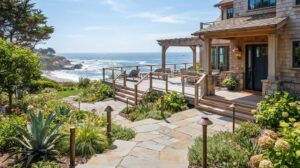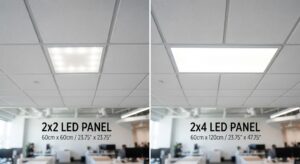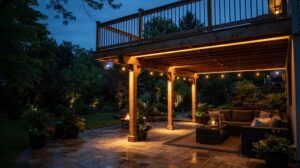
Good exterior lighting does more than look nice. It keeps you safe walking up the driveway. It highlights your home’s best features. And in 2026, it does all this while staying energy efficient and easy to control from your phone.
Homeowners want layered lighting systems now. Not just random fixtures scattered around the yard. A real plan that balances safety, style, and smart features.
Outdoor lighting stays one of the most popular home upgrades every year. In 2026, the trends point toward specific color temperatures, tougher fixture materials, and smarter automation. This guide covers all of it. You’ll learn how to layer your lighting design. You’ll see where modern homes place their fixtures. And you’ll get practical advice on installation, maintenance, and return on investment.
The Approach to Layered Outdoor Lighting
Why Layered Lighting Works
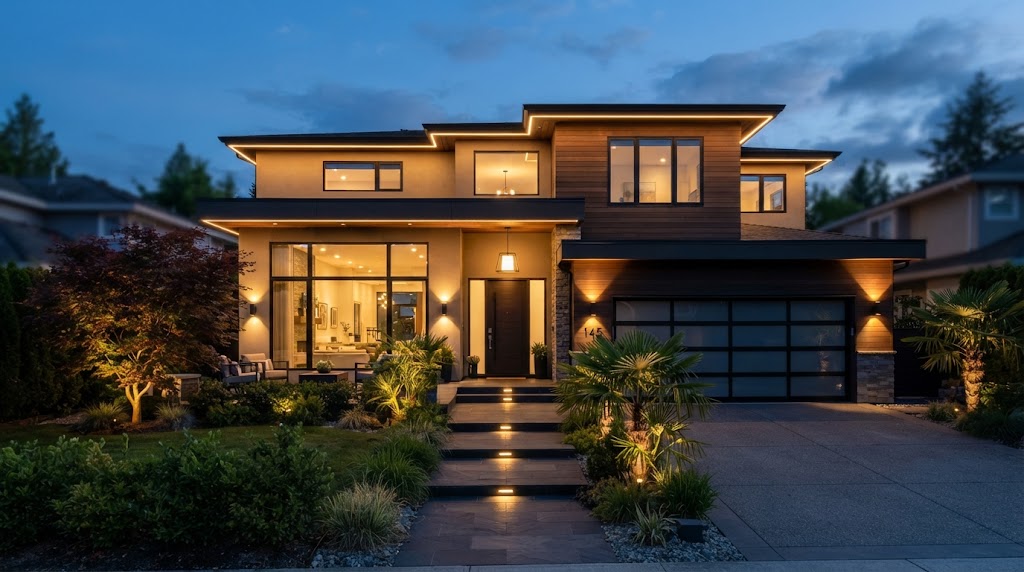
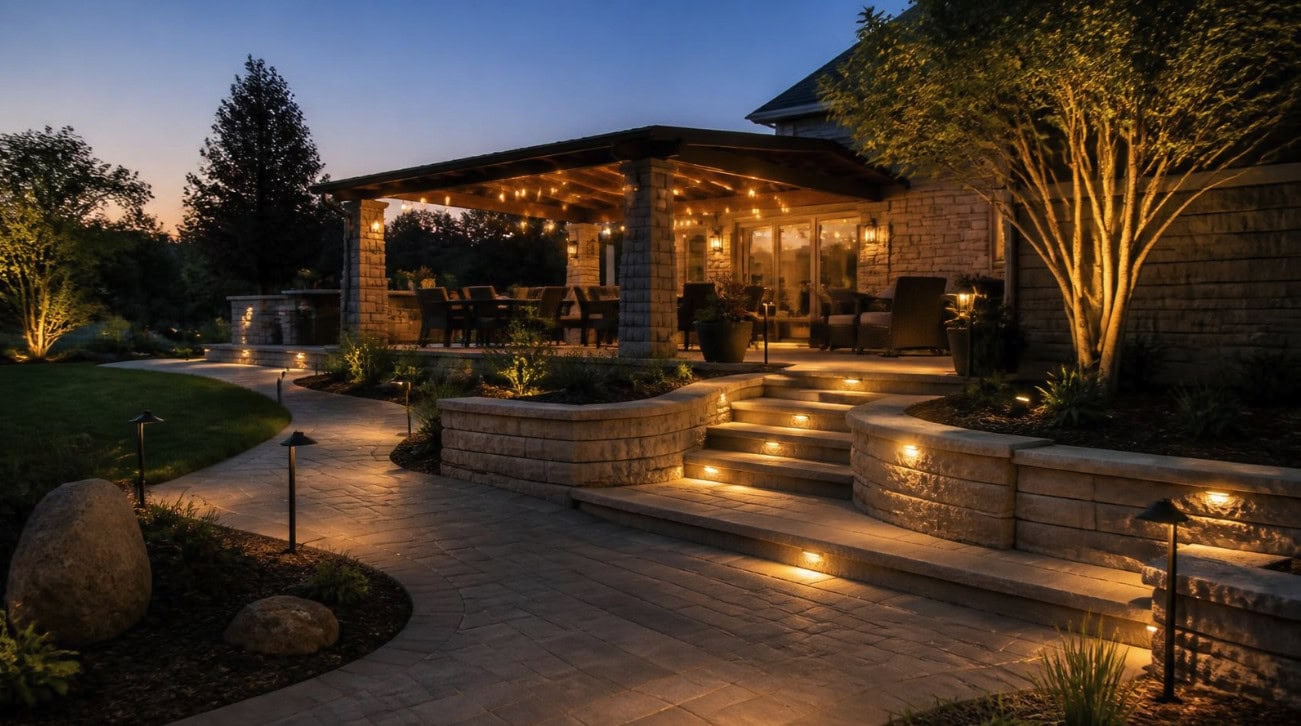
Layered lighting uses three types of light together. Each one does a different job.
- Ambient lighting lights up your whole outdoor living space. Think patios and seating areas.
- Task lighting focuses on function. It lights walkways, steps, and driveways so you can see where you’re walking.
- Accent lighting draws attention to specific features. Maybe it’s a tree, a stone wall, or your home’s facade.
These three layers work as a team. Use them together and your yard feels balanced. Skip one layer and you’ll end up with dark spots or areas that feel too harsh. You also gain more control this way. You can dim the ambient lights for a quiet evening. You can brighten the task lights during a party. Each layer adjusts on its own.
2026 Layering and Color Temperature Trends
Homeowners in 2026 are mixing warm and cool light within the same system. They don’t stick to one color temperature anymore.
Warm white light, around 2700K to 3000K, still dominates ambient and accent lighting. It gives your yard a cozy, welcoming feel.
Cooler light, around 4000K to 5000K, shows up more in task lighting. You’ll see it near driveways and entryways. Cooler tones improve visibility exactly where you need it most.
Mixing color temperatures takes planning. Get it wrong and your lighting looks disjointed instead of intentional.
Map out each zone’s purpose first. Then pick your color temperatures based on what that zone needs to do. In actual project implementation, we have found that maintaining the same or very similar color temperatures in visually continuous spaces creates a more natural and comfortable visual effect.
Where Modern Homes Are Placing Outdoor Lighting
Pathway, Step, and Driveway Lighting for Safer Navigation
Safety comes first when you plan outdoor lighting. Dark steps and uneven walkways cause falls. Good lighting fixes that problem fast.
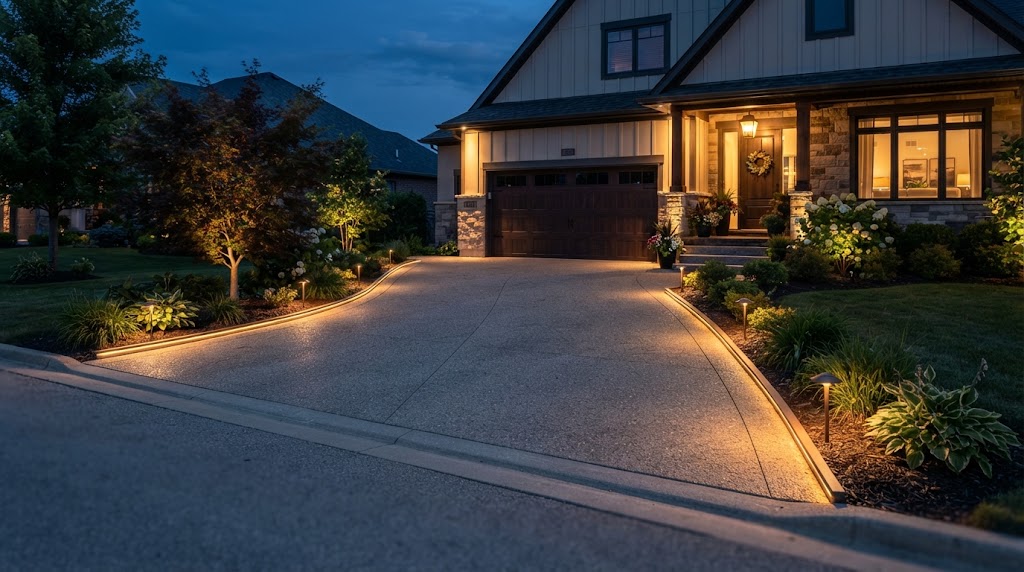
Path lights work best when spaced evenly along walkways. Aim for one fixture every 6 to 8 feet. This spacing lights your way without creating a runway effect.
Steps need extra attention. Install lights at each riser or along the edge of each step. This helps you judge depth, especially at night. It also helps guests who don’t know your property as well as you do.
Driveways benefit from lighting along both edges. This guides cars in safely and marks the boundary clearly. Many homeowners in 2026 pair driveway lights with motion sensors: The lights stay dim until a car or person approaches, then brighten automatically.
Architectural and Landscape Focal-Point Lighting
Your home has features worth showing off. Good lighting makes them pop after dark.
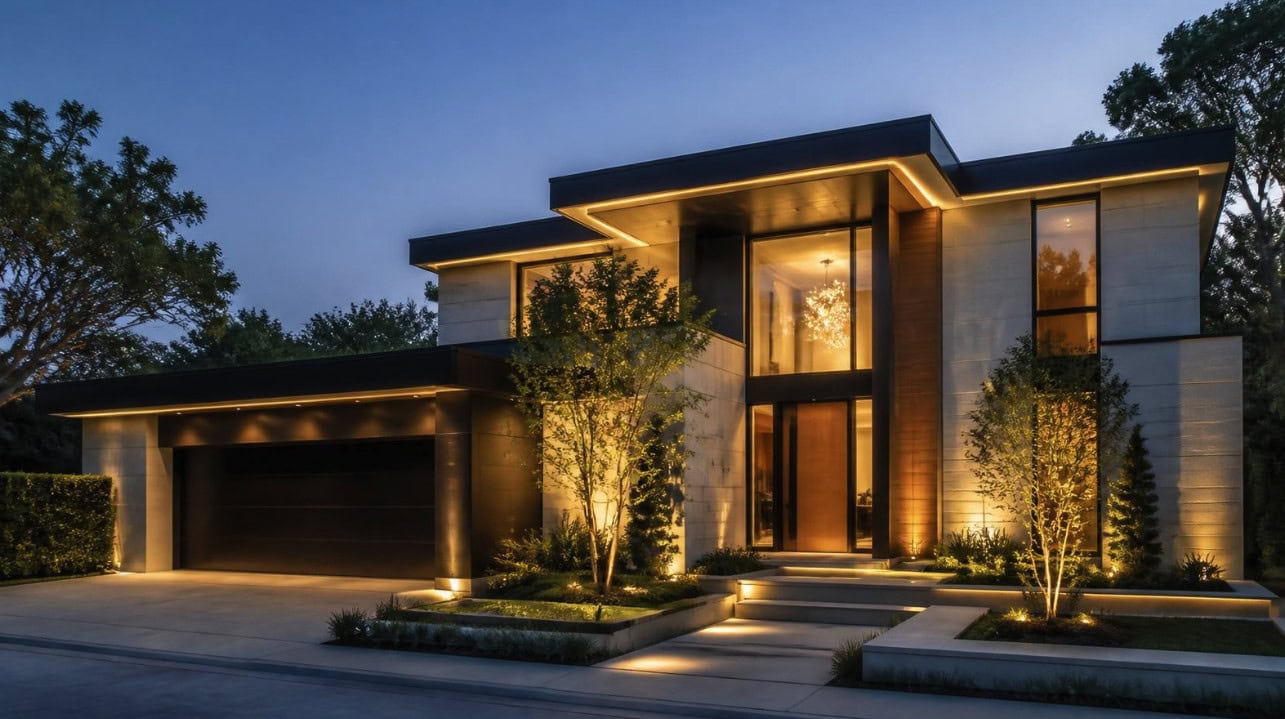
Wall washing spreads soft light across a flat surface, like a stone or brick facade. It creates a dramatic backdrop without harsh shadows.
Uplighting works well on trees, columns, and textured walls. Place the fixture at the base and angle it upward. This technique adds depth and makes your landscaping look intentional, not accidental.
Focal-point lighting targets one specific feature, maybe a fountain, a sculpture, or a specimen tree. Keep it simple. One well-placed light often works better than several scattered ones.
Precision matters here. A slightly wrong angle can wash out a feature instead of highlighting it. Take time to test angles before you finalize fixture placement.
Year-Round Ambient Lighting for Patios and Outdoor Living
Outdoor living spaces deserve lighting that shines through every season and occasion—not just summer barbecues.
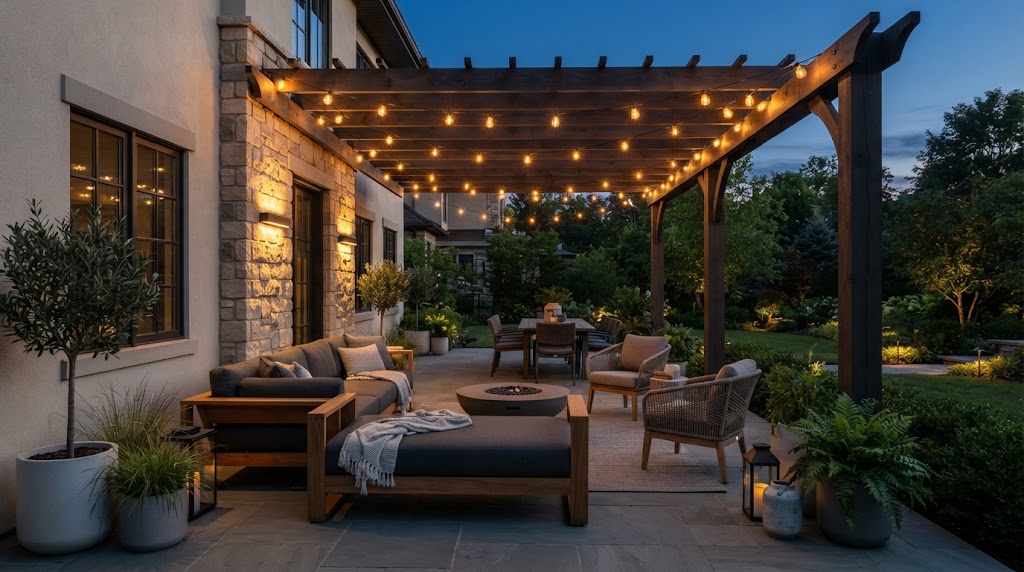
String lights stay a patio and pergola favorite, casting warm, welcoming glow that never feels stiff or overly formal. In 2026, more homeowners opt for dimmable LED string lights. You can crank up brightness for birthday gatherings or holiday dinners, then dim it down for quiet weeknight evenings. These lights easily transition from autumn harvest parties to winter holiday get-togethers, and spring garden brunches alike.
Built-in outdoor wall light and low-profile wall sconces can deliver a streamlined aesthetic. They blend seamlessly into your home’s architecture rather than drawing extra attention, offering steady ambient illumination all year long. They work beautifully as subtle backdrop lighting for Halloween gatherings, Fourth of July celebrations, or casual spring cookouts.
Fire features also pull double duty as ambient light sources. Fire pits and outdoor fireplaces bring both radiant heat and gentle light. Pair them with soft accent lighting nearby to craft a cohesive evening setting, perfect for cozy winter holiday nights or fall bonfire-style gatherings.
No matter which lighting solution you pick, design with year-round use in mind. Choose fixtures rated for outdoor exposure to stand strong against rain, snow and shifting temperatures. Reliable weatherproof lighting ensures your patio stays ready for impromptu dinners, seasonal festivals and everyday relaxation, no matter the month.
Choosing the Right Fixture and Power System
Low-Voltage vs. Line-Voltage Systems
Your power system choice affects safety, cost, and flexibility. This decision matters more than most homeowners realize upfront.
Low-voltage systems run on 12 volts, stepped down through a transformer. They’re safer to install yourself since the risk of shock is minimal. They also cost less upfront and use less energy over time.
Line-voltage systems run on standard household power, 120 volts. They handle brighter, more powerful fixtures. But they need a licensed electrician for installation, and local codes often require it by law.
Most residential landscapes in 2026 still favor low-voltage systems. They’re flexible enough for path lights, accent lights, and most ambient fixtures. Line-voltage makes more sense for larger properties or fixtures that need serious brightness, like security floodlights covering a wide area.
Material and Durability Considerations for 2026
Outdoor fixtures face real wear. Rain, sun, freezing temperatures, and humidity all take a toll over time.
Look for fixtures with an IP65 rating or higher. This rating means the fixture resists dust and water jets, which matters if you live somewhere with heavy rain or snow.
Material matters too. Brass and stainless steel resist corrosion better than aluminum, especially near coastal areas with salt air. Powder-coated finishes also add a layer of protection against rust and fading.
In 2026, more manufacturers offer fixtures with replaceable LED modules. This means you don’t have to throw out the entire fixture when the bulb dies. You just swap the module, which saves money and reduces waste over the fixture’s lifespan.
Smart Controls and Security Trends for 2026 Properties
App-Based and Voice-Controlled Lighting Systems
Smart lighting isn’t a luxury add-on anymore. It’s becoming a standard expectation for new landscape lighting installations in 2026.
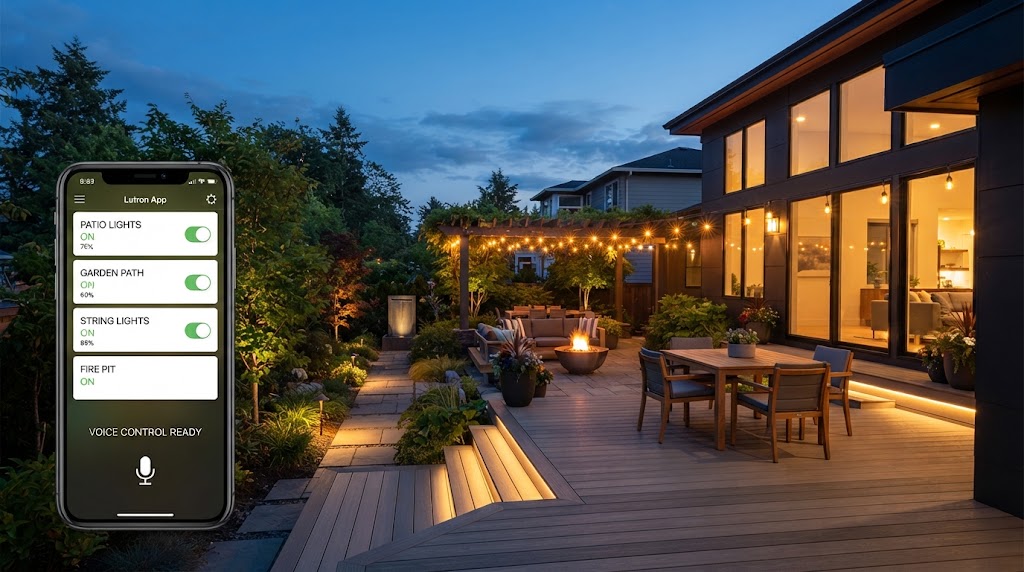
App-based systems let you control brightness, color temperature, and scheduling from your phone. You can set your pathway lighting to turn on at sunset automatically, no manual switching required.
Voice control adds another layer of convenience. Many systems now integrate with Alexa or Google Home. You can dim patio lights or turn on security floodlights just by speaking.
Scheduling features help with both convenience and energy savings. You set your ambient lights to dim after 11 PM, or driveway lights to brighten only when someone’s actually approaching, to elevate your outdoor spaces.
Motion-Sensor and Security-Focused Lighting
Security remains a top reason homeowners upgrade their outdoor lighting. Motion sensors add both safety and energy efficiency.
Motion-activated floodlights deter unwanted visitors. They also save energy since the lights only run at full brightness when triggered, not all night long.
Dusk-to-dawn sensors work differently. They keep a baseline level of light on throughout the night, then boost brightness when motion is detected. This combination gives you visibility and security without keeping every fixture at full power constantly.
Placement matters for security lighting. Cover entry points first, doors, garages, and any blind spots around the property. Then extend coverage to secondary areas, like side yards or detached structures.
Installation, ROI, and Maintenance Best Practices
Wiring and Voltage Drop Considerations for Modern Systems
A 20-watt fixture placed 80 feet from a 12V transformer on standard 12-gauge wire can lose enough voltage along the way to drop brightness by 20% or more. Homeowners often assume the bulb is failing when the real problem is wire sizing.
Here’s the rule of thumb most lighting manufacturers publish: 12-gauge wire handles runs up to roughly 100 feet at loads under 200 watts before voltage drop becomes visible. Push past that distance or load, and fixtures at the end of the run visibly dim compared to ones near the transformer. Switching to 10-gauge wire extends the usable range to roughly 150–200 feet before the same drop-off occurs.
If you notice path lights getting progressively dimmer the further they sit from the transformer, wire gauge is almost always the cause, not failing bulbs. Swapping bulbs won’t fix it. Re-running the circuit with heavier gauge wire, or splitting the run into two shorter circuits, will.
Multi-tap transformers give you another option. Most units offer taps at 12V, 13V, 14V, and 15V. Installers use the higher taps to push more voltage down long runs, compensating for the drop before it reaches the fixture. A 100-foot run might use the 13V tap, while a 150-foot run on the same transformer might need the 14V or 15V tap to deliver consistent brightness.
Calculating ROI on LED and Smart Lighting Upgrades
Run the numbers on a typical 12-fixture landscape system to see where the savings come from.
Incandescent fixtures at 20 watts each pull 240 watts total. Running 6 hours a night, that’s 1.44 kWh per night. LED equivalents at 3 watts each pull just 36 watts total, or 0.216 kWh per night for the same runtime.
At an example rate of 0.15/kWh, that′s a difference of about 0.15/kWh, that’s a difference of about 0.15/kWh,that′s a difference of about 0.18 per night, or roughly $66 per year for one 12-fixture system. Actual savings depend on your local utility rate and how many hours the system runs, so use your own electricity rate to calculate a precise figure.
Lifespan is where the bigger savings show up. Incandescent bulbs typically last 1,000–2,000 hours, meaning a fixture running 6 hours a night needs a new bulb every 1–2 years. LED fixtures rated for 25,000–50,000 hours can run 15–20 years before needing replacement at the same usage rate. Factor in the labor and hassle of repeated bulb changes, and the LED upfront premium usually pays for itself within 2–4 years.
Home value is the hardest variable to quantify. Well-executed exterior lighting is a feature real estate agents frequently mention as a factor in curb appeal, though the dollar impact varies too much by market to state as a fixed number.
Maintenance Routines That Extend Fixture Lifespan
Outdoor fixtures need a real schedule, not vague “clean occasionally” advice.
Monthly: Wipe lenses and housings with a soft cloth. Dust, pollen, and sprinkler mineral deposits cut light output gradually, and most homeowners don’t notice the dimming until it’s cleaned and the difference is obvious.
Quarterly: Check wire connectors and housing seals for water intrusion. Open a few fixtures near sprinkler heads or low points in the yard where water pools. Corrosion starts here first.
Seasonally (spring and fall): Do a full system check. Test the transformer’s voltage output, inspect exposed wiring for cracks or rodent damage, and recalibrate motion sensors or timers for daylight saving time shifts.
Watch for these early warning signs specifically:
- Flickering when you touch or jostle a fixture usually means a loose wire connector, not a failing LED.
- Fogging or condensation inside the fixture lens signals a failed gasket or seal, letting moisture in. Left alone, this leads to corrosion on the internal contacts.
- Green or white residue on brass fixtures is early-stage oxidation. Cleaning it now with a brass-safe polish prevents pitting that eventually requires fixture replacement.
Catching these signs during routine checks costs a few minutes. Catching them after failure usually costs a full fixture replacement.
FAQs
How many fixtures can one transformer power?
Transformers are rated by total wattage capacity, commonly 300W, 600W, or 900W for residential systems. Add up the wattage of every fixture on the circuit, then stay under about 80% of the transformer’s rated capacity to leave headroom and avoid overheating. For example, a 300W transformer running 3-watt LED fixtures can technically power up to 100 fixtures, but most installers cap it closer to 80 fixtures to keep voltage stable across the whole run. If you’re mixing LED and older halogen fixtures on the same system, calculate wattage separately for each fixture type since halogen draws significantly more power per unit.
Do I need to worry about dark sky or light pollution regulations in 2026?
Yes, if you live in a municipality with a dark sky ordinance, which is becoming more common. These regulations typically limit uplighting angles, require fully shielded fixtures that direct light downward, and cap total lumens per property in residential zones. Check with your local planning department before finalizing your design, especially for floodlights and architectural uplighting, which are the fixture types most often restricted. Violating a dark sky ordinance can mean a required retrofit after installation, so it’s worth a five-minute call before you buy fixtures.
How many lumens do I actually need for different areas of my yard?
Lumen needs vary a lot by function. Path and step lights work well at 50–100 lumens per fixture, enough to guide movement without glare. Accent lighting for trees or architectural features typically uses 50–300 lumens, depending on the size of what you’re highlighting. Security floodlights need considerably more, usually 700–1,300 lumens, to effectively illuminate a driveway or side yard. Going brighter than necessary wastes energy and creates harsh shadows, so match the lumen output to the fixture’s job, not just to “more visibility.”
Can solar-powered fixtures replace a wired low-voltage system in 2026?
Solar fixtures work well for supplemental accent lighting, like marking a garden bed or a secondary path, but they’re not a full replacement for a wired system yet. Solar output depends on daily sun exposure, so fixtures in shaded yards or during winter months often dim or shut off earlier in the evening. Wired low-voltage systems deliver consistent brightness regardless of weather or season, which matters for safety lighting on steps and driveways. Most homeowners in 2026 use solar fixtures as a low-cost add-on in sunny, low-priority zones, while keeping wired systems for anything tied to safety or security.
Conclusion
2026’s outdoor lighting trends all point toward the same idea: fewer single floodlights, more intentional layers. A dimmable path light here, a warm-toned wall wash there, a smart-controlled accent on the feature tree — each fixture doing one job well instead of one fixture trying to light the whole yard.
That’s a different way to shop than most people are used to. Instead of buying “outdoor lights” as one category, you’re really buying three or four categories — task, accent, ambient, and security — and matching each one to the zone it needs to cover.
Building Your 2026 Outdoor Lighting Plan
Once you know the 20look you’re going for, the harder part is finding fixtures that actually match it — the right color temperature, beam angle, and finish, without paying for features you don’t need or settling for a fixed spec that’s close but not quite right.
That’s where RC Lighting can help. With 12 years in the lighting field, we manufacture fixtures with flexible customization — adjustable wattage, color temperature, beam angle, and size — so you’re not stuck picking from a fixed catalog. Whether you need a handful of fixtures for a single property or a larger order for multiple projects, our low MOQ makes it practical either way.