Want your yard to actually stop people in their tracks this Halloween? Good outdoor lighting does more work than any inflatable skeleton or fog machine. Solid Halloween lighting ideas are what turn a few pumpkins on the porch into a full haunted scene.
We work with landscape lighting installers every day, so we’ve picked up a few tricks most homeowners never think to try, from shadow angles to color layering. We’ll also show you something most people miss: how to pick lights that nail the spooky effect now and still hold up when you want warm white porch light again in November.
In this guide, we’ll walk through design techniques, safety basics for trick-or-treat night, and what to look for if you’re buying new fixtures. Let’s start with the lights themselves.
How to Choose the Right Halloween Lighting Fixtures
The fixtures you pick decide how much control you have over the final effect. Before you get into layout and shadow tricks, it helps to know what separates a fixture that nails the spooky look from one that just kind of sits there.
Color Temperature and Color-Changing Range for the Right Mood
Color temperature is measured in Kelvin, and it tells you how warm or cool a light looks. Lower numbers mean warmer, more orange tones, while higher numbers push toward cooler, bluer light.
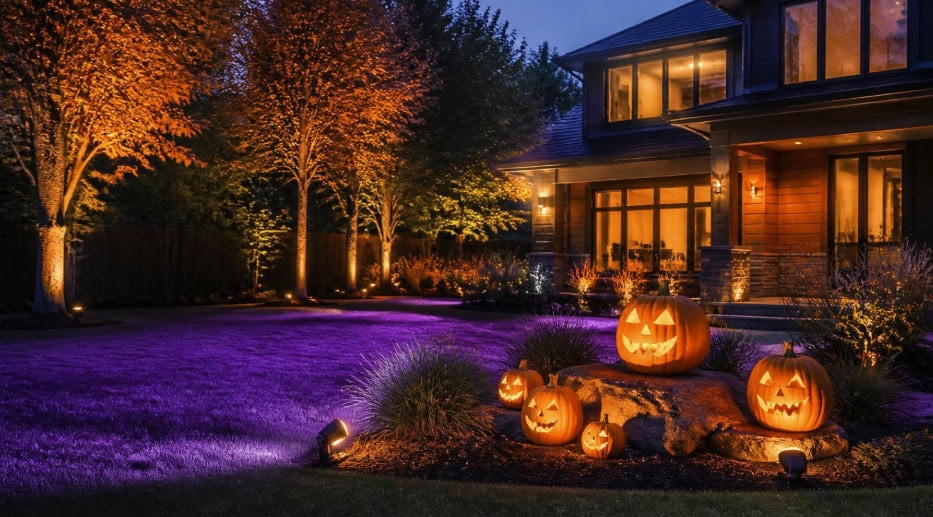
For Halloween, deep amber light at 1800K–2200K mimics the candle glow of a jack-o’-lantern and lights pumpkins or porch steps perfectly to build a spooky atmosphere. Bluish-white light above 6500K delivers the cold, eerie look common in haunted house setups.
If you want more flexibility, look for fixtures with color-changing capability, usually labeled RGB or RGBW. These let you shift between orange, purple, and green on the same fixture, so you can experiment with different zones of your yard without buying separate lights for each color.
One side benefit worth mentioning: a good RGBW fixture can also switch back to a warm white around 2700K to 3000K once the season’s over, so it doesn’t have to sit in a box until next October.
Beam Angle and Brightness for Dramatic Shadows
Beam angle controls how tight or wide the light spreads, and it’s usually listed in degrees on the packaging or spec sheet. A narrow beam, something like 15 to 30 degrees, throws a focused spot that’s great for highlighting a single prop or tombstone.
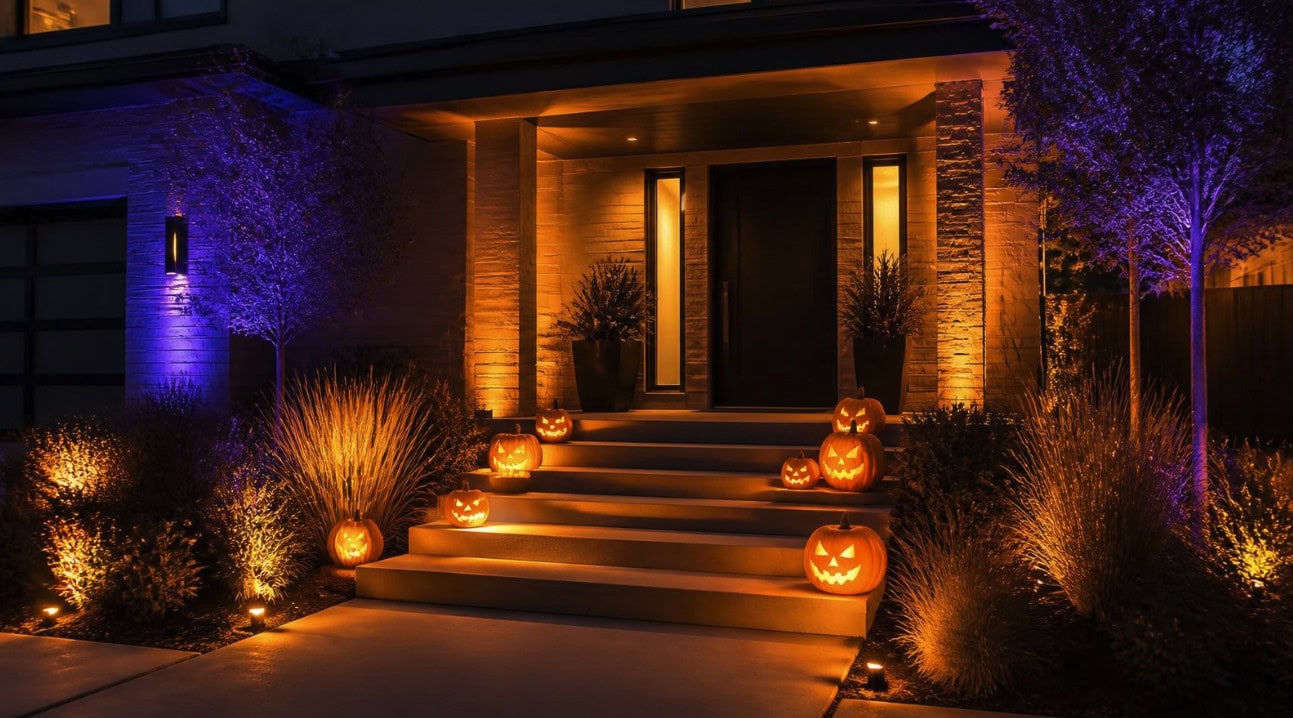
A wider beam, closer to 60 degrees or more, washes light across a broader area, which works better for lighting up a whole porch or a cluster of pumpkins. For dramatic uplighting on trees or house facades, a narrow to medium beam angled from below tends to create the longest, spookiest shadows.
Brightness matters just as much as angle. Too much light flattens the shadows you’re trying to create, while too little makes the effect hard to see from the street. Most landscape spotlights fall somewhere between 200 and 700 lumens, and that range is usually enough for residential yards without washing out the scene.
IP Rating: Why It Matters for an Effect That Actually Lasts All Night
IP rating tells you how well a fixture resists dust and water, and it shows up as a two-digit code like IP65 or IP67. The first digit covers dust protection, the second covers water resistance, and higher numbers always mean better protection.
For anything installed outdoors and exposed to rain, dew, or sprinklers, look for at least IP65. This matters more than people realize on Halloween night specifically, since a fixture that shorts out or flickers halfway through trick-or-treat hours can kill the whole effect you spent hours setting up.
Fixtures placed near a fog machine’s water reservoir, a fake pond, or anywhere moisture pools should carry IP67 or higher. This isn’t just a marketing number. It’s a standard defined by the International Electrotechnical Commission, and you can check the full IP rating scale here if you want the technical breakdown.
Fixture Types by Effect
Different fixture types create very different effects, so it helps to know what each one actually does before you buy. Halloween decorations usually combine a few types rather than relying on just one.
For dramatic, directional effects:
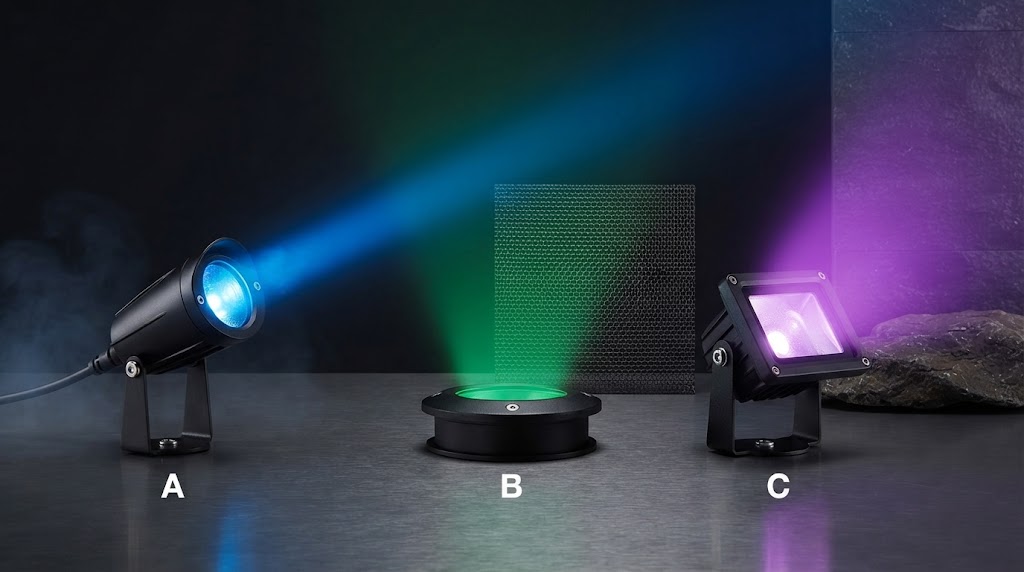
Spotlights throw a focused beam at a specific target, like a pumpkin display or a tombstone prop. Uplights sit on the ground and point upward, making them the go-to choice for stretched-out shadows on trees, columns, or house facades. Flood lights cover a wider area with less focus, useful for washing an entire lawn section in color.
For ambient and accent lighting:
String lights work well for outlining a porch, fence, or walkway, but they’re decorative rather than directional. Net lights drape over bushes and shrubs, covering the whole shape instead of just tracing an edge. Path or stake lights line walkways at ground level, useful for guiding trick-or-treaters safely while adding a low, spooky glow.
For special effects:
Flame-effect or flicker bulbs mimic torchlight, adding movement without any real fire, popular for lining a walkway or flanking a doorway.
Black lights, also called UV lights, make white fabric, certain paints, and fake spiderwebs glow, which is a favorite trick for haunted house props.
Strobe lights add a jolt of movement for a “lightning” or “haunted” flicker, though they’re best used sparingly since too much strobing can be more distracting than scary.
Projectors cast moving images or patterns, like bats or fog effects, onto walls or the ground for a more theatrical touch.
For hardware-free or low-effort setups:
Well lights install flush into the ground, useful if you want lighting without visible hardware during the day. Wall wash lights spread a soft, even glow across a flat surface like a garage door or exterior wall, working well as a backdrop for props. Solar stake lights need no wiring at all, which makes them the easiest option for renters or anyone who doesn’t want to run extension cords.
For Halloween, most yards end up mixing four or five of these: uplights for drama, string or net lights for outline, one or two special-effect fixtures for a focal point. These layered Halloween decorations build depth and visual interest. We’ll get into specific layout examples in the next section.
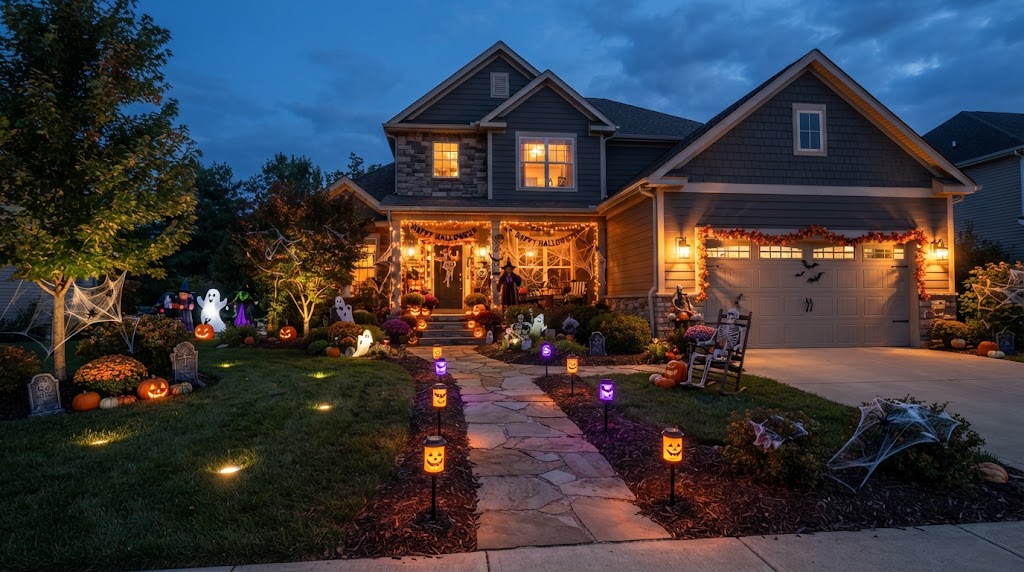
Safety Tips for Trick-or-Treaters and DIY Setup
A great lighting design only works if it’s safe for the kids walking through it. A few basic checks before Halloween night prevent most of the common accidents and electrical issues.
Lighting Walkways and Steps to Prevent Trip Hazards
Walkways and steps need enough light to show elevation changes clearly, without creating glare that makes it harder to see the ground. Path lights spaced every 6 to 8 feet along a walkway usually give trick-or-treaters enough visual reference without leaving dark gaps.
Steps deserve extra attention. A single well-placed light at the top and bottom of a staircase, angled downward rather than out, shows the edge of each step without blinding anyone walking up. Avoid pointing any fixture directly at eye level near a path, since a bright glare can hide a step or uneven pavement instead of revealing it.
Low-Voltage vs. Extension Cords: What’s Safer Outdoors
Low-voltage landscape lighting systems run at 12V, which is significantly safer for outdoor, exposed setups than running household extension cords across a wet lawn. A 12V system also tolerates minor damage to a cable’s insulation without creating the same shock risk as a 120V line.
If you do need extension cords for other decorations, only use cords rated for outdoor use and plug them into a GFCI-protected outlet. The U.S. Consumer Product Safety Commission recommends inspecting outdoor cords for cracks or fraying before each use, since damaged insulation is one of the more common causes of outdoor electrical incidents during the holiday season.
Avoiding Circuit Overload With Multiple Fixtures
Every outlet and transformer has a maximum load, and Halloween setups tend to grow fixture by fixture until that limit gets pushed without anyone noticing. A standard 15-amp household circuit can safely handle around 1,800 watts, but running it anywhere close to that limit for hours isn’t a good practice, especially outdoors.
Before adding “just one more” string of lights, add up the wattage of everything already plugged into that circuit or transformer. If you’re not sure how much is already connected, check the labels on each fixture or transformer, since guessing is how most overloads happen.
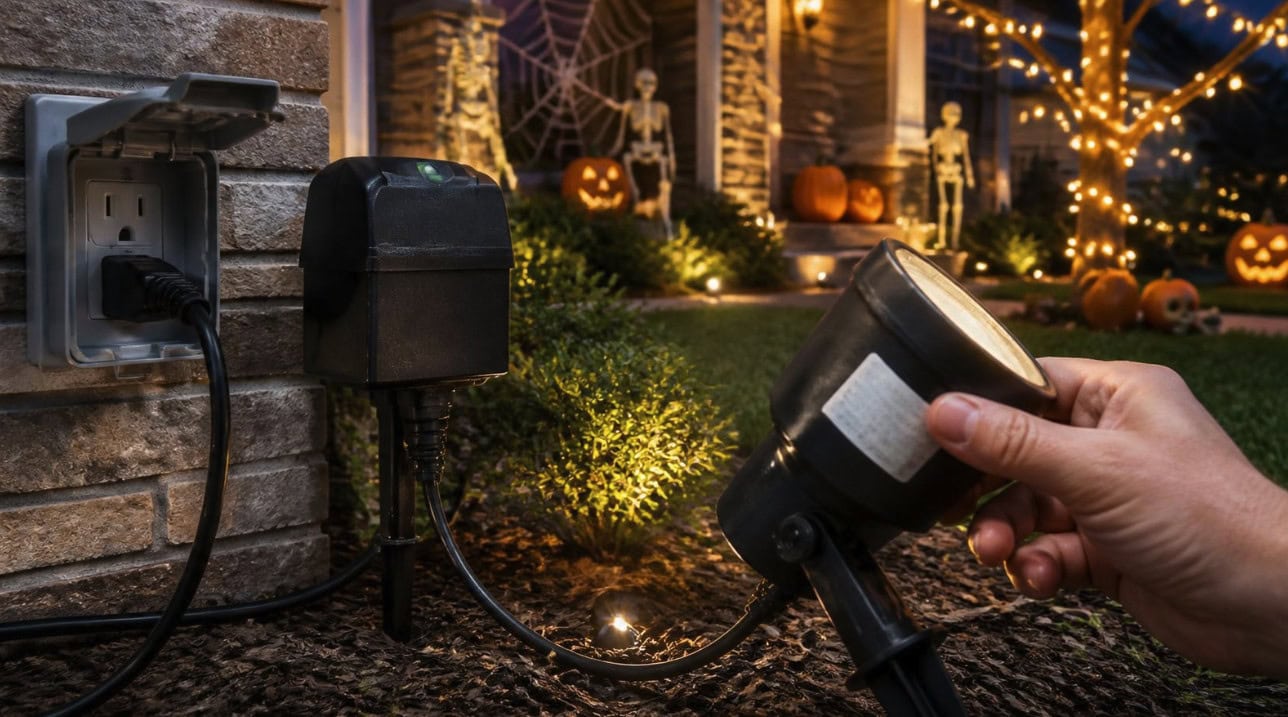
Low-Voltage System Tips for DIY Landscape Lighting Owners
If you already have a low-voltage landscape lighting system installed, Halloween doesn’t require buying a whole new setup. A few checks and adjustments let you repurpose what’s already in the ground.
How Much Load Your Transformer Can Handle
Every low-voltage transformer has a maximum wattage rating printed on the housing, usually somewhere between 100W and 900W for residential units. Before adding Halloween fixtures to an existing run, add up the wattage of everything already connected, then add the wattage of the new fixtures you want to install.
Good practice is to stay at or below 80% of the transformer’s rated capacity, leaving headroom for inrush current when the system powers on. A transformer running at its absolute limit tends to run hotter and shortens the lifespan of both the transformer and the connected fixtures.
Adjusting Color and Angle on an Existing System for Halloween
If your existing fixtures are RGBW or color-changing, switching to a Halloween palette is usually just a controller setting, no rewiring needed. Fixed-color warm white fixtures can’t change color, but many still allow physical angle adjustments through a swivel mount, which is often enough to create a different shadow effect without buying anything new.
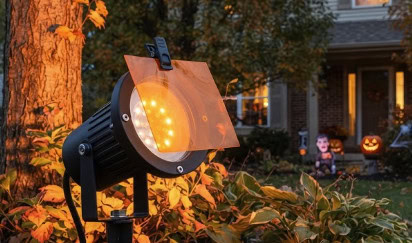
For fixed-color systems where you want an actual color change, clip-on gels are the simplest fix. They slide over the existing lens and don’t require touching the wiring or housing at all.
Voltage Drop on Long Runs
Adding more fixtures to an existing run increases current draw along the same wire. On longer cable runs, this extra load creates noticeable voltage drop.
This is a very common site issue I run into: the last few lights on a long string dim or shift color. One job sticks in my mind: a 12V landscape circuit with 12 lights on 16AWG wire, total run length 180 feet.
I took measurements at the transformer, midpoint, and final fixture. The transformer output read 12.2V. Halfway down the line it dropped to 11.1V, and the last fixture only hit 9.7V. Once voltage falls below 10.5V, LED drivers lose stable output. That’s what triggers dimming and that orange color shift.
I moved the supposedly bad end fixture up close to the transformer, and brightness and color returned right away. That test proved the fixture itself was fine. The wire gauge was just too small for that run length and total load.
If you’re adding Halloween lighting to the far end of an existing circuit, pull out a multimeter and check voltage at the last fixture first. Don’t jump to the conclusion your new light is defective. This quick test lets you separate wiring problems from faulty hardware.
Halloween Lighting Ideas by Yard Size
The right setup depends less on strict fixture counts and more on picking one or two strong visual ideas that fit your space. Here are proven layouts by yard size.
Small Yards: The Glowing Pumpkin Path
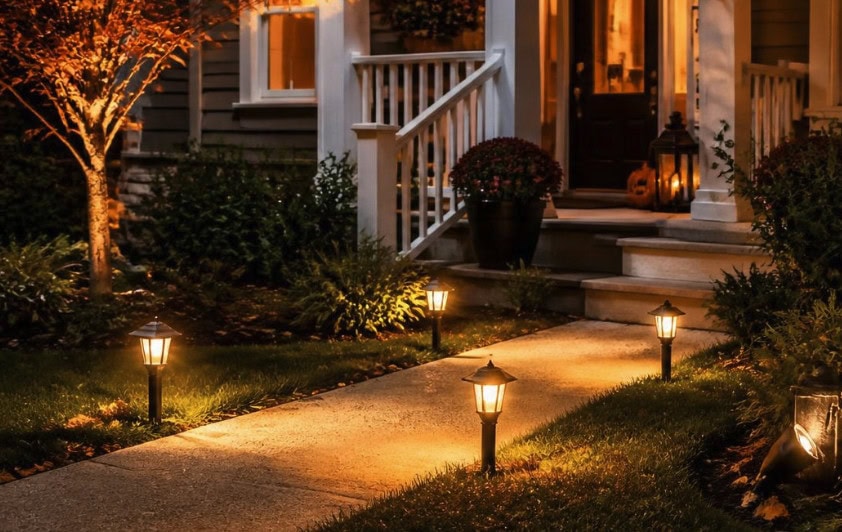
For a small front yard, skip trying to light everything and focus on one clear path. Line the walkway with 4 to 6 amber path lights spaced every 6 to 8 feet, then add a single uplight aimed at your biggest pumpkin display or porch column.
This creates a warm, inviting “follow the glow” effect that reads as spooky-cute rather than overwhelming, which works well if you get a lot of young trick-or-treaters.
Medium Yards: Color-Zoned Haunted Scene
With more space to work with, try splitting your yard into two lighting zones. Use deep amber (1800K–2200K) near the entrance and porch to keep it welcoming, then shift to cool blue-white or purple further back in the yard, near tombstone props or a fog machine, for a more haunted feel.
Add one wash light across your garage door or a blank fence section to act as a backdrop, and a couple of uplights on trees for tall, stretched shadows. This zone contrast is one of the easiest ways to make a mid-size yard feel like it has depth, not just more lights.
Large Yards: Layered Depth With a Focal Scene
A bigger property or long driveway gives you room to build an actual scene instead of just decorating the front door. Try uplighting a large tree as the centerpiece with a tight beam for dramatic shadows, then use net lights or flood washes across shrubs and hedges to fill in the mid-ground.
Save one or two special-effect fixtures, a flicker bulb by the entry or a projector casting bats on a wall, for a single focal point rather than scattering them everywhere. On bigger properties, this restraint usually reads scarier than lighting up every corner.
Budget-Friendly Idea: Light Fewer Things, Better
Regardless of yard size, one of the most effective approaches is picking two or three focal points, a large tree, the front door, one prop cluster, and putting most of your lighting budget there. A few well-lit, well-shadowed features almost always look more intentional than a yard with lights scattered evenly but none of them doing much.
FAQs
How far in advance should I set up Halloween outdoor lighting?
Most homeowners install their lighting one to two weeks before Halloween, which gives enough time to test everything, fix any dim or flickering fixtures, and make adjustments during a few evening walk-throughs before the actual night. If you’re adding to an existing low-voltage system, test-run it at least a few days early. That gives you time to check for voltage drop issues or loose connections without scrambling on October 31st.
Can I put Halloween lights on a timer or smart control?
Yes, and it’s one of the easiest upgrades if your fixtures support it. Many low-voltage transformers include a built-in timer or photocell that turns lights on automatically at dusk, and RGBW systems with a smart controller can often be scheduled through an app to switch on a Halloween color scheme at a set time and revert to warm white the next morning. This is particularly useful for trick-or-treat night, since you can set lights to turn on before the first trick-or-treaters arrive without needing to flip a switch yourself.
What if I don’t have an outdoor outlet near where I want to add lights?
Solar stake lights are the simplest fix, since they need no wiring or nearby outlet at all, though they typically put out less brightness than wired fixtures and depend on sun exposure earlier in the day. If you need a stronger effect farther from an outlet, running a properly rated outdoor extension cord to a low-voltage transformer is usually more reliable than relying on battery-powered fixtures for the whole display. Just make sure any cord run is rated for outdoor use and connected to a GFCI-protected outlet, as covered in the safety section above.
How should I store Halloween lighting fixtures so they still work next year?
Wipe down fixtures to remove dirt, cobwebs, or fake spiderweb residue before storing, since leftover debris can trap moisture against the housing over time. Coil cables loosely rather than tightly wrapping them, which reduces stress on the insulation, and store fixtures somewhere dry rather than in a damp garage corner or shed floor. If you’re using RGBW or color-changing fixtures you plan to switch back to warm white for regular use, there’s no need to store them at all. They can stay installed and simply get reprogrammed for the next season.
Conclusion
The best Halloween lighting ideas come down to the same handful of decisions covered in this guide: the right color temperature for the mood you want, a beam angle that creates real shadows instead of flat light, an IP rating that survives the whole night, and a layout that gives your yard one or two strong focal points instead of scattered brightness everywhere.
If you already have a low-voltage system, most of this comes down to reprogramming color, adjusting angles, and checking your transformer’s headroom, not buying a whole new setup. If you’re starting from scratch or your current fixtures can’t hit the amber glow, cold blue-white, or IP65+ durability this guide covers, that’s usually when it makes sense to look at new fixtures built for the effect you actually want.
Find the Right Fixture for Your Halloween Setup
RC Lighting manufactures RGBW spotlights, path lights, and flicker-effect fixtures with configurable color temperature, beam angle, and IP rating, so you can spec a fixture close to what your yard needs rather than settling for whatever a standard kit includes.
If you know what effect you’re after, our team can walk you through fixture specs, color options, and bulk pricing for larger properties. Reach out to discuss custom specifications, or browse our current lineup to see what’s available off the shelf.