Ever walked into a store and just felt like staying longer? Chances are, the lighting had a lot to do with it. Lighting quietly shapes how shoppers feel, where they look, and what they buy — often without them even noticing.
We’ve seen it firsthand. In one women-swear store, adjusting the accent lighting alone lifted high-margin sales by more than 17%. No new products or promotions were introduced, just better light. That’s the kind of impact good lighting can deliver.
In this guide, we’ll break down how lighting influences consumer behavior, what the research says about dwell time and sales, and how to build a lighting plan that actually moves the needle. We’ll also cover LED upgrades and smart controls, so you can boost sales and cut energy costs. Let’s dive in.
Why Lighting Shapes Retail Sales and Customer Behavior
Vision drives most buying decisions.
Studies suggest people form a first impression of a space within milliseconds, and lighting is the very first thing the eye reacts to, ahead of layout, signage, or even the products themselves. Light literally decides what a shopper sees first.
It works on three levels at once:
- Emotion. Brightness and warmth trigger how relaxed, energized, or comfortable a shopper feels — and mood directly affects spending.
- Attention. The eye is naturally drawn to the brightest, best-lit object in view. That means lighting decides which products get noticed.
- Perception. The same handbag can look premium under quality light or cheap under poor light. Lighting shapes how much value — and price — a customer assigns to your goods.
Because it influences feeling, focus, and perceived value all at the same time, lighting becomes a genuine revenue lever, not just an overhead line item. Pull it the right way, and shoppers stay longer, trust more, and buy more.

The Psychology of Lighting: How Light Influences Shoppers
We just covered why lighting matters. Now let’s look at how it actually works on the human brain — because once you understand the psychology, the strategy becomes obvious.
Affects Mood and Emotion
Light and emotion are closely linked. Bright, warm lighting tends to make people feel relaxed and welcome, while harsh or dim lighting can feel cold or stressful.
This matters because mood drives spending. A relaxed shopper browses longer, feels less rushed, and is more open to making a purchase. Research on retail atmospherics has repeatedly linked a pleasant store environment to higher purchase intent, and lighting is one of the biggest atmospheric factors you can control.
Builds Trust and Product Appeal
Ever seen a product that looked amazing in-store but dull at home? That’s lighting at work.
Good lighting makes colors accurate, textures rich, and materials look high-quality. When a fabric shows its true color or a piece of jewelry sparkles the way it should, shoppers instinctively trust what they see, and trust is what turns browsing into buying.
Poor lighting does the opposite. It washes out products, distorts colors, and makes even premium goods look cheap. That single impression can cost you the sale.
Guides Customer Movement (Wayfinding)
Here’s a subtle one: light controls where people walk.
The eye is naturally drawn toward the brightest point in a space. Retailers use this to pull shoppers deeper into the store, slow them down at key displays, and highlight the paths they want customers to follow.
Think of commercial lighting as a silent guide. Bright feature displays act like magnets, while balanced ambient light keeps people comfortable as they move. Done well, you’re gently steering the customer journey without a single sign.
What Research Says: Lighting, Dwell Time, and Sales
The link between lighting and behavior isn’t just theory. It shows up in the numbers.
Studies in retail environments have found that well-designed lighting increases dwell time, which is the amount of time shoppers spend in a store or at a display. Dwell time matters because the longer someone stays, the more likely they are to buy. Analysis of shopper behavior consistently shows a strong correlation between time spent in-store and total spend.
Accent lighting has an especially direct effect. When a product is spotlighted against a softer background, it grabs attention and pulls shoppers over. That extra stop, even just a few seconds, often leads to a pick-up. And a pick-up often leads to a purchase.
Understanding Retail Lighting: Ambient, Accent, Color Temperature & CRI
Ambient Lighting and Wayfinding
Ambient lighting is the base layer of light that fills your store and makes everything else possible. Its two jobs are simple: provide comfortable overall illumination, and guide how customers move through the space.
Good ambient light supports circulation. It keeps aisles, transitions, and entry zones clearly lit so shoppers move naturally toward key areas without hesitating in a dim corner. When wayfinding is smooth, customers browse longer and reach more of your merchandise.
Brightness needs vary by retail format. As a general guide (measured in lux at the shopping level):
- Discount / value stores: 750–1,000 lux, bright and easy to scan.
- Supermarkets / general retail: 500–750 lux, clear and functional.
- Apparel / mid-market: 300–500 lux, comfortable with room for accent contrast.
- Luxury / boutique: 150–300 lux ambient, intentionally lower so accent lighting carries the drama.
There is a rule you should remember: ambient light should be the supporting layer, not the star. Set it too high and you erase the contrast that makes products stand out.
Accent Lighting Strategies That Drive Sales

Accent lighting is where lighting stops being infrastructure and starts being a sales tool. It’s the directional light that pulls attention exactly where you want it.
Spotlight endcaps and premium displays. Endcaps are prime real estate, and high-margin displays deserve focused light. A tight beam on a feature table or premium shelf tells the shopper’s eye, “look here first.” This is often the fastest way to lift attention on hero products.
Use track lighting for flexible merchandising. Retail layouts change with seasons, promotions, and new arrivals. Track systems let you reposition and re-aim fixtures in minutes instead of rewiring, so your lighting stays matched to your merchandising without an electrician on call.
Get the accent-to-ambient ratio right. Contrast creates focus. As a working target, aim for roughly a 3:1 intensity ratio between accented products and surrounding ambient light. Below 2:1, products blend into the background. Push higher for premium or dramatic displays.
How much difference does accent lighting alone make? Consider a project we ran in a 1,100 sq ft mid-luxury womenswear store, where we changed nothing but the accent lighting: no new fixtures, no merchandising changes, no promotions.
We shifted the track spotlights from a flat 45° angle to a 25°–32° cross-lighting position, raised the accent-to-ambient contrast ratio from 1.9:1 to 3.4:1, and used narrow 18° beams to anchor the high-margin cashmere and silk pieces.
The results over four weeks were striking. Average dwell time at feature displays rose 41%, the browse-to-stop rate climbed from 16% to 29%, and high-margin sales increased 17.2%. Shoppers simply reported that the garments “looked better made.” The lesson is that beam angle and contrast ratio, not brightness, decide what customers notice first.
Color Temperature: Warm vs. Cool Effects
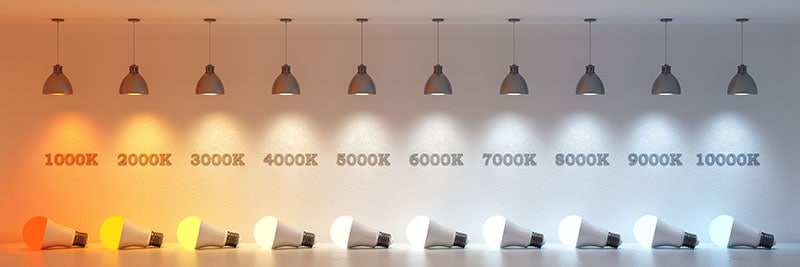
Color temperature, measured in Kelvin (K), controls the mood of your space and how your products feel to the shopper. It ranges from warm, amber tones to cool, blue-white light.
Warm light (2700K–3000K) feels inviting, relaxed, and premium. It flatters skin tones, wood, and rich textures, which is why it suits apparel, hospitality, jewelry, and any environment where you want customers to linger.
Neutral light (3500K–4000K) feels clean and balanced. It works well for general retail, homeware, and mixed-merchandise floors where you want accurate, comfortable visibility without a strong emotional cast.
Cool light (4000K–5000K+) feels crisp, energetic, and clinical. It signals freshness and precision, making it a strong fit for supermarkets, electronics, and value retail.
Color temperature also shapes spatial perception. Cooler light can make a space feel larger, brighter, and more active, while warmer light makes it feel smaller, calmer, and more intimate. Matching temperature to your product category and your desired mood is one of the easiest wins in a lighting plan:
Supermarket general floor: 4000K
Apparel & fashion: 3000K–3500K
Jewelry & luxury goods: 2700K–3000K
Cosmetics & beauty: 3000K–3500K (with high color accuracy)
Fresh food & produce: 3000K–4000K, tuned per category
Electronics & hardware: 4000K–5000K
Color Rendering (CRI) and Product Perception
Color temperature sets the mood, but Color Rendering Index (CRI) decides whether your products look true to life. CRI measures how accurately a light source reveals colors compared to natural daylight, on a scale up to 100.
For color-critical merchandise, CRI 90+ is the baseline, not a luxury. Below that, reds mute, skin tones flatten, and premium finishes lose their richness. A dull red on a dress or a greyed-out gemstone directly undercuts perceived quality, and perceived quality drives price acceptance.
The most important habit is to test product appearance under your actual store lighting before committing to bulk fixtures. Bring real inventory, not a spec sheet, and view it under sample fixtures at the intended color temperature and beam angle. What looks fine in a warehouse can look wrong on your sales floor.
Here’s where many buyers get caught: a high overall CRI (Ra) does not guarantee good red rendering, which is measured separately as R9. Low-cost LEDs frequently score a respectable Ra while lacking red spectrum entirely, and reds are exactly what make jewelry, apparel, and cosmetics look expensive.
We saw this play out in a new jewelry boutique that bought standard commercial LED track lights at 3000K, CRI Ra83, to save budget. Within 18 days they were forced into a partial retrofit: rubies and morganite looked dull and brownish, rose gold turned grey, and diamond sparkle fell flat next to competitors. The cause was low R9. Once we replaced the fixtures with CRI 96 / R9 >92 units, color-mismatch returns dropped nearly 30%.
For color-critical merchandise, never rely on basic CRI Ra alone. Check the R9 value, and always test sample fixtures against your real inventory before placing a bulk order.
Building a Retail Lighting Plan by Zone

The most reliable way to design store lighting is to stop thinking about the room as one space and start thinking in zones. Each zone has a different job, so each needs a different mix of ambient, accent, and task light.
Entrance and transition zone. This is where shoppers adjust from outdoor to indoor light. Keep it bright and welcoming, and use accent light to pull the eye toward your first feature display.
Main circulation and general floor. Prioritize even ambient light and clean wayfinding so customers move comfortably and reach the back of the store.
Feature and hero displays. This is where accent lighting earns its keep. Use narrow beams and a strong contrast ratio to make premium and high-margin products stand out.
Fitting rooms and mirror zones. Use flattering, high-CRI light at eye level. Poor fitting-room light is one of the most common reasons a shopper puts a product back.
Checkout. Keep it clearly lit and calm, with enough task light for accurate transactions without harshness.
LED Upgrades and Smart Controls
If your store still runs older lighting, upgrading to LED is usually the highest-return improvement you can make. LEDs cut energy use dramatically, last far longer, and give you precise control over color temperature, CRI, and beam angle, the exact factors that shape how products look.
Smart controls add a second layer of value. Dimming, scheduling, and zone-based scenes let you shift the mood by time of day, dim unused areas to save energy, and adjust displays for promotions without touching a single fixture.
Together, LED fixtures and smart controls turn lighting from a fixed cost into a flexible merchandising tool.
Frequently Asked Questions
What CRI do I need for jewelry, apparel, or fresh food?
For all three, aim for CRI 90 or higher, but check the R9 value separately since it measures red rendering specifically. Jewelry, apparel with warm tones, and fresh food like meat and produce rely heavily on strong reds to look vivid and appealing. A fixture can post a high overall CRI while still having weak R9, which dulls these products, so confirm both numbers before you buy.
How long until an LED retrofit pays for itself?
Most retail LED retrofits pay back within one to three years, depending on your operating hours, local electricity rates, and the efficiency of your old fixtures. Stores that run long daily hours and replace halogen or incandescent lighting tend to see the fastest return, since LEDs cut energy use by roughly 75% and slash relamping labor and material costs.
What’s the ideal accent-to-ambient lighting ratio?
For feature and hero displays, aim for an accent-to-ambient ratio of around 3:1, meaning the highlighted product receives about three times the light of the surrounding area. For premium or high-impact displays, you can push this to 5:1 or higher. The goal is enough contrast to draw the eye without leaving the general floor feeling dim or uneven.
Should I install dimming controls now or later?
It’s almost always cheaper to install dimming and smart controls during the initial fit-out or retrofit rather than adding them afterward, since retrofitting controls later can mean rewiring and reprogramming. If budget is tight, at minimum choose dimmable LED fixtures and control-ready wiring now, so you can layer in smart controls down the line without replacing hardware.
Turning Light Into Sales
Retail store lighting is never just about visibility. It shapes how customers feel, where they look, how long they stay, and how much they trust the quality of what you sell. When you get it right, lighting quietly guides shoppers toward your best products and makes those products look worth the price.
The strongest lighting plans come down to a few fundamentals: build in three layers, match color temperature to your product category, protect color accuracy with high CRI and R9, and design zone by zone so every area does its job. From there, LED fixtures and smart controls give you the flexibility to adapt over time.
If you’re planning a new store fit-out or a lighting upgrade, the smartest first step is to test real fixtures against your actual inventory before committing to a bulk order. Our technical team can help you match fixtures to your product categories, target color temperature, beam angles, and CRI requirements, and provide samples so you can verify appearance on your own floor. Contact us for a lighting consultation to make sure your lighting works as hard as your merchandise.